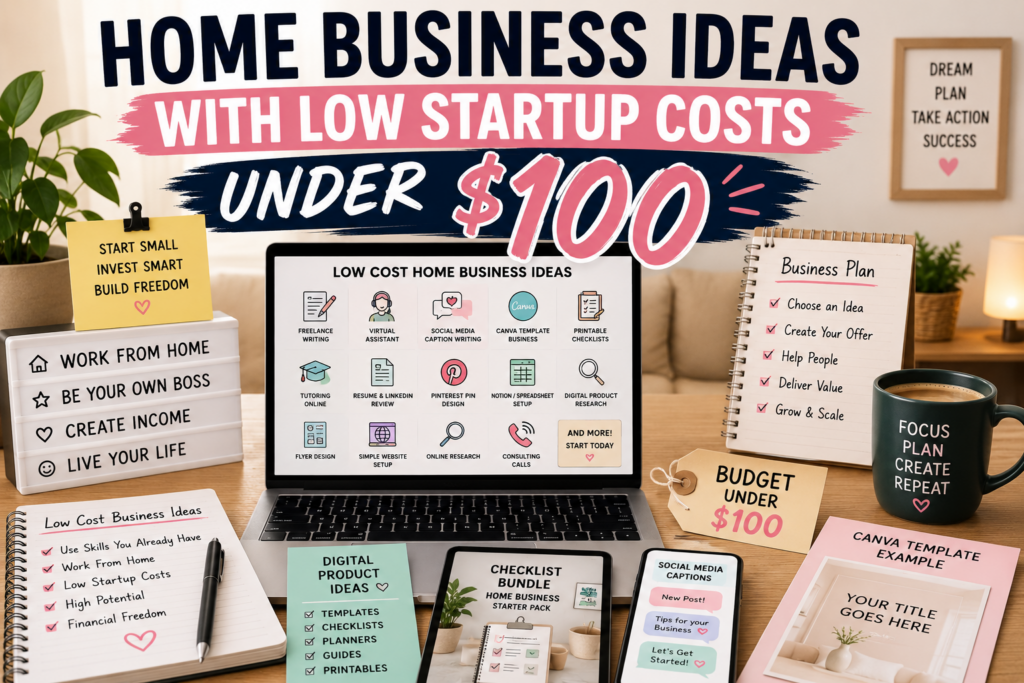
Starting a business from home does not have to begin with a large investment.
Many people imagine that they need expensive equipment, a rented office, inventory, paid advertising, business cards, packaging, software subscriptions, and a complete website before they can start.
But that is not always true.
Some home-based businesses can start with less than $100.
Not because they are small forever.
Not because they are easy.
But because the first version can be simple.
A low-cost home business usually starts with one of these:
- a skill
- a service
- a digital product
- a simple website
- a social media account
- a local offer
- a template
- a small audience
- a useful problem to solve
The goal is not to look like a large company on day one.
The goal is to test whether people want what you offer.
If the idea works, you can reinvest earnings later.
This article explores practical home business ideas with low startup costs under $100. These ideas are useful for beginners who want to start small, avoid unnecessary risk, and build from home.
Affiliate disclosure: This post contains affiliate links. If you make a purchase through one of these links, ProBusinessStrategy may earn a small commission at no extra cost to you. We only recommend tools we genuinely believe in.
What Can You Really Start With Under $100?
A $100 startup budget is not enough for every business.
It is not enough to open a restaurant, buy serious inventory, build a complex app, rent a shop, hire staff, or launch a large product line.
But it can be enough to test many simple business ideas.
With under $100, you may be able to pay for:
- a domain name
- simple website hosting
- a basic design tool
- a small software subscription
- printing flyers
- a few digital templates
- a sample product
- a small local test
- a business email
- a marketplace listing
- a simple landing page
- basic materials for a service
The smartest approach is to avoid spending money before you know what people want.
Do not buy too many tools.
Do not build a complicated website first.
Do not order large quantities of products.
Do not pay for branding before you have an offer.
Start with the smallest useful version of the business.
Then test it.
1. Freelance Writing From Home
Freelance writing is one of the simplest home business ideas with low startup costs.
You can write:
- blog posts
- website pages
- email newsletters
- product descriptions
- social media captions
- landing page copy
- case studies
- small business articles
- service pages
The startup cost can be very low because you mainly need a computer, internet connection, writing samples, and a way for people to contact you.
You can start by creating three sample articles in one niche.
For example:
- home services
- personal finance
- travel
- small business
- health and wellness
- parenting
- real estate
- ecommerce
- local business marketing
Then offer your writing service to businesses, bloggers, agencies, or website owners.
A simple first offer could be:
“I write clear 1,000-word blog posts for small business websites.”
That is much stronger than saying:
“I can write anything.”
Specific offers are easier to sell.
2. Virtual Assistant Service
A virtual assistant helps business owners with remote tasks.
This can include:
- email management
- calendar scheduling
- data entry
- research
- customer support
- social media scheduling
- simple document formatting
- online store updates
- lead list building
- appointment reminders
This business can start with almost no money if you already have a laptop and internet connection.
The real asset is reliability.
Many business owners do not need a highly technical assistant.
They need someone organized, responsive, and careful.
A beginner can start with one focused package:
“5 hours of admin help per week for small business owners.”
Or:
“Simple inbox and calendar support for busy freelancers.”
The clearer the offer, the easier it is to get the first client.
3. Social Media Caption Writing
Many small businesses struggle to write captions.
They may have photos, products, and services, but they do not know what to say online.
A home-based caption writing service can help them create:
- Instagram captions
- Facebook posts
- LinkedIn posts
- TikTok descriptions
- Pinterest descriptions
- product captions
- promotional posts
- local business updates
This is a low-cost service business because you do not need inventory or expensive tools.
A simple offer could be:
“30 social media captions for local businesses.”
Or:
“Weekly caption pack for small business owners.”
You can create samples for a bakery, salon, cleaning company, fitness coach, or local shop and use those samples to show your style.
4. Canva Template Business
A Canva template business can start from home with low costs.
You can create templates for:
- social media posts
- Pinterest Pins
- lead magnets
- resumes
- planners
- checklists
- business cards
- flyers
- price lists
- event invitations
- wedding planners
- content calendars
- small business brochures
The key is to serve one audience.
For example:
- Canva templates for real estate agents
- Canva templates for cleaning businesses
- Canva templates for coaches
- Canva templates for wedding planners
- Canva templates for small restaurants
- Canva templates for Pinterest creators
A template business can start with a small set of designs.
You do not need 100 templates.
You could start with one useful bundle and test demand.
5. Printable Checklist Business
Printables are simple digital products that customers can download and use.
You can create printable checklists for:
- home cleaning
- business startup
- moving house
- wedding planning
- meal planning
- budgeting
- travel packing
- baby preparation
- school organization
- content planning
- home office setup
This business can start with very low cost.
You create the checklist once and sell it repeatedly.
A strong printable solves one small problem clearly.
For example:
“Home Office Setup Checklist for New Remote Workers”
Or:
“Small Business Launch Checklist for Beginners”
Do not make the first product too broad.
A specific checklist is easier to sell.
6. Resume and LinkedIn Profile Review
Many people need help improving their resume or LinkedIn profile.
This can be a home-based service with low startup costs.
You can offer:
- resume review
- LinkedIn headline rewrite
- About section improvement
- profile summary review
- job application document cleanup
- cover letter feedback
You do not need to become a full career coach on day one.
Start with one simple package:
“Resume and LinkedIn Profile Review With 10 Improvement Suggestions.”
This can be delivered as a PDF, video review, or written document.
This business works best if you can give clear, practical feedback.
7. Proofreading Service
If you are good at spotting grammar, spelling, formatting, and clarity issues, proofreading can be a good low-cost home business.
You can proofread:
- blog posts
- ebooks
- resumes
- business documents
- product descriptions
- website pages
- student papers where appropriate
- newsletters
- reports
Start with a specific niche.
For example:
- proofreading for bloggers
- proofreading for small business websites
- proofreading for resumes
- proofreading for digital product creators
A clear offer could be:
“I proofread short business documents up to 2,000 words.”
This makes pricing easier.
8. Digital Product Research Service
Many entrepreneurs want to create digital products but do not know what to make.
You could offer a research service from home.
For example:
“I will research 20 digital product ideas for your niche.”
The deliverable could include:
- product idea
- target audience
- problem solved
- possible title
- format
- pricing suggestion
- content angle
- keyword ideas
- marketplace examples
This service works well for bloggers, creators, coaches, and small business owners.
Startup cost is low because your main tools are research, organization, and writing.
9. Home-Based Tutoring
Tutoring can be started from home if you have knowledge in a subject.
You can tutor:
- math
- English
- languages
- reading
- writing
- business basics
- computer skills
- exam preparation
- beginner software tools
You can offer tutoring online through video calls or locally from home where appropriate.
To start under $100, create a simple service page, flyer, or local post.
A focused offer works best.
For example:
“Beginner English tutoring for adults.”
Or:
“Math homework help for middle school students.”
Or:
“Basic computer lessons for seniors.”
The more specific the audience, the easier it is to communicate the value.
10. Online Notion or Spreadsheet Setup Service
Many people want to be organized but do not want to build their own systems.
You can create simple Notion dashboards or spreadsheets for:
- personal budgeting
- business tracking
- content planning
- client management
- habit tracking
- project planning
- student organization
- home management
- wedding planning
- small business finances
This can start as a service before becoming a digital product business.
For example:
“I will create a simple content calendar spreadsheet for your small business.”
After doing the service several times, you may turn the system into a template and sell it.
That is a smart way to build a product from a service.
11. Local Flyer Design Service
Many local businesses still need simple flyers.
You can create flyers for:
- restaurants
- cleaners
- tutors
- salons
- gyms
- local events
- repair services
- small shops
- community groups
- real estate agents
This business can start from home using basic design tools.
A simple offer could be:
“One-page flyer design for local businesses.”
You can deliver the file digitally, and the customer can print it themselves.
Add-ons could include:
- social media version
- poster version
- business card version
- menu version
- price list version
This is a practical low-cost service because many small business owners need simple marketing materials.
12. Pinterest Pin Design Service
Pinterest is visual, and many bloggers and website owners need fresh Pins.
You can offer:
- Pinterest Pin designs
- Pin templates
- blog post Pin packs
- product Pin designs
- affiliate Pin designs
- seasonal Pin bundles
A strong offer could be:
“5 Pinterest Pins for one blog post.”
Or:
“Monthly Pinterest Pin pack for bloggers.”
This business fits well if you enjoy visual design and understand how to make readable vertical graphics.
You can start with a small portfolio of sample Pins.
13. Simple Website Setup Service
Some small business owners need a basic website but do not know where to start.
You could offer a simple setup service from home.
This does not have to mean custom web development.
It could be:
- setting up a simple WordPress site
- creating a one-page business website
- adding basic pages
- setting up contact forms
- organizing homepage text
- creating a simple service page
- connecting a domain
- helping with basic website structure
For clients who need a beginner-friendly setup, you can naturally mention tools like Namecheap for domain names or Bluehost for hosting when it fits the project.
This business can start with low costs if you already know how to set up simple websites.
14. Blog Setup and Content Planning Service
Many people want to start a blog but do not know what to write first.
You can offer a blog planning service.
The deliverable could include:
- niche idea
- blog categories
- first 20 article ideas
- homepage structure
- simple SEO titles
- content calendar
- internal linking plan
- first lead magnet idea
This is a useful home-based business for people who understand content strategy.
A simple offer could be:
“Starter Blog Plan: 20 article ideas and a basic content structure for your niche.”
The startup cost is low because the product is your knowledge and research.
15. Local Errand Coordination Service
Some home-based businesses do not need to be fully online.
A local errand coordination service can be managed from home.
You organize small local tasks such as:
- pickup and delivery
- return drop-offs
- grocery top-ups
- document runs
- dry cleaning pickup
- forgotten item delivery
- gift delivery
- small business errands
You can start by offering the service in one neighborhood.
The startup cost can stay low if you use simple tools:
- phone
- local flyer
- Google Form
- basic website
- social media page
The key is to keep the service area small at first.
A local errand service works best when it is fast, reliable, and personal.
16. Home-Based Consulting Call Service
If you have experience in a specific area, you can sell short consulting calls.
Examples:
- business idea review
- website review
- content strategy call
- home business planning call
- Pinterest strategy call
- beginner startup call
- freelance pricing review
- product idea feedback
You do not need to create a full consulting company immediately.
Start with one specific call.
For example:
“60-Minute Home Business Idea Review.”
The customer books a call, you review their idea, and you send follow-up notes.
This business has low startup costs because it mainly requires your expertise, scheduling, and communication.
17. Digital Decluttering Service
Many people have messy digital lives.
You can offer help organizing:
- Google Drive
- Dropbox
- desktop files
- email folders
- photos
- business documents
- digital downloads
- templates
- project folders
A digital decluttering service can be done remotely.
A clear offer could be:
“I help small business owners organize their digital files into a simple folder system.”
This is a useful service because disorganization wastes time.
You can begin with one package and create a simple checklist.
18. Email Newsletter Setup Service
Many small business owners know they should build an email list but do not know how to start.
You could offer a simple newsletter setup package.
The package could include:
- choosing a newsletter topic
- creating a signup form
- writing a welcome email
- planning the first 5 emails
- setting up a basic lead magnet
- connecting signup links
- creating a simple content calendar
This service can be started from home with low costs.
It works especially well for bloggers, coaches, local service providers, and online creators.
19. Voiceover or Audio Recording Service
If you have a clear voice and quiet space, you could offer simple voiceover services.
This can include:
- YouTube narration
- short video voiceovers
- podcast intros
- audiobook samples
- explainer videos
- local ads
- social media videos
You may need a basic microphone, but beginners can start simple and upgrade later.
A clear first offer could be:
“Voiceover for short business videos up to 60 seconds.”
This is easier to sell than offering every type of voice work.
20. AI Prompt Pack Business
AI prompt packs can be created from home with low startup costs.
You can create prompt packs for:
- small business ideas
- blog post outlines
- social media captions
- email marketing
- Pinterest descriptions
- product descriptions
- Etsy sellers
- coaches
- freelancers
- local businesses
- real estate agents
- content creators
The key is not to sell generic prompts.
The prompt pack should help one audience achieve one result.
For example:
“50 AI Prompts for Small Business Owners Who Need Social Media Posts.”
Or:
“100 AI Prompts for Testing a Business Idea From Home.”
A prompt pack can be sold as a PDF, Google Doc, Notion page, or digital download.
21. Home Office Setup Advice
Many people work from home but do not have a good workspace.
You can offer a simple home office setup consultation.
This can include advice on:
- desk layout
- lighting
- camera setup
- storage
- cable organization
- productivity flow
- video call background
- budget-friendly improvements
A simple offer:
“Home Office Setup Review: send photos of your workspace and receive improvement suggestions.”
This can be delivered remotely.
You can also create affiliate content around home office products later, but the service itself can start with little money.
22. Meal Plan or Grocery List Service
If you enjoy food planning, you can create meal plans and grocery lists.
This can serve specific audiences:
- busy parents
- students
- remote workers
- budget-conscious families
- people cooking for one
- people who want simple lunches
- beginners who hate planning meals
The business can start as a PDF service:
“Weekly meal plan and grocery list for busy home workers.”
You can later turn the best plans into digital products.
23. Pet Sitting Coordination From Home
If you love animals, you can start a simple pet sitting or pet care coordination service.
Depending on your area and rules, this can include:
- pet sitting
- dog walking coordination
- feeding visits
- litter box visits
- pet supply reminders
- vacation pet care checklists
You can manage bookings from home and perform the service locally.
Startup costs may include flyers, a simple website, and basic supplies.
Trust is very important in this business.
Start with your neighborhood and build testimonials.
24. Online Research Service
Many people need research but do not have time to do it.
You can offer research services for:
- business ideas
- competitors
- content topics
- product ideas
- travel plans
- local vendors
- affiliate programs
- market opportunities
- supplier lists
- event ideas
A clear offer could be:
“I will research 25 content ideas for your niche.”
Or:
“I will create a competitor research summary for your small business.”
This business can start from home with almost no costs beyond time and internet access.
25. Lead Magnet Creation Service
Small businesses and bloggers often need a free resource to grow an email list.
You can create lead magnets such as:
- checklists
- short guides
- worksheets
- templates
- cheat sheets
- resource lists
- planning pages
- mini workbooks
A simple offer could be:
“I create a one-page checklist lead magnet for your blog or business.”
This service pairs well with writing, design, and content strategy.
It can start under $100 using basic design tools and simple delivery.
How to Choose the Right Low-Cost Home Business
Not every idea will fit every person.
Choose based on your skills, time, and comfort level.
Ask yourself:
What can I do well from home?
What problem can I solve for someone else?
Can I create a simple offer this week?
Can I test it without spending much money?
Can I deliver the result reliably?
Would people understand the value quickly?
Can this idea grow later?
A good home business does not need to be perfect at the beginning.
It needs to be clear enough to test.
What Should You Spend Your First $100 On?
Do not spend your first $100 randomly.
Spend it only on things that help you get customers or deliver the service.
Possible smart expenses:
- domain name
- simple website hosting
- basic design tool
- flyer printing
- portfolio mockups
- business email
- sample product materials
- local advertising test
- booking tool
- payment setup
- template software
Avoid spending money on things that do not matter yet.
Do not buy expensive branding before you have an offer.
Do not pay for complicated tools before you have customers.
Do not buy inventory before testing demand.
Your first $100 should help you validate the business, not decorate it.
A Simple 7-Day Launch Plan
Here is a simple plan for starting a low-cost home business this week.
Day 1: Choose One Idea
Pick one business idea from this list.
Do not pick five.
Choose one clear offer.
Day 2: Define the Customer
Write down who the service or product is for.
Be specific.
For example:
“Small business owners who need Pinterest Pins.”
Or:
“Parents who need printable home organization checklists.”
Day 3: Create the First Offer
Write one sentence:
“I help [audience] get [result] with [offer].”
Example:
“I help bloggers get more Pinterest content with a 5-Pin design pack.”
Day 4: Create a Simple Sample
Make one example of your work.
This could be a sample template, sample checklist, sample caption pack, sample flyer, or sample service result.
Day 5: Create a Contact or Order Method
Use a simple form, email address, booking link, or landing page.
Do not wait for a perfect website.
Day 6: Share the Offer
Post it where the audience can see it.
This may be LinkedIn, Facebook groups, local groups, Pinterest, TikTok, Instagram, email, or direct outreach.
Day 7: Collect Feedback
Track responses.
Did anyone ask questions?
Did anyone click?
Did anyone request pricing?
Did anyone buy?
Use that feedback to improve the offer.
Common Mistakes to Avoid
The first mistake is trying to start too big.
A low-cost home business should begin with one clear offer.
The second mistake is buying tools before getting customers.
Tools do not create a business by themselves.
The third mistake is choosing an idea only because it sounds profitable.
Choose something you can actually deliver.
The fourth mistake is being too general.
“Virtual assistant” is broad.
“Email inbox support for solo consultants” is clearer.
The fifth mistake is waiting too long to show the offer to people.
You learn faster when real people respond.
The sixth mistake is underpricing forever.
Starting low can help you get experience, but your pricing should grow as your results improve.
Final Thoughts
You do not need a huge budget to start a home-based business.
You need a clear problem, a simple offer, and the willingness to test.
Many home business ideas with low startup costs can begin under $100 if you avoid unnecessary spending.
Start with what you already have.
Use your skills.
Create one useful offer.
Test it with real people.
Then improve.
A home business can start as a small service, a simple template, a printable checklist, a consulting call, a local errand offer, a Pinterest design package, or a digital product.
The first version does not have to be perfect.
It only has to be clear enough for someone to understand, try, and pay for.
That is how a low-cost home business begins.
Not with a giant investment.
But with one useful offer launched from home.
Related Articles