Many people delay starting a business because they think they need a complete product first.
They want the perfect website.
The perfect logo.
The perfect app.
The perfect online course.
The perfect product line.
The perfect business plan.
But that is often the wrong starting point.
Before you build the full version of a business, you need to know whether people actually want the thing you are trying to create.
That is where an MVP can help.
MVP stands for minimum viable product.
In simple words, an MVP is the smallest useful version of your idea that allows you to test real demand.
It is not the final version.
It is not the polished version.
It is not the dream version.
It is the test version.
A good MVP helps you answer one important question:
Will people show real interest before I spend months building this?
That interest could be an email signup, a paid pre-order, a booked call, a small purchase, a form submission, a waiting list, a deposit, a reply, or a conversation with a serious potential customer.
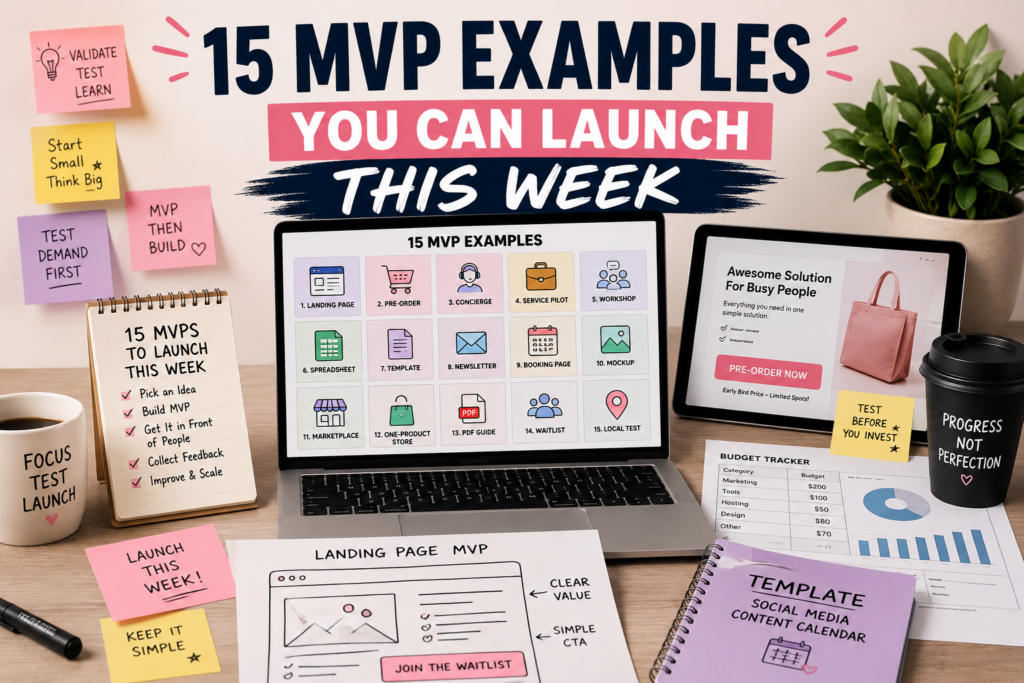
This article gives you 15 MVP examples you can launch this week.
These are not complicated startup theories.
They are practical minimum viable product ideas for beginners, solopreneurs, service providers, bloggers, creators, consultants, and small business owners.
Affiliate disclosure: This post contains affiliate links. If you make a purchase through one of these links, ProBusinessStrategy may earn a small commission at no extra cost to you. We only recommend tools we genuinely believe in.
What Is an MVP?
An MVP is the simplest version of a product, service, or offer that lets you test the market.
The goal is not to impress everyone.
The goal is to learn quickly.
A good MVP should help you test:
- whether people understand the offer
- whether the problem is real
- whether the audience cares
- whether people click
- whether people sign up
- whether people ask questions
- whether people pay
- whether people share it
- whether people come back
- whether the business idea deserves more work
An MVP is not an excuse to create something sloppy.
It should still be useful, clear, and honest.
But it does not need every feature.
For example, if you want to build a full online course, your MVP could be a paid live workshop.
If you want to create a software tool, your MVP could be a spreadsheet that solves the same problem manually.
If you want to create a marketplace, your MVP could be a simple landing page and manual matching process.
If you want to start a product business, your MVP could be a pre-order page before you buy inventory.
The main idea is simple:
Start with the smallest test that can produce real feedback.
Why You Should Launch an MVP First
Launching an MVP can save time, money, and energy.
Many beginners make the mistake of building too much before testing.
They create a full website, buy inventory, design packaging, set up social media accounts, create complicated funnels, and spend weeks polishing the idea.
Then they launch and discover that nobody wants it.
An MVP helps prevent that.
It lets you test demand before going too far.
It also helps you improve the idea based on real reactions instead of assumptions.
You may discover that:
- people want a different price
- people prefer a smaller version
- people need a clearer promise
- people care about one feature more than the rest
- people do not understand the name
- people want a service instead of a product
- people want a template instead of a course
- people want help implementing, not just learning
That feedback is valuable.
The goal of an MVP is not to prove that your first idea is perfect.
The goal is to discover what the market actually responds to.
1. The Landing Page MVP
A landing page MVP is one of the simplest ways to test a business idea.
You create one page that explains:
- the problem
- the solution
- who it is for
- what the offer does
- why it matters
- what the next step is
The next step could be:
- join the waiting list
- request early access
- book a call
- download a sample
- pre-order now
- ask for pricing
- sign up for updates
This MVP is useful because it tests whether people understand and want the idea.
For example, if you want to launch a service that creates custom business idea reports, you can build a landing page before creating the full service.
The page could say:
“Get a custom business idea report based on your skills, budget, and available time.”
Then you measure whether people sign up.
You can build a landing page with a simple website. If someone wants to test this professionally, they could use a domain from Namecheap and create a basic website with Bluehost or WordPress Website Builder.
The landing page MVP is best for testing interest before building a larger product.
2. The Pre-Order MVP
A pre-order MVP tests whether people are willing to pay before the product is fully ready.
This is stronger than asking people, “Would you buy this?”
Many people say yes politely.
Fewer people actually pay.
A pre-order gives you a clearer signal.
This can work for:
- digital products
- templates
- ebooks
- courses
- physical products
- workshops
- paid reports
- small software tools
- subscription boxes
- niche guides
For example, you could create a page for:
“100 Low-Cost Business Ideas You Can Test From Home”
Instead of creating the entire product first, you offer a pre-order at a lower early-bird price.
If people buy, you create and deliver it by the promised date.
If nobody buys, you learn that the offer may need to change.
Important rule:
Be honest.
Do not pretend the product is ready if it is still being created.
Tell people clearly that it is a pre-order and when they will receive it.
3. The Concierge MVP
A concierge MVP means you deliver the result manually before building a system or software.
This is especially useful for service businesses, software ideas, marketplaces, and personalized products.
For example, imagine you want to build an AI tool that creates business ideas for users.
Instead of building the full tool first, you manually create business idea reports for 10 people.
You ask them questions, research their situation, and deliver a custom PDF.
This helps you learn:
- what questions people ask
- what they value
- what they do not understand
- what output they want
- what they might pay for
- what parts could later be automated
The concierge MVP is powerful because it gives you deep customer insight.
It may be slower than software, but it teaches you what the software should actually do.
4. The Service Pilot MVP
A service pilot MVP is a small test version of a service.
Instead of launching a full agency or service company, you test one focused offer with a few customers.
For example:
- “I will create 10 Pinterest Pin ideas for your blog.”
- “I will review your homepage and give you 5 improvement ideas.”
- “I will create a simple lead magnet for your article.”
- “I will organize your business idea into a one-page plan.”
- “I will create a content calendar for one niche.”
The service pilot helps you test whether people will pay for the service and whether you can deliver it efficiently.
You can start with:
- 3 beta clients
- a discounted test price
- one clear result
- one delivery format
- one revision
- one testimonial request
Do not offer everything.
The smaller and clearer the pilot, the easier it is to sell.
5. The Paid Workshop MVP
If you want to create a course, start with a workshop.
A paid workshop is one of the best MVP examples for education businesses.
Instead of recording 40 lessons, building a course platform, and designing everything perfectly, you run one live workshop.
For example:
- How to Choose Your First Business Idea
- How to Build a Simple MVP in One Weekend
- How to Create a Lead Magnet That Converts
- How to Use ChatGPT to Plan a Small Business
- How to Start a Pinterest Affiliate Blog
- How to Test a Digital Product Before Building It
The workshop tests whether people care about the topic enough to pay.
It also shows you which questions people ask.
Those questions can later become course lessons.
A workshop MVP can be delivered through Zoom, Google Meet, a private webinar, or even a recorded session after registration.
If the workshop sells, you can turn it into a course later.
6. The Spreadsheet MVP
A spreadsheet MVP is a simple but powerful way to test a product idea.
Many software ideas can begin as spreadsheets.
For example:
- business idea tracker
- budget calculator
- startup cost planner
- content calendar
- pricing calculator
- inventory tracker
- habit tracker
- client pipeline tracker
- affiliate link tracker
- delivery route planner
- wedding planning budget sheet
- social media content planner
A spreadsheet can solve a real problem without expensive software development.
If people buy or use the spreadsheet, you may later turn it into:
- a better template
- a Notion dashboard
- a web app
- a course
- a paid tool
- a membership resource
For beginners, this is one of the best MVP examples because it is fast to create and easy to sell as a digital product.
7. The Template MVP
A template MVP tests whether people want a shortcut.
Templates are useful because they save time.
You can create templates for:
- business plans
- pitch decks
- social media calendars
- email sequences
- invoices
- contracts
- content briefs
- lead magnets
- Pinterest Pins
- TikTok scripts
- client proposals
- onboarding forms
- event planning
- wedding moodboards
- Notion dashboards
- Google Docs guides
The template does not need to be complicated.
It needs to create one useful result.
For example:
“A One-Page Business Idea Validation Template”
Or:
“Client Proposal Template for Beginner Freelancers”
Or:
“Pinterest Product Roundup Blog Post Template”
You can sell the template as a PDF, Google Doc, Canva template, Notion template, spreadsheet, or editable file.
This MVP works well because people often want to move faster without starting from a blank page.
8. The Newsletter MVP
A newsletter MVP tests whether people want your ideas consistently.
You do not need a full media company to start.
You can launch a simple newsletter around one promise.
Examples:
- 5 Business Ideas Every Monday
- One MVP Example Every Week
- Weekly AI Business Ideas
- Pinterest Affiliate Ideas for Beginners
- Local Business Opportunities in Your City
- Product Ideas Found From Online Communities
- Simple Business Tests for Solopreneurs
The MVP is the newsletter concept.
You test whether people subscribe and read.
Later, the newsletter can lead to:
- digital products
- sponsorships
- affiliate links
- consulting
- paid membership
- courses
- services
- website traffic
The key is to make the newsletter specific.
“Business tips” is too broad.
“Weekly MVP ideas you can test without a big budget” is clearer.
9. The Booking Page MVP
A booking page MVP is useful when you want to test a consulting, coaching, or service offer.
You create a page that explains one offer and lets people book a call.
For example:
- MVP Idea Review Call
- Business Idea Validation Session
- Website Launch Planning Call
- Affiliate Website Strategy Call
- Pinterest Business Idea Session
- Content Machine Planning Call
- Small Business Startup Review
The page should include:
- who the call is for
- what problem it solves
- what the customer gets
- how long the call is
- price
- booking calendar
- what happens after booking
This MVP tests whether people are willing to book time with you.
If nobody books, the offer may be unclear, too broad, too expensive, or not reaching the right audience.
If people book, you learn what they need and how to improve the offer.
10. The Mockup MVP
A mockup MVP is useful for physical products, apps, websites, marketplaces, and visual ideas.
You create a realistic preview before building the full thing.
Examples:
- product packaging mockup
- app screen mockup
- website preview
- dashboard design
- course sales page
- subscription box concept
- digital product cover
- planner design
- marketplace listing preview
- print-on-demand product mockup
Then you show the mockup to the target audience and measure interest.
For example, if you want to sell a “New Entrepreneur Starter Box,” you can create a mockup first.
Show the box, contents, price, and promise.
Ask people to join the waitlist or pre-order.
If people respond, you can build the real version.
If not, you can adjust the concept before spending money.
11. The Manual Marketplace MVP
A marketplace is difficult to build.
But you do not need a full platform at the beginning.
You can test the marketplace manually.
For example:
You want to create a marketplace for dance dress rentals.
Instead of building a complex platform, you start with a simple page showing available dresses, then manually handle inquiries, payments, deposits, and pickup.
Or you want to connect local delivery runners with small businesses.
Instead of building an app, you create a form for requests and manually match jobs with couriers.
A manual marketplace MVP can test:
- whether buyers exist
- whether sellers exist
- what trust issues appear
- how pricing works
- what questions people ask
- what features are actually needed
This is a smart way to test a marketplace before spending money on development.
12. The One-Product Online Store MVP
If you want to start ecommerce, do not begin with 100 products.
Start with one product.
A one-product online store MVP helps you test:
- product demand
- price
- messaging
- photos
- shipping
- customer questions
- conversion rate
- ad performance
- organic traffic
- supplier reliability
Examples:
- one printable planner
- one digital template bundle
- one print-on-demand shirt
- one niche gift box
- one local delivery kit
- one handmade item
- one business starter checklist
- one service package
- one themed party planning kit
If the product sells, you can add variations.
If it does not sell, you have learned without building a large store.
For someone who wants to test ecommerce, Shopify can be useful for setting up a simple one-product store. If the product is print-on-demand, Printful can be relevant when the business model fits.
13. The Paid PDF Guide MVP
A paid PDF guide is one of the easiest MVP examples for knowledge-based businesses.
You create a short, useful guide that solves one problem.
Examples:
- How to Validate a Business Idea in 7 Days
- 25 Business Ideas You Can Start From Your Phone
- Beginner Guide to Product Roundup Affiliate Posts
- How to Create Your First MVP Without Coding
- Quinceañera Moodboard Planning Guide
- Delivery Business Idea Starter Guide
- Dance Dress Rental Business Checklist
The guide does not need to be 200 pages.
It can be 10 to 30 pages if it is useful.
A paid PDF tests whether people will pay for organized information.
If it sells, you can later expand it into:
- a course
- a template pack
- a video workshop
- a coaching offer
- a membership
- a larger ebook
14. The Waitlist MVP
A waitlist MVP tests future demand.
You create a simple page or form where people can sign up for something that is coming soon.
This can work for:
- software tools
- digital products
- local services
- delivery businesses
- online courses
- marketplaces
- community groups
- coaching programs
- newsletters
- subscription boxes
A waitlist is weaker than a paid pre-order because people can sign up without paying.
But it is still useful if the numbers are strong.
To make it better, ask one or two questions when people join:
- What problem are you trying to solve?
- What would you pay for this?
- Which feature matters most?
- What are you using now?
- How soon do you need this?
That turns the waitlist into research.
15. The Small Local Test MVP
Some business ideas are best tested locally.
Instead of building a full brand, test the service with a small group in one area.
Examples:
- midnight snack delivery for one student neighborhood
- emergency baby supplies delivery for one district
- office crisis delivery for one business area
- Airbnb host delivery for one tourist zone
- forgotten item delivery for one school area
- local gift basket delivery for one town
- farmers market delivery for one weekend
- laundry pickup for one apartment building
A local MVP can be very simple.
You can test with:
- flyers
- local Facebook groups
- one landing page
- QR codes
- direct messages
- personal network
- simple order form
The goal is to learn whether real people in a real area will use the service.
If the first area works, you can improve the system and expand.
How to Choose the Right MVP
The best MVP depends on your business idea.
Use this simple guide:
If you want to test a digital product, use a template MVP, PDF guide MVP, spreadsheet MVP, or pre-order MVP.
If you want to test a service, use a service pilot MVP, booking page MVP, or concierge MVP.
If you want to test a course, use a paid workshop MVP.
If you want to test software, use a landing page MVP, spreadsheet MVP, mockup MVP, or concierge MVP.
If you want to test a marketplace, use a manual marketplace MVP.
If you want to test ecommerce, use a one-product online store MVP.
If you want to test a local business, use a small local test MVP.
The important thing is not the format.
The important thing is the learning.
Your MVP should help you answer a real business question.
What Makes a Good MVP?
A good MVP has five qualities.
1. It Tests One Clear Idea
Do not test five business ideas at once.
Choose one offer and one audience.
2. It Is Fast to Launch
An MVP should not take months.
For this article, the goal is to launch this week.
3. It Has a Clear Call to Action
People should know what to do.
Examples:
- sign up
- pre-order
- book a call
- buy now
- request a quote
- join the waitlist
4. It Measures Real Behavior
Do not rely only on compliments.
Measure actions.
Clicks, signups, payments, bookings, replies, deposits, and repeat interest matter more than polite praise.
5. It Helps You Decide the Next Step
After the MVP, you should know whether to:
- continue
- change the offer
- change the audience
- change the price
- improve the message
- stop the idea
- build a larger version
That is the purpose of the test.
Common MVP Mistakes to Avoid
The first mistake is making the MVP too complicated.
If it takes three months to create, it may not be minimum.
The second mistake is testing with the wrong people.
Friends may be supportive, but they may not be buyers.
The third mistake is ignoring payment.
Interest is useful, but payment is stronger.
The fourth mistake is building features nobody asked for.
Start with the core problem.
The fifth mistake is quitting too soon.
Sometimes the idea is good, but the message is unclear.
The sixth mistake is continuing too long without evidence.
If nobody signs up, books, pays, or asks for more, listen to the signal.
The seventh mistake is thinking an MVP must be ugly.
Simple does not mean careless.
Your MVP can be small and still professional.
A Simple 7-Day MVP Launch Plan
Here is a practical plan you can use this week.
Day 1: Choose One Idea
Pick one problem, one audience, and one offer.
Write it in one sentence:
“I help [audience] achieve [result] with [simple offer].”
Day 2: Choose the MVP Format
Pick one format from this article.
Do not overthink it.
Choose the fastest version that can test real demand.
Day 3: Create the Offer Page
Create a landing page, booking page, product page, form, or sales post.
Keep it simple.
Explain:
- who it is for
- what problem it solves
- what the customer gets
- price or signup option
- next step
Day 4: Create the First Version
Create the template, guide, workshop outline, mockup, service process, or sample deliverable.
It does not need to be final.
It needs to be useful enough to test.
Day 5: Share It With the Right People
Post it where your audience already spends time.
Use:
- social media
- local groups
- TikTok
- Facebook groups
- direct outreach
- personal network
Day 6: Collect Feedback
Track:
- clicks
- signups
- replies
- questions
- objections
- purchases
- bookings
- shares
Notice what people actually do.
Day 7: Decide the Next Move
Ask:
- Did anyone care?
- Did anyone pay?
- Did people understand the offer?
- What questions came up?
- What should be changed?
- Should I continue or test a different angle?
This gives you momentum.
Final Thoughts
You do not need a perfect business to start.
You need a test.
These MVP examples show that a minimum viable product can be simple, small, and fast.
It can be a landing page.
A pre-order.
A spreadsheet.
A paid workshop.
A service pilot.
A mockup.
A booking page.
A newsletter.
A local test.
The goal is not to build everything immediately.
The goal is to learn what people actually want.
A good MVP helps you replace guessing with evidence.
It helps you stop polishing ideas in private and start testing them in the real world.
If you want to start a business, choose one MVP from this list and launch it this week.
Not next year.
Not after everything is perfect.
This week.
That is how real business momentum begins.
Related Articles