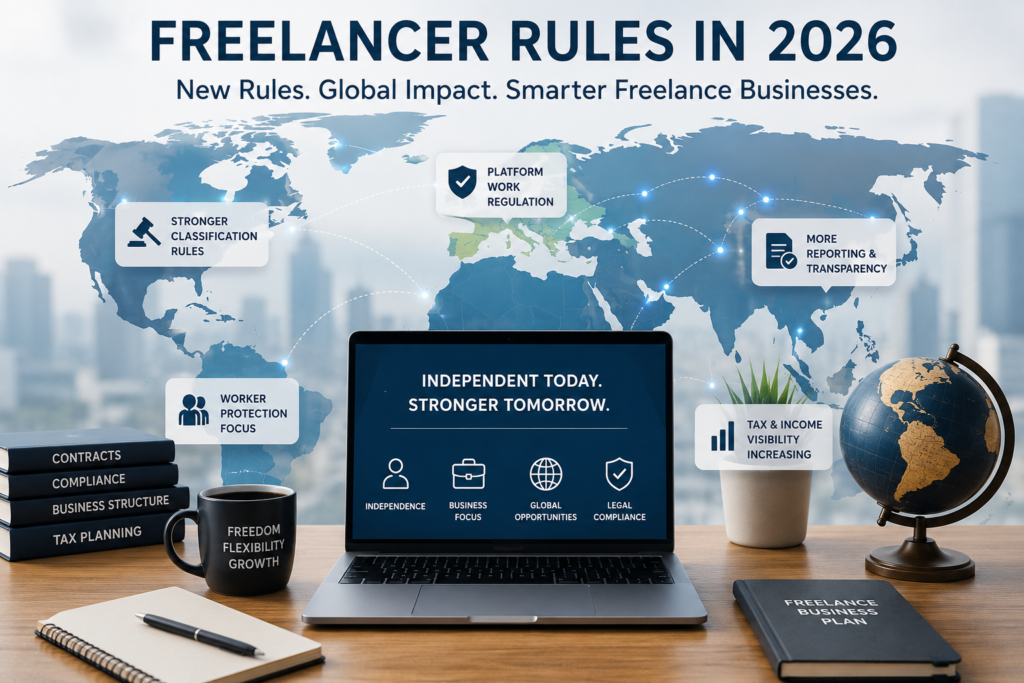
Freelancing is not disappearing in 2026. But the days when almost any flexible working arrangement could simply be labelled “freelance” are coming under increasing pressure.
Governments, courts, tax authorities, and labour regulators are paying closer attention to the difference between a genuinely independent business owner and someone who is technically called a contractor but works like an employee.
This development affects more than delivery drivers and people working through gig apps. It can also affect designers, consultants, writers, developers, virtual assistants, seasonal workers, online service providers, and the businesses that hire them.
The changes are not moving in exactly the same direction everywhere. Some governments are strengthening worker protections. Others are trying to create clearer tests for legitimate contractors. Many are also requiring platforms to report more information about payments, workers, and working arrangements.
The central lesson is not that freelancing is becoming illegal.
It is that freelancers increasingly need to operate like real independent businesses rather than informal additions to a client’s workforce.
Affiliate disclosure: This post contains affiliate links. If you make a purchase through one of these links, ProBusinessStrategy may earn a small commission at no extra cost to you. We only recommend tools we genuinely believe in.
Key Takeaways
- Governments increasingly look at the real working relationship, not just the wording of a contract.
- Platform workers and independent business owners are not always treated in the same way.
- Countries are taking different approaches to contractor classification.
- Rules intended to stop exploitation can also make companies reluctant to hire legitimate freelancers.
- New freelancers should build visible independence from the beginning.
- Creating a company may help a growing business, but it does not automatically solve classification problems.
Why Governments Are Paying More Attention to Freelancers
Freelancing has become a normal part of the modern economy. Businesses use independent professionals to access specialist skills, manage seasonal demand, complete short projects, and operate without hiring a permanent employee for every task.
At the same time, some companies have used contractor arrangements to avoid responsibilities normally connected with employment.
A person may be described as self-employed while:
- working fixed hours determined by one company;
- being closely supervised;
- using the company’s systems and equipment;
- having little ability to reject work;
- depending almost entirely on one source of income;
- performing the same ongoing role as regular employees.
In such cases, governments may decide that the relationship is employment in practice, regardless of what the contract says.
The official reasons for tighter rules usually include protecting workers, preventing unfair competition, maintaining social-security systems, and ensuring that taxes and employment contributions are handled correctly.
Those goals can be reasonable. A business should not be able to remove employee protections simply by changing the name written at the top of an agreement.
The difficulty is that regulation does not affect only abusive arrangements. Unclear rules can also frighten companies away from hiring genuine freelancers who deliberately chose independence.
That is where the current debate becomes more complicated.
Three Ways Freelancer Rules Are Changing
Although every country has its own legal system, most regulatory changes fall into three broad categories.
1. Greater attention to worker classification
Authorities increasingly examine who controls the work, who carries financial risk, whether the person can serve other clients, and whether the freelancer is genuinely operating a business.
The label “independent contractor” is not decisive by itself. The actual relationship matters more.
Official UK guidance, for example, states that a business cannot simply choose someone’s status. Classification must reflect the reality of the working relationship. Factors such as control, financial risk, freedom to negotiate fees, integration into the client’s business, and the ability to refuse work may all be relevant.
2. More regulation of digital labour platforms
Governments are also examining the power held by online platforms.
A platform may not look like a traditional employer, but it can still influence work through:
- automated task allocation;
- ratings and rankings;
- account restrictions;
- pricing systems;
- performance monitoring;
- penalties for rejecting assignments;
- automated suspension or deactivation.
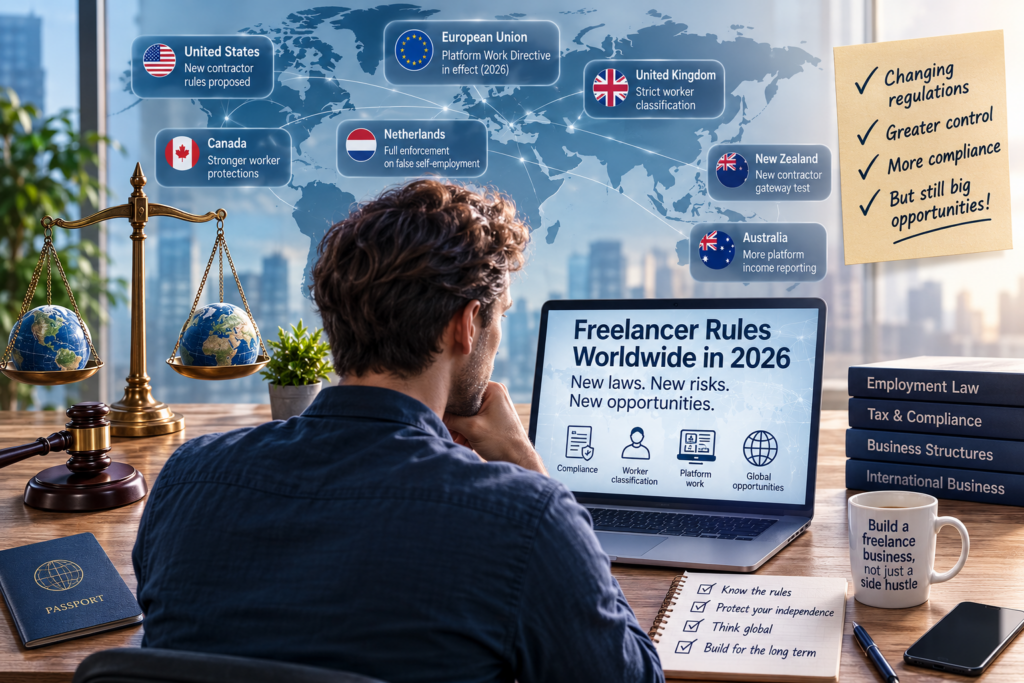
The European Union’s Platform Work Directive specifically addresses employment status, automated monitoring, algorithmic decision-making, and transparency in platform work. It requires EU member states to implement the directive in national law by 2 December 2026.
3. Greater visibility of freelance income
Digital work is becoming easier for tax authorities to track.
Platforms in several jurisdictions must already report certain payments or transactions. Australia’s Sharing Economy Reporting Regime, for example, requires covered electronic distribution platforms to report qualifying transactions to the Australian Taxation Office.
This does not make platform income illegal or undesirable. It does mean that freelancers should no longer assume that small online payments, side-income, or international platform earnings remain invisible.
Governments Are Not All Taking the Same Approach
It would be misleading to say that every country is simply making freelancing more difficult.
Some are introducing stronger presumptions of employment. Some are developing clearer contractor tests. Others are changing reporting requirements or reviewing previous regulations.
European Union
The EU Platform Work Directive focuses specifically on work organised through digital labour platforms. It does not automatically turn every European freelancer into an employee.
Under the directive, member states must create procedures for determining the correct employment status of people performing platform work. Where facts indicate direction and control by a platform, a rebuttable presumption of employment may apply.
The directive also regulates automated monitoring and decision-making. Platforms must provide greater transparency, allow human review of certain decisions, and cannot rely entirely on automated systems to terminate a contractual relationship.
This is important, but it should not be confused with a general EU law covering every consultant, photographer, designer, or independent professional working directly with clients.
The Netherlands
The Netherlands resumed full enforcement against false self-employment on 1 January 2025. If an arrangement described as freelance is later found to be employment, the client may still owe payroll taxes and can face risks under employment and pension law.
In March 2026, the Dutch government announced that enforcement would continue but abandoned part of an earlier legislative proposal that had created substantial uncertainty. It also announced plans to develop a new Self-Employed Persons Act while retaining a proposed legal presumption intended to strengthen the position of lower-paid freelancers.
The Dutch example shows the unintended effects of uncertainty. When companies cannot confidently determine whether a freelancer is genuinely independent, some stop hiring freelancers altogether—even where the person may be operating legitimately.
United States
The United States is moving in a different direction at federal level.
In February 2026, the US Department of Labor proposed replacing its 2024 contractor-classification rule with a more streamlined economic-reality test.
The proposal would place particular emphasis on two factors:
- the worker’s control over the work;
- the opportunity to make a profit or loss through initiative or investment.
Other factors would include the skill required, the permanence of the relationship, and whether the work forms part of an integrated production process.
This was still a proposed rule rather than a final rule at the time of writing. State laws may also use different or stricter tests, so there is no single classification standard that applies to every US working relationship.
United Kingdom
The United Kingdom distinguishes between employees, workers, and self-employed contractors for employment-rights purposes.
A person’s employment status determines which protections and obligations apply. Tax status may be assessed through a separate system, which means someone’s status for employment law does not always perfectly match their treatment for tax purposes.
This illustrates why international freelancers should be careful with general online advice. A term such as “contractor” can have different consequences depending on the country and the specific area of law involved.
Canada
Canada has strengthened protections against misclassification in federally regulated industries.
When classification is contested, workers—including gig workers—are presumed to be employees unless the employer proves otherwise. The Canadian government states that these measures do not change the status of genuine independent contractors.
The important limitation is that these provisions concern federally regulated sectors. Canada also has provincial rules, so the same framework does not necessarily apply to every freelancer or company in the country.
New Zealand
New Zealand introduced a new contractor “gateway test” on 21 February 2026.
Where a working arrangement meets all the conditions of the gateway test, the person is recognised as a specified contractor. When one or more conditions are not satisfied, the existing common-law employment-status test continues to apply.
The stated purpose is to give businesses and workers more certainty in advance. This is a clear example of a government trying to establish a safer route for genuine contracting rather than simply presuming that flexible work must be employment.
Why Genuine Freelancers Are Feeling the Effects
Rules against false self-employment are generally aimed at companies that exercise employer-level control without accepting employer-level responsibility.
But legitimate freelancers can still become collateral damage.
A small business may need extra capacity for only a few weeks. A restaurant may need temporary help during a holiday season. An online company may require a specialist for one product launch. A consultant may prefer working independently for several clients instead of accepting a permanent position.
When classification rules are unclear, clients may decide that the safest option is not to hire a freelancer at all.
They may instead:
- postpone projects;
- overwork existing employees;
- use an agency or payroll provider;
- offer only employment contracts;
- avoid flexible workers;
- demand excessive paperwork from small suppliers.
This is an example of regulatory overcorrection. A rule designed to stop abusive contracting can unintentionally reduce opportunities for genuine entrepreneurs.
The answer is not to ignore classification rules. It is to create clearer distinctions between vulnerable dependent workers and people who are demonstrably running businesses of their own.
Platform Worker or Independent Business Owner?
Not everyone who invoices for work is building an independent business.
A person may be highly dependent on a platform that controls access to customers, determines the price, monitors performance, and can remove the person’s ability to earn income.
A genuine independent professional generally has more commercial control.
For example, an independent business owner may:
- market services under a personal or business brand;
- negotiate prices;
- decide which clients to accept;
- determine how a project is completed;
- invest in tools and marketing;
- carry the risk of making a loss;
- work with several clients;
- create services rather than simply fill shifts;
- build customer relationships outside a single platform.
No single factor automatically proves that someone is self-employed. Working for one major client does not necessarily make someone an employee, just as having several clients does not automatically make every arrangement legitimate.
The complete working relationship matters.
What These Changes Mean for New Freelancers
The best response to changing rules is not panic. It is better business design.
Build a recognisable business identity
Use a business name where appropriate, create a professional website, issue invoices, maintain proper financial records, and present clear services to the market.
These actions do not determine legal status on their own, but they help demonstrate that you are building an independent commercial activity.
Sell an outcome, not simply your availability
A project with a defined result usually looks more independent than an open-ended role in which the client controls every working hour.
Instead of becoming “an extra member of staff” indefinitely, describe:
- what will be delivered;
- what the scope includes;
- when the project ends;
- what the client is paying for;
- which responsibilities belong to each party.
Preserve meaningful control
Clients can set deadlines, quality requirements, safety rules, and project objectives. That does not automatically create employment.
The risk becomes greater when the client controls almost every part of the working relationship, including methods, hours, location, pricing, availability, and the ability to work for others.
Reduce unnecessary dependency
A freelancer does not need ten clients at all times. However, building a business that can survive the loss of one client is commercially and legally stronger than depending indefinitely on one organisation.
Developing multiple lead sources, repeatable services, and direct customer relationships also makes the business more resilient.
Keep evidence of how the business operates
Useful records may include:
- proposals;
- contracts;
- invoices;
- project scopes;
- pricing decisions;
- marketing materials;
- records of client communication;
- business expenses;
- proof of other commercial activities.
A contract that says “independent contractor” is not enough when the daily reality looks like employment. But clear documentation can help show how the relationship actually functions.
Learn the rules where you live and work
Freelancers should understand the basic requirements of their own country before accepting advice written for another jurisdiction.
The rules governing an American LLC, a Dutch BV, a British limited company, or a Canadian corporation are not interchangeable.
Cross-border work can also introduce separate questions about tax residence, social-security contributions, permanent establishments, data protection, and applicable contract law.
Those issues deserve their own investigation rather than a quick assumption that online work takes place “nowhere.”
Will Creating a Company Solve the Problem?
As a freelance business grows, forming a limited company may become a sensible step.
Depending on the country and circumstances, incorporation can provide:
- a clearer separation between personal and business finances;
- improved liability protection;
- greater credibility with larger clients;
- more options for retaining and reinvesting profits;
- a structure that supports employees, partners, or additional companies.
However, incorporation is not a magic shield against misclassification.
A client cannot necessarily avoid employment responsibilities simply by requiring a worker to create a company. Authorities may still examine the real relationship between the people and businesses involved.
The right reason to incorporate is usually that the business has reached a level where protection, investment, ownership, risk, or growth requires a more formal structure—not merely to make an employee-like arrangement look independent.
Freelancing Is Becoming More Professional, Not Impossible
The global direction is not a straightforward war against freelancing.
Governments are trying to solve different problems:
- workers being denied employment protections;
- companies facing uncertainty about whom they can hire;
- platforms exercising control through algorithms;
- undeclared digital income;
- social-security systems designed around traditional employment;
- laws that have not kept pace with online and cross-border work.
Some reforms will protect people who were incorrectly classified. Others may create more clarity for real contractors.
Poorly designed regulation can also damage legitimate entrepreneurship. When the rules become so uncertain that companies stop hiring independent professionals, both businesses and freelancers lose opportunities.
That is why the future of freelancing should not be reduced to a choice between completely unrestricted contracting and forcing everyone into employment.
A functioning freelance economy needs room for both:
- meaningful protection for people who are employees in practice;
- legal recognition for people who genuinely choose to operate independent businesses.
Final Thoughts
Freelancing in 2026 still offers flexibility, independence, and access to a worldwide market. But it also demands more professional discipline.
Calling yourself a freelancer is no longer enough. Independent professionals increasingly need to show that they control their services, carry genuine business responsibility, maintain commercial records, and operate separately from their clients’ internal workforce.
That may feel like an additional burden, especially for people starting small. But it can also be an advantage.
The same steps that make a freelance setup more credible—clear services, defined projects, multiple lead sources, proper records, and visible independence—also create a stronger business.
Governments will continue changing the boundaries between employment and self-employment. Freelancers who understand those developments early will be better prepared to protect their independence, serve international clients, and eventually build companies that extend far beyond their own billable hours.
Explore the complete Global Freelancing & Business Structures hub for guidance on freelancing, legal risk, company structures, and international growth.
Disclaimer: This article provides general educational information and does not constitute legal, employment, or tax advice. Rules differ by country and individual working arrangement. Consult a qualified local adviser when making decisions about classification, taxation, contracts, or business structures.

บทความดีมาก เล่นเกมเสียงฟรีที่ The Choicer Voicer: tcvthechoicervoicer.com