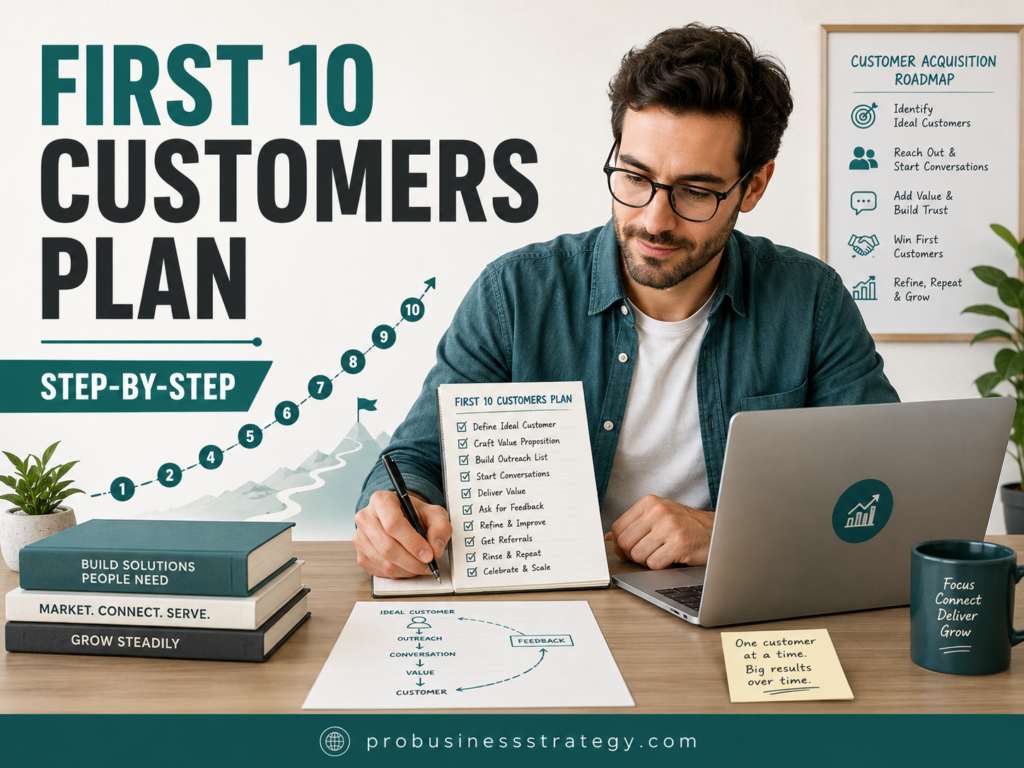
Getting your first 10 customers is one of the most important milestones in any new business.
Not your first logo.
Not your first perfect website.
Not your first business card.
Not your first long business plan.
Your first 10 customers.
Because once real people pay you, everything changes. Your idea is no longer just an idea. Your business starts to exist in the real world.
Many new entrepreneurs spend weeks or months preparing before they ever make an offer. They design the brand, adjust the website, rewrite the homepage, compare tools, watch more tutorials and keep waiting for the “right moment.”
But the truth is simple:
You do not need a perfect business to get your first customers.
You need a clear offer, a specific audience and a direct plan.
This guide gives you a practical step-by-step system to find, approach and win your first 10 customers without overcomplicating the process.
Whether you are starting a service business, freelance business, coaching business, local business, online business or small digital product brand, the principle is the same:
Start small.
Talk to real people.
Make a simple offer.
Deliver well.
Use the first results to grow.
Let’s build your first 10 customers plan.
Affiliate disclosure: This post contains affiliate links. If you make a purchase through one of these links, ProBusinessStrategy may earn a small commission at no extra cost to you. We only recommend tools we genuinely believe in.
Why the First 10 Customers Matter So Much
Your first 10 customers are not just sales.
They are proof.
They prove that people understand your offer. They prove that your pricing is not just a theory. They prove that your business solves a real problem. They also show you what people actually want, not what you assumed they wanted.
Before you get your first customers, everything feels abstract.
You may wonder:
Is my idea good enough?
Will people pay for this?
Am I charging too much?
Am I targeting the right people?
Should I change my offer?
Do I need a better website first?
The first 10 customers answer many of these questions faster than research ever could.
They help you discover:
What people care about most
Which objections keep coming up
What words customers use to describe their problem
Which part of your offer feels most valuable
What needs to be simplified
What can be improved
What can be turned into testimonials, case studies or referrals
That is why your first goal should not be “build a big business.”
Your first goal should be:
Get 10 real customers and learn from them.
Step 1: Choose One Clear Offer
The biggest mistake many new business owners make is trying to sell too many things too early.
They say:
“I do websites, branding, social media, content, strategy, SEO, email marketing and business advice.”
That sounds flexible, but it is confusing.
A confused customer does not buy quickly.
For your first 10 customers, choose one clear offer.
Examples:
A one-page website setup for local businesses
A social media content package for coaches
A bookkeeping cleanup service for freelancers
A logo and basic brand kit for new businesses
A landing page copywriting package
A meal planning service for busy parents
A beginner fitness coaching package
A virtual assistant package for online entrepreneurs
A simple product photography service for small shops
A resume improvement service for job seekers
The offer should be specific enough that someone can quickly understand it.
A weak offer says:
“I help businesses grow.”
A better offer says:
“I help new service businesses get their first professional website online in 7 days.”
A weak offer says:
“I do social media.”
A better offer says:
“I create 20 Instagram post ideas and captions for small business owners who do not know what to post.”
Your first offer does not have to be your forever offer. It only needs to be clear enough to sell now.
Step 2: Define One Specific Customer Group
After choosing one offer, choose one specific type of customer.
Do not target “everyone.”
Everyone is too broad. Everyone has different problems, budgets, expectations and buying triggers.
Instead, choose a small group you can understand and reach.
Examples:
New coaches
Local restaurants
Wedding photographers
Personal trainers
Etsy sellers
Freelancers
Small cleaning companies
Real estate agents
Online course creators
Home-based business owners
Small ecommerce brands
Busy parents
Job seekers
New entrepreneurs
The more specific your first target group is, the easier your marketing becomes.
You can speak directly to their problem.
For example:
Instead of saying:
“I help businesses with websites.”
You can say:
“I help new personal trainers launch a simple website that explains their services, shows their prices and helps them get client inquiries.”
That is much stronger.
Specific does not mean small forever. It means focused enough to get traction.
Once you have your first customers, you can always expand.
Step 3: Write a Simple Result Statement
Before you contact anyone, write one sentence that explains the result you help people get.
Use this format:
“I help [specific customer] achieve [specific result] without [common frustration].”
Examples:
“I help new coaches create a simple website without spending weeks figuring out WordPress.”
“I help small business owners create consistent social media content without staring at a blank screen every day.”
“I help freelancers organize their invoices and basic finances without getting overwhelmed.”
“I help local service businesses improve their Google Business Profile without hiring a full marketing agency.”
This sentence becomes the foundation for your outreach, website, social media bio and sales conversations.
You do not need clever branding at this stage.
You need clarity.
People should understand what you do within a few seconds.
Step 4: Create a Basic Trust Setup
You do not need a perfect website before you get your first 10 customers, but you do need a basic place where people can check you out.
This can be:
A simple one-page website
A landing page
A Google Doc portfolio
A LinkedIn profile
A Facebook business page
A Notion page
A simple PDF offer sheet
The goal is not perfection. The goal is trust.
Your basic page should include:
Who you help
What problem you solve
What your offer includes
Who it is for
What result people can expect
How to contact you
Any examples, samples or previous work if you have them
If you want to look more professional from the start, you can use tools like Namecheap for a domain name, Bluehost for hosting or a simple WordPress setup, and Fiverr if you need help with a small logo, design element or technical task.
But do not hide behind setup work.
A simple page with a clear offer is better than a perfect website with no customers.
Step 5: Build a List of 50 Potential Customers
To get your first 10 customers, start by building a list of 50 potential people or businesses you can contact.
This does not mean spamming random strangers.
It means creating a focused prospect list.
Your list can include:
People in your network
Local businesses
Former colleagues
Friends of friends
LinkedIn contacts
Instagram accounts in your niche
Facebook group members
Small businesses with outdated websites
Businesses already spending money in your category
People who recently started a business
People asking questions related to your offer
For each potential customer, write down:
Name
Business name
Website or profile
Contact method
Why they may need your offer
Personal note
Status
You can use a simple spreadsheet.
The key is to be intentional.
Do not just say, “I need customers.”
Say:
“I am going to contact 50 specific people who could benefit from this exact offer.”
That changes everything.
Step 6: Start With Warm Outreach
Your first customers often come from people who already know you, trust you or are connected to someone who does.
Warm outreach is usually easier than cold advertising.
Start with people in your existing network:
Friends
Family
Former colleagues
Old clients
Local business owners
Online contacts
Community members
Social media followers
But do not write a desperate message.
Do not say:
“Please support my new business.”
Instead, make it clear and useful.
Example message:
“Hi [Name], I recently started helping [specific customer group] with [specific result]. I am currently looking for my first few clients so I can build strong examples and testimonials. I thought of you because [personal reason]. Would it be useful if I sent you a quick overview?”
This does not pressure them.
It opens a conversation.
Another version:
“Hi [Name], I’m working on a new service for [target group]. It helps with [problem/result]. You may not need this yourself, but do you know anyone who might be a good fit?”
This is powerful because people may refer you even if they do not buy.
Your first 10 customers may come through second-degree connections.
Step 7: Use Simple Cold Outreach
Warm outreach is helpful, but you should not depend only on your personal network.
Cold outreach can work if it is specific, respectful and relevant.
Bad cold outreach is generic.
Good cold outreach shows that you understand the person’s situation.
Example:
“Hi [Name], I came across your business and noticed you offer [service/product]. I also saw that your website does not clearly show [specific issue]. I help [type of business] improve this with a simple [offer]. Would you be open to a quick idea?”
This is much better than:
“Hi, I offer marketing services. Let me know if you are interested.”
The goal of the first message is not always to close the sale immediately.
The goal is to start a conversation.
Keep it short.
Make it personal.
Focus on one problem.
Do not attach long documents.
Do not overexplain.
Do not send five paragraphs.
For your first 10 customers, aim for conversations, not mass messages.
Step 8: Make the First Offer Easy to Say Yes To
Your first offer should be simple and low-friction.
That does not mean you must work for free.
But it does mean you should reduce the risk for the customer.
You can do this with:
A starter package
A fixed price
A clear timeline
A small first project
A limited “founding customer” offer
A free audit followed by a paid package
A money-back guarantee if appropriate
A pay-after-first-step structure if it makes sense
Examples:
“Website homepage review: €49”
“Five social media captions: €75”
“Basic logo concept package: €99”
“Google Business Profile cleanup: €149”
“Starter website setup: €399”
“Business idea validation call: €59”
The exact price depends on your market, skill level and offer.
The key is that the customer should understand exactly what they get.
Avoid vague packages like:
“Marketing support — price depends.”
That may work later, but it is harder when you are trying to win your first customers.
A clear starter offer is easier to buy.
Step 9: Follow Up Without Being Annoying
Most new business owners give up too early.
They send one message.
The person does not reply.
They assume the answer is no.
But people are busy.
A polite follow-up can make a big difference.
Use a simple follow-up system:
Day 1: First message
Day 3 or 4: Friendly follow-up
Day 7: Final short follow-up
Example follow-up:
“Hi [Name], just wanted to quickly follow up on this. No pressure at all. I thought it may be relevant because [specific reason]. Happy to send a short overview if useful.”
Final follow-up:
“Hi [Name], I’ll leave this here for now. If improving [specific problem] becomes relevant later, feel free to reach out.”
This is professional.
You are not begging.
You are not pushing.
You are simply giving people a second chance to respond.
Many first customers come from follow-up messages, not the first message.
Step 10: Treat Every Conversation Like Research
When someone replies, do not immediately jump into selling.
Ask questions.
You want to understand:
What are they struggling with?
Have they tried solving it before?
Why is it still a problem?
What would a good result look like?
What is stopping them from fixing it?
How urgent is it?
What would make them feel comfortable moving forward?
This helps you sell better, but it also improves your business.
You may discover that your original offer needs a small adjustment.
For example, maybe you thought people wanted a full website, but they actually need a simple landing page.
Maybe you thought they wanted social media management, but they only need content ideas.
Maybe you thought they wanted coaching, but they want templates.
Your first 10 customers are your first market research group.
Listen carefully.
The goal is not just to close deals. The goal is to learn what the market actually wants.
Step 11: Deliver Better Than Expected
Once someone becomes a customer, your job is not just to complete the task.
Your job is to create trust, proof and momentum.
For your first 10 customers, delivery matters more than scale.
Communicate clearly.
Set expectations.
Meet deadlines.
Explain what you are doing.
Make the process simple.
Ask for feedback.
Fix small issues quickly.
Be professional even if the project is small.
A happy first customer can become:
A repeat customer
A testimonial
A referral source
A case study
A confidence boost
A better version of your offer
Do not treat small early customers as less important.
They are the foundation.
Step 12: Ask for a Testimonial or Referral
After you deliver the work, ask for proof.
Many new business owners feel awkward about this, but it is normal.
You can say:
“I’m glad this was helpful. Since I’m building up this new service, would you be comfortable writing a short testimonial about your experience?”
Or:
“Do you know one or two other people who might benefit from this?”
Make it easy for them.
You can ask three simple questions:
What problem did you have before working with me?
What changed after the service?
Would you recommend this to someone else?
Their answers can become a testimonial.
Testimonials help your next customers trust you faster.
Your first 10 customers should help you get your next 10.
Step 13: Track Your Numbers
You do not need advanced software at this stage.
Use a simple spreadsheet and track:
People contacted
Replies received
Calls booked
Offers made
Customers closed
Revenue earned
Testimonials collected
Referrals received
This helps you see what is actually happening.
For example:
50 people contacted
18 replies
8 calls
5 offers
3 customers
That tells you something useful.
Maybe you need more outreach.
Maybe your message is working.
Maybe your sales call needs improvement.
Maybe your price is too high or too unclear.
Maybe your target group is not urgent enough.
Without tracking, you guess.
With tracking, you improve.
A Simple 7-Day Plan to Get Moving
Here is a practical 7-day plan you can use.
Day 1: Define Your Offer
Choose one clear offer.
Write your result statement.
Decide who it is for.
Set a simple starter price or package.
Day 2: Create Your Basic Trust Page
Make a one-page website, landing page, PDF or profile page.
Explain what you do, who it helps and how to contact you.
Day 3: Build Your Prospect List
Write down 50 potential customers or referral contacts.
Include both warm and cold prospects.
Day 4: Send 10 Warm Messages
Start with people who already know you or may know someone relevant.
Do not pressure them. Open conversations.
Day 5: Send 10 Focused Cold Messages
Contact people or businesses that clearly match your offer.
Make each message specific and relevant.
Day 6: Follow Up and Book Conversations
Follow up with people who did not respond.
Book short calls or message-based conversations with interested people.
Day 7: Make Offers
For people with a clear need, make a simple offer.
Explain the result, price, timeline and next step.
Repeat this process weekly until you reach your first 10 customers.
Common Mistakes to Avoid
Waiting Until Everything Is Perfect
Your first customers do not need your perfect final brand.
They need a clear solution to a real problem.
Making the Offer Too Complicated
A confused customer delays.
Keep the first offer simple.
Targeting Too Broadly
“Small businesses” is usually too broad.
“New personal trainers who need a simple website” is better.
Selling Features Instead of Results
People do not buy “five pages, three revisions and a PDF.”
They buy clarity, confidence, time saved, more leads, better organization or a problem solved.
Not Following Up
Many deals are lost because the business owner never follows up.
Undercharging Too Much
A starter offer can be affordable, but do not make it so cheap that you resent the work.
Forgetting to Ask for Testimonials
Your first customers should help create proof for your next customers.
What Happens After Your First 10 Customers?
Once you have your first 10 customers, pause and review.
Ask yourself:
Which customers were the best fit?
Which projects were easiest to deliver?
Which offer sold fastest?
Which objections appeared most often?
Which price felt reasonable?
Which result mattered most to customers?
Which customers referred others?
Which work do I want more of?
Then improve your business.
You may decide to:
Raise your price
Narrow your niche
Improve your website
Create a better package
Add a second offer
Build a referral system
Create case studies
Start content marketing
Run ads later
Turn your service into a digital product
But do not worry about all of that on day one.
First, get the first 10.
Final Thoughts
The first 10 customers plan is not about becoming famous, going viral or building a complicated marketing funnel.
It is about doing the simple work most beginners avoid.
Choose one offer.
Choose one customer group.
Write a clear result statement.
Create a basic trust page.
Build a prospect list.
Start conversations.
Make simple offers.
Deliver well.
Ask for proof.
Repeat.
That is how a business starts becoming real.
Your first 10 customers may not come perfectly. Some people will ignore you. Some will say no. Some will ask questions and disappear. That is normal.
The goal is not to avoid rejection.
The goal is to create momentum.
Because once you have 10 real customers, you are no longer just planning a business.
You are building one.