Writing product descriptions can feel simple until you actually have to do it.
You have a product.
You know what it is.
You know what it does.
But then you open your online store, marketplace listing or product page and suddenly the words feel boring.
You write:
“High-quality shirt with comfortable fabric.”
Or:
“Beautiful mug with unique design.”
Or:
“Useful planner for daily organization.”
Technically, these descriptions are not wrong. But they are not strong either.
A good product description does more than describe the product. It helps the buyer understand why the product matters, how it fits into their life and why they should choose it instead of clicking away.
This is where AI can become very useful, especially if you are building a mobile business from your phone.
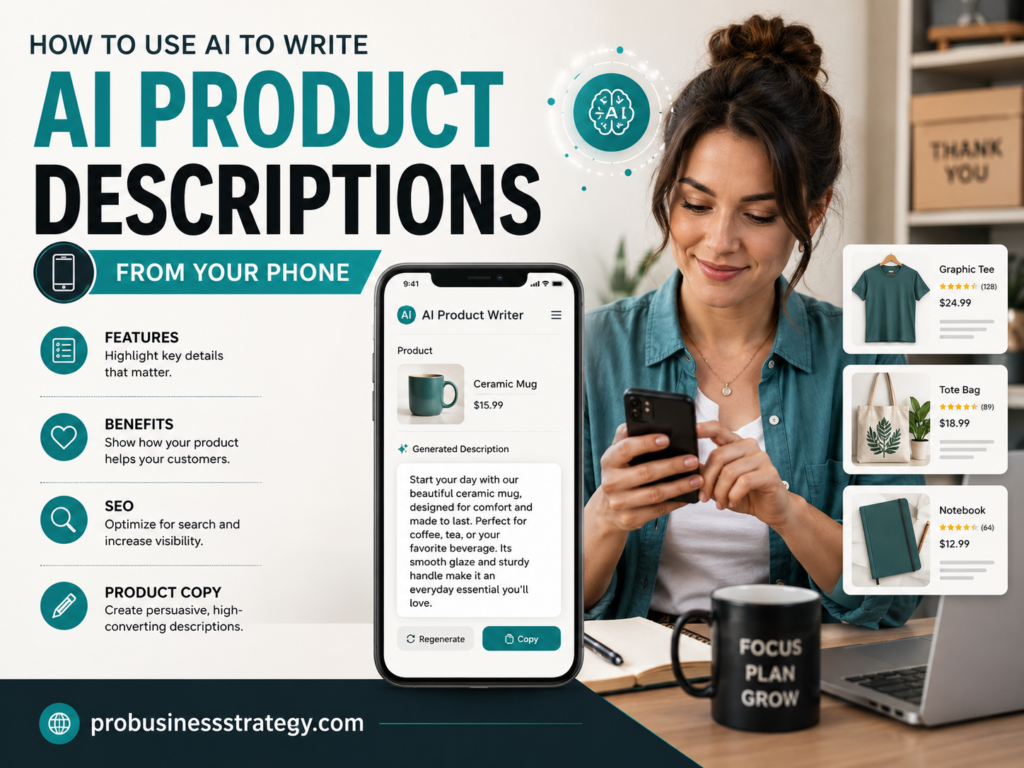
With the right prompts, you can use AI to write product descriptions, improve weak descriptions, create variations for different platforms, optimize for search and turn basic product details into copy that sounds more convincing.
You do not need a laptop.
You do not need to be a professional copywriter.
You do not need to stare at a blank screen for an hour.
You can do a large part of the work from your smartphone.
This guide will show you how to use AI to write product descriptions from your phone in a simple, practical way.
Affiliate disclosure: This post contains affiliate links. If you make a purchase through one of these links, ProBusinessStrategy may earn a small commission at no extra cost to you. We only recommend tools we genuinely believe in.
Why Product Descriptions Matter
Many new ecommerce sellers underestimate product descriptions.
They think the image does all the selling.
Images are important, but the description still matters because it answers the questions the image cannot fully explain.
A good product description can help the customer understand:
What the product is
Who it is for
What problem it solves
What benefit it gives
How it can be used
What makes it different
Why it is worth buying
What size, material or features it has
How it fits into a lifestyle, occasion or need
A weak description makes the product feel generic.
A strong description makes the product feel useful, specific and easier to buy.
For example, this is weak:
“Nice tote bag for daily use.”
This is stronger:
“Carry your daily essentials in a simple, lightweight tote bag designed for work, errands, study days and weekend trips. The clean design makes it easy to match with casual outfits, while the roomy interior gives you space for books, groceries, small devices or everyday items.”
The second version helps the customer imagine using the product.
That is the real goal.
You are not just describing the item.
You are helping the customer picture the value.
Why AI Is Useful for Product Descriptions
AI is not magic, but it is very useful for getting past the blank page.
When you give AI the right information, it can help you create:
Short product descriptions
Long product descriptions
Bullet point benefits
SEO-friendly product copy
Marketplace descriptions
Social media captions
Email product blurbs
Ad copy variations
Product title ideas
Feature-to-benefit explanations
Descriptions in different tones
Descriptions for different customer types
This is especially useful when you sell many products.
For example, if you run a small print-on-demand shop with 50 designs, writing every description manually can take a long time. AI can speed up the first draft process.
If you use platforms like Shopify for your store or Printful for print-on-demand products, you can use AI from your phone to prepare product copy before publishing or updating your listings.
The biggest mistake is expecting AI to understand your product automatically.
AI works best when you give it clear input.
Bad input creates generic output.
Good input creates useful copy.
That is why your process matters.
Step 1: Gather the Product Details First
Before opening your AI tool, collect the basic product information.
Do not start with a vague prompt like:
“Write a product description for a shirt.”
That will usually give you a generic description.
Instead, collect details such as:
Product type
Material
Color
Size options
Main features
Design style
Who it is for
Use case
Occasion
Problem it solves
Emotional appeal
Brand tone
Price level
Shipping or care notes if relevant
For example:
Product: Minimalist coffee mug
Material: Ceramic
Color: White with black text
Design: “Build Before You’re Ready” quote
Audience: Entrepreneurs, freelancers, startup founders
Use: Morning coffee, desk setup, home office
Tone: Motivational, clean, modern
Main benefit: Encourages action and consistency
Occasion: Gift for entrepreneurs or business owners
Now AI has something real to work with.
The better your input, the better your product description.
You can keep a simple note template on your phone and fill it in for each product.
Step 2: Use a Simple AI Prompt
Once you have the details, use a basic prompt.
Here is a simple prompt you can copy:
Prompt:
Write a compelling product description for this product:
Product: [product type]
Material: [material]
Color/design: [color or design details]
Audience: [target customer]
Use case: [how the product is used]
Main benefit: [main customer benefit]
Tone: [brand tone]
Write:
- A short product description
- A longer product description
- Five benefit-focused bullet points
- A short SEO title
- A meta description under 155 characters
This prompt gives you multiple useful pieces of copy at once.
You can use the short description for a product grid, the longer description for the product page, the bullet points for quick scanning and the SEO title for search visibility.
From your phone, this is easy to do in any AI writing tool.
The key is not to ask AI for “a description.”
Ask for the exact product copy pieces you need.
Step 3: Turn Features Into Benefits
One of the most important parts of product description writing is understanding the difference between features and benefits.
A feature explains what the product has.
A benefit explains why that feature matters to the customer.
Feature:
“Made from stainless steel.”
Benefit:
“Keeps your drink in a durable bottle that is built for daily use.”
Feature:
“Large interior pocket.”
Benefit:
“Gives you extra space to organize your phone, keys, wallet and small essentials.”
Feature:
“Digital planner with weekly pages.”
Benefit:
“Helps you plan your week clearly without switching between multiple notebooks or apps.”
Customers care about features, but they buy because of benefits.
AI can help you turn features into benefits.
Use this prompt:
Prompt:
Turn these product features into customer-focused benefits. Keep the language clear, natural and persuasive.
Features:
- [feature 1]
- [feature 2]
- [feature 3]
- [feature 4]
Target customer: [customer type]
Write each benefit in one sentence.
This is one of the best ways to improve weak product copy quickly.
Step 4: Choose the Right Tone for the Product
Not every product description should sound the same.
A luxury wedding product should not sound like a funny novelty mug.
A business planner should not sound like a children’s birthday shirt.
A premium handmade item should not sound like a discount gadget.
Before you ask AI to write, decide on the tone.
Examples:
Clean and professional
Warm and friendly
Luxury and elegant
Playful and fun
Minimalist and modern
Bold and energetic
Soft and emotional
Practical and direct
Gift-focused
Premium boutique style
You can include this in your prompt.
Example:
“Use a warm and friendly tone for busy moms.”
Or:
“Use a clean, premium tone for a luxury-style product page.”
Or:
“Use a playful tone for a funny gift product.”
Tone matters because it affects how the buyer feels.
A product description should match the product, the customer and the brand.
Step 5: Create Different Versions for Different Platforms
One description does not always work everywhere.
A Shopify product page can use a longer description.
An Etsy listing may need search-friendly wording.
A Facebook post needs a shorter promotional style.
A Pinterest Pin needs curiosity and clarity.
An Instagram caption may need a more lifestyle-focused angle.
AI can help you adapt one product into multiple formats.
Use this prompt:
Prompt:
Rewrite this product description for the following platforms:
- Shopify product page
- Etsy listing
- Instagram caption
- Pinterest Pin description
- Short Facebook post
Keep the core message the same, but adapt the style for each platform.
Product description:
[paste description]
This saves time because you do not have to start from zero for every platform.
You can create a product once and then turn it into several marketing assets from your phone.
That is powerful for a small ecommerce business.
Step 6: Add Search Keywords Naturally
Product descriptions can also help with search.
This does not mean stuffing keywords everywhere.
It means using clear words that customers may actually search for.
For example, if you sell a productivity planner, possible search terms may include:
Daily planner
Weekly planner
Goal planner
Productivity planner
Printable planner
Digital planner
Business planner
Time management planner
AI can help you add keywords naturally.
Use this prompt:
Prompt:
Improve this product description by naturally including the following keywords where they fit. Do not overuse them. Keep the copy readable and persuasive.
Keywords:
- [keyword 1]
- [keyword 2]
- [keyword 3]
Product description:
[paste description]
This is useful because many AI-generated descriptions sound nice but do not always include the practical search terms buyers use.
Good product copy should be readable for humans and clear for search engines.
Step 7: Make the First Sentence Stronger
The first sentence of your product description matters.
Many customers scan quickly. If the opening line is boring, they may not read the rest.
Weak opening:
“This is a high-quality notebook for daily use.”
Stronger opening:
“Plan your day with a clean, simple notebook designed to keep your tasks, ideas and goals in one place.”
Weak opening:
“This is a nice shirt for entrepreneurs.”
Stronger opening:
“Wear a simple reminder to build, launch and keep going even before everything feels perfect.”
Weak opening:
“This mug is good for coffee.”
Stronger opening:
“Start your morning with a motivational mug made for builders, dreamers and business owners in progress.”
AI can help you create stronger openings.
Use this prompt:
Prompt:
Give me 10 stronger opening sentences for this product description. Make them clear, benefit-focused and natural.
Product:
[product details]
Target customer:
[target customer]
Tone:
[tone]
Then choose the best one and use it in your final description.
Step 8: Avoid Generic AI Language
AI can sometimes produce copy that sounds too polished, too vague or too generic.
Watch out for phrases like:
Elevate your lifestyle
Unlock your potential
Perfect for every occasion
Crafted with passion
Designed to inspire
A must-have addition
High-quality and stylish
Take your experience to the next level
These phrases are not always wrong, but they are often overused.
A better product description is specific.
Instead of:
“Elevate your daily routine with this stylish planner.”
Try:
“Organize your tasks, appointments and weekly goals in one simple planner you can use at your desk, in your bag or during your morning planning routine.”
Specific copy is usually stronger than fancy copy.
After AI gives you a draft, edit it.
Remove vague lines.
Add real product details.
Make the benefits clearer.
Make the tone more natural.
Check that it sounds like your brand.
AI should help you write faster, but you are still responsible for the final quality.
Step 9: Create Product Description Templates
Once you find a structure that works, turn it into a template.
This is especially helpful if you sell similar products.
For example, a print-on-demand store may sell:
T-shirts
Mugs
Tote bags
Posters
Phone cases
Hoodies
Notebooks
Each product type can have its own template.
A simple product description template could look like this:
Opening benefit sentence
Short lifestyle description
Key product features
Who it is for
Gift or use case
Final buying encouragement
Example structure:
“Bring [main feeling/result] into your daily routine with this [product type]. Designed for [target customer], this [product] is ideal for [use case]. The [design/material/feature] makes it a practical choice for [situation]. Use it for [occasion], or give it as a thoughtful gift to [gift recipient].”
Now you do not have to invent the structure every time.
You can ask AI to fill the template using new product details.
This is how you create a repeatable mobile workflow.
Step 10: Use AI to Improve Existing Product Descriptions
You do not only need AI for new products.
You can also use it to improve old product descriptions.
If you already have products online, review your weakest descriptions first.
Look for descriptions that are:
Too short
Too vague
Too technical
Too boring
Missing benefits
Missing keywords
Not clear about who the product is for
Not matching the product image
Not persuasive enough
Then use this prompt:
Prompt:
Improve this product description. Make it clearer, more benefit-focused and more persuasive. Keep the tone natural and avoid exaggerated claims.
Current description:
[paste description]
Product details:
[paste details]
Target customer:
[paste target customer]
This is a quick way to update old listings from your phone.
Even improving a few product pages can make your store feel more professional.
Step 11: Write Product Descriptions in Batches
AI becomes even more useful when you work in batches.
Instead of writing one product description at a time, group similar products together.
For example:
10 motivational mugs
20 niche T-shirts
5 digital planners
15 printable wall art designs
8 tote bags for teachers
12 wedding-themed products
Create one strong prompt and use it repeatedly.
You can also ask AI to create a spreadsheet-style output.
Example prompt:
Prompt:
Create product descriptions for these 10 products. For each product, give me:
- Product title
- Short description
- Long description
- Five bullet point benefits
- SEO keywords
- Pinterest description
Products:
[paste product list]
This can save a lot of time.
From your phone, you can prepare product copy during small pockets of time: during a break, while commuting, while sitting on the couch or while planning your next product batch.
That is the advantage of a phone-based business workflow.
You do not always need a full office setup to make progress.
Step 12: Check Accuracy Before Publishing
AI can write quickly, but it can also make assumptions.
Always check the final product description before publishing.
Make sure:
The material is correct
The size is correct
The color is correct
The shipping details are correct
The product features are accurate
The care instructions are correct
The description does not promise something false
The tone matches your brand
The keywords fit naturally
The copy does not sound too generic
This is especially important if you sell physical products.
Do not let AI invent features.
If the product is not waterproof, do not call it waterproof.
If it is not handmade, do not call it handmade.
If it does not include accessories, do not suggest that it does.
If delivery times vary, do not promise exact delivery unless you can control it.
Trust matters.
A product description should persuade, but it should not mislead.
Step 13: Combine AI With Human Judgment
The best product descriptions are not just AI output.
They are AI-assisted human writing.
AI can help you:
Generate the first draft
Create variations
Improve weak copy
Find better angles
Turn features into benefits
Adapt copy for platforms
Speed up repetitive work
But you still bring the most important part:
Understanding your product
Understanding your customer
Choosing the right message
Removing weak lines
Adding real details
Making the copy trustworthy
Making final decisions
Think of AI as your writing assistant, not your replacement.
You are still the business owner.
You decide what gets published.
Example: From Basic Details to Finished Product Description
Let’s say you sell a motivational notebook for new entrepreneurs.
Basic details:
Product: Hardcover notebook
Design: “Build Before You’re Ready”
Audience: New entrepreneurs, freelancers, creators
Use: Notes, planning, business ideas
Tone: Motivational and practical
Benefit: Helps users capture ideas and stay consistent
AI-assisted product description:
“Capture your business ideas, daily plans and next bold move in a notebook made for entrepreneurs who are building before everything feels perfect. This hardcover notebook is ideal for planning content, writing goals, outlining offers, tracking ideas or organizing your next project. With a clean motivational design, it works well on your desk, in your bag or as a thoughtful gift for a creator, freelancer or new business owner.”
Bullet points:
Hardcover notebook for daily business planning
Motivational design for entrepreneurs and creators
Useful for ideas, notes, goals and project planning
Great gift for freelancers, startup founders and small business owners
Simple desk-friendly style for work, study or home office use
This is much stronger than:
“Nice notebook for entrepreneurs.”
The product feels clearer, more specific and more useful.
That is what AI can help you create.
A Simple Mobile Workflow for AI Product Descriptions
Here is a simple workflow you can follow from your phone:
- Open your product list
- Choose one product
- Collect the basic product details
- Open your AI tool
- Paste your product description prompt
- Generate short and long descriptions
- Ask for bullet point benefits
- Ask for SEO keywords
- Ask for platform variations
- Edit the final version manually
- Save it in your store, notes app or content document
- Repeat for the next product
You can do this with one product per session or batch several at once.
This makes product description writing less overwhelming.
Instead of thinking, “I need to write copy for my whole store,” you can think:
“I will improve five product descriptions today from my phone.”
That is much easier to start.
Tools That Can Support This Workflow
You can keep the setup simple.
A phone-based product description workflow may include:
An AI writing app
A notes app
A spreadsheet app
Your ecommerce platform app
A product image folder
A keyword list
A simple brand tone guide
A saved prompt template
If you are building an online store, platforms like Shopify can help you manage ecommerce products. If you are building a print-on-demand product business, Printful can help you create and sell products without holding inventory.
If you need help with product image editing, store setup, branding or listing support, you can also use Fiverr to find freelancers for specific small tasks.
The important point is this:
Do not let tools become a delay.
Start with a simple workflow and improve it as your store grows.
Common Mistakes to Avoid
Using AI Without Product Details
If you only say, “Write a product description for a mug,” the result will usually be generic.
Give AI specific details.
Publishing Without Editing
AI can create a useful first draft, but you should still review and improve it.
Making Every Product Sound the Same
If all descriptions use the same phrases, your store starts to feel repetitive.
Change the angle, tone and benefits where needed.
Forgetting the Customer
Do not only describe the product. Describe why the product matters to the buyer.
Overusing Keywords
SEO matters, but keyword stuffing makes your copy hard to read.
Making False Claims
Never let AI invent product features, results or promises.
Ignoring Mobile Formatting
Many people shop on phones. Use short paragraphs, bullet points and clear wording.
Final Thoughts
Using AI to write product descriptions from your phone is one of the easiest ways to improve a mobile ecommerce business.
You can take basic product details and turn them into stronger descriptions, better bullet points, SEO-friendly titles, social captions and platform-specific copy.
But the quality depends on your process.
Give AI clear information.
Ask for specific outputs.
Turn features into benefits.
Choose the right tone.
Edit the final text.
Check every detail before publishing.
This is not about replacing your thinking.
It is about speeding up the writing process so you can create, publish and improve more products without getting stuck.
If you run a small online store, print-on-demand shop, Etsy-style product business or ecommerce side hustle, this is a skill worth learning.
Because every product needs words.
And with AI in your pocket, you can write better product descriptions from almost anywhere.
Related Articles
50 Businesses You Can Run from Your Phone
How to Use ChatGPT from Your Phone for Business
How to Create a YouTube Affiliate Channel from Your Smartphone