Starting a cake business from home is one of the best “real-world” businesses a beginner can build—because it’s simple at the core:
You make a product people already want, you sell it locally, and you get paid.
But the difference between a hobby baker and a real business is not your talent.
It’s your system: pricing, consistency, hygiene, customer communication, and a marketing engine that brings orders to you without begging friends and family.
This blueprint shows you how to build a cake business from home the right way—and how to promote it on every major platform, with a separate strategy for Pinterest, YouTube, Instagram, TikTok, Facebook, and more.
Affiliate disclosure: This post contains affiliate links. If you make a purchase through one of these links, ProBusinessStrategy may earn a small commission at no extra cost to you. We only recommend tools we genuinely believe in.
1) Choose Your Cake Business Model (Don’t Start Too Broad)
Most home cake businesses fail because they say “I make cakes” and then accept everything:
wedding cakes, cupcakes, allergy-friendly, corporate catering, kids parties, themed fondant sculptures…
That’s a recipe for stress and chaos.
Start with one clear lane:
Option A — Celebration Cakes (best beginner model)
Birthdays, anniversaries, baby showers
Simple offers, repeatable designs
Highest demand year-round
Option B — Cupcake Boxes / Mini Cakes (fast production)
Lower price point
Easy upsells (toppers, themes, gift notes)
Great for social media “unboxing” content
Option C — Signature Flavor Cakes (premium brand)
3–6 signature cakes you become known for
Higher margins
Perfect for recurring orders
Option D — “Cake by Subscription” (predictable income)
Example: monthly cake box for families or offices
Fewer marketing cycles, more stability
Rule: Start with one main offer, then expand after you’ve nailed delivery, consistency, and pricing.
2) Legal & Food Safety Basics (Read This First)
You can run a cake business from home—but only if you treat it like a real food business: safe, hygienic, and transparent.
Important: this section is general guidance, not legal advice. Food rules vary by country, region, and even city. You are always responsible for checking the requirements where you live.
Here are the common compliance themes that apply in most places:
Business registration & permissions
Check whether you need to register as a business (even as a side hustle).
Some areas require notifying your local municipality/city or getting permission for a home-based food business.
If you sell at markets or events, there may be extra rules.
Food safety system (Hygiene plan / HACCP-style thinking)
Even small home businesses are usually expected to work with a basic food safety plan:
Clean working surfaces and tools (document your cleaning routine)
Prevent cross-contamination (raw vs ready-to-eat, allergens, separate tools)
Safe storage rules (fridge/freezer temperatures, shelf life, labeling)
Safe transport if you deliver (time + temperature control)
Allergen communication (non-negotiable)
Customers must be able to make safe decisions. Always be clear about:
Common allergens (e.g., gluten/wheat, eggs, milk/dairy, nuts, soy)
Cross-contamination risk (especially if you’re not an allergen-free kitchen)
A simple rule: if someone asks “does this contain X?” you should be able to answer confidently.
Labeling, packaging & product information
Depending on how/where you sell (pickup, delivery, markets, online), you may need:
Ingredients list
Allergen statements
Production date / best-before guidance
Storage instructions (e.g., “keep refrigerated”)
Your business contact details
Insurance & liability (smart, even if not required)
Consider basic business liability coverage—food businesses can have higher risk.
3) Your Home Cake Setup (What You Actually Need)
You don’t need a professional bakery to start. You need a repeatable setup.
Essential equipment (start lean)
Digital scale (mandatory for consistency)
Oven thermometer (ovens lie)
Stand mixer (nice) or strong hand mixer (fine)
Cake pans (2–3 sizes you standardize)
Turntable + scraper (for clean sides)
Piping bags + a few core tips
Cooling racks
Cake boards + boxes
Basic palette knives / offset spatula
Ingredients: standardize your “core recipes”
Your customers don’t need 50 flavors. They need 3–6 that are excellent and consistent:
Vanilla bean
Chocolate fudge
Red velvet
Lemon
Carrot
Seasonal special (strawberry, speculoos, etc.)
Your goal in month 1: build a menu you can produce without stress.
4) Pricing (The #1 Make-or-Break Skill)
Underpricing is the silent killer of home bakers.
If you price like a hobby, you will work like a slave.
Use this simple pricing formula
On a per-cake basis:
Price=(Ingredients+Packaging)×Multiplier+(Hours×Hourly Rate)+Profit\text{Price} = (\text{Ingredients} + \text{Packaging}) \times \text{Multiplier} + (\text{Hours} \times \text{Hourly Rate}) + \text{Profit}Price=(Ingredients+Packaging)×Multiplier+(Hours×Hourly Rate)+Profit
A practical approach:
Track ingredient cost roughly (you can get precise later)
Set a minimum hourly rate you refuse to go below
Add a complexity fee for custom design work
Add these standard fees (professional move)
Delivery fee (distance-based)
Rush fee (orders inside 48–72 hours)
Design complexity fee (fondant figures, intricate piping)
Weekend fee (optional)
Deposit / non-refundable booking fee for custom orders
5) Your Ordering System (Make It Easy to Buy)
If ordering feels hard, people don’t buy.
Minimum viable system (smartphone-friendly)
A simple “Order Request” page or form (Google Form is fine)
A calendar tool (even just Google Calendar)
WhatsApp Business for fast customer communication
Payment method (payment request links, bank transfer, etc.)
What your order form must ask
Date + time needed
Pickup or delivery
Number of servings
Flavor choice
Allergies (and a disclaimer about cross-contamination if relevant)
Inspiration photo (optional)
Budget range (this filters time-wasters)
6) Packaging, Photos, and the “Premium Feel”
People buy cakes with their eyes first.
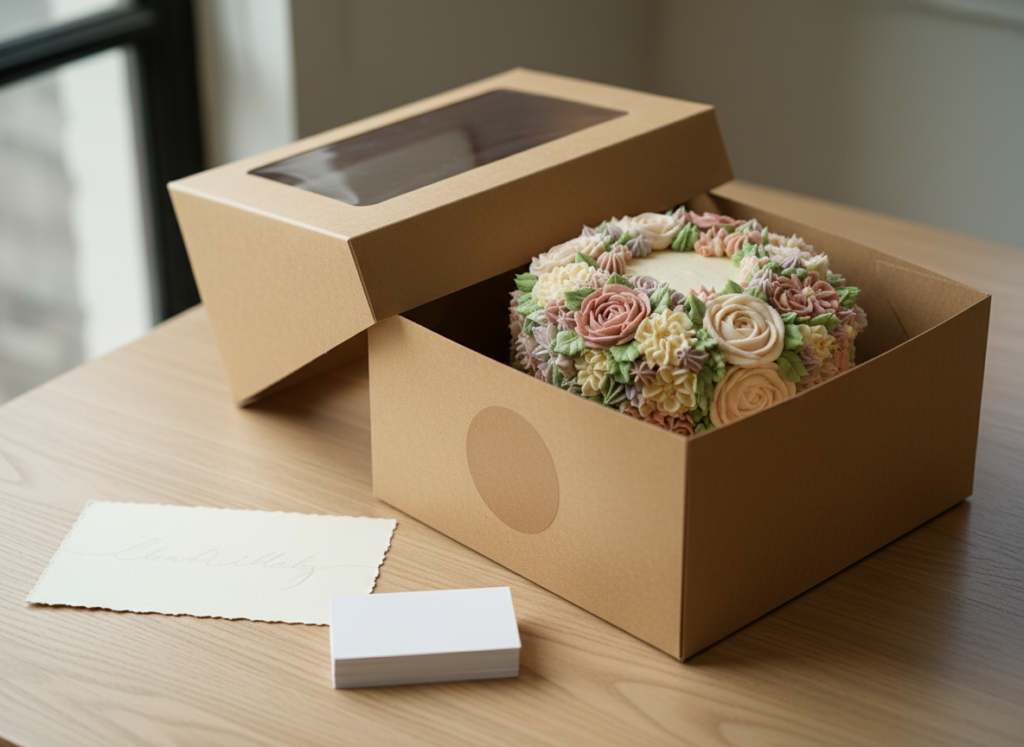
Packaging basics
Sturdy cake box
Clean cake board
A simple sticker/label with your brand name
Optional: thank-you card + care instructions
Your photo standard (non-negotiable)
Use the same photo setup every time:
Natural window light
Clean background
One wide shot + one close-up
One “cut slice” photo for texture (if possible)
Your social media will get 10x better from this alone.
7) Marketing: Your Social Media Engine (Channel-by-Channel)
Your marketing goal is not to “post content.”
Your goal is to create proof:
proof it looks amazing
proof it tastes good
proof you’re reliable
proof you’re in-demand (social trust)
Below is a separate strategy for every major channel.
Pinterest (evergreen traffic + local discovery)
Pinterest is a search engine for ideas:
birthday cake ideas
wedding cake inspiration
“cute cake designs”
“cake flavors”
party planning boards
What to post
Vertical pins (2:3) with clear text overlays:
“10 Birthday Cake Ideas (2026)”
“Simple Elegant Buttercream Designs”
“Pricing Guide: Custom Cakes”
Before/after transformations
Seasonal content (Mother’s Day, graduation, Christmas)
How to make Pinterest work for sales
Link pins to a page where people can:
see your portfolio
read pricing ranges
request an order
Use boards like:
“Birthday Cakes”
“Kids Party Cakes”
“Wedding Cakes”
“Cupcake Boxes”
“Cake Pricing & Planning Tips”
Posting pace: 3 pins per week is enough if consistent.
YouTube (trust + authority + “I want THIS baker” energy)
YouTube is where you become “the cake person.”
Two content types that work best
YouTube Shorts (15–45 sec)
frosting smoothing
piping
decorating timelapses
“from plain to WOW” transformations
Long videos (5–12 minutes)
“How I make my best-selling vanilla cake”
“How I price custom cakes”
“A full order from start to delivery”
Smartphone filming setup (simple)
Tripod
Window light or cheap LED
Film vertical for Shorts, horizontal for long-form
Local sales tip
In the description:
mention your city/region
show how to order (link + WhatsApp)
Instagram (visual showroom + daily trust)
Instagram is your portfolio and social proof machine.
What to post
Reels: frosting + decorating + “cut the slice”
Stories: daily behind-the-scenes
Carousels: “Cake pricing explained” / “How to order”
Highlights:
“Menu”
“Prices”
“Order”
“Reviews”
“FAQ”
Growth shortcut
Tag local venues, photographers, party planners
Use location tags consistently
Post customer reactions (UGC) when allowed
TikTok (reach + viral transformations)
TikTok is where “satisfying” wins.
Content that performs
3-second hook:
“Watch this ugly cake become a wedding cake…”
Timelapses
ASMR mixing/frosting sounds
Customer pickup moments (even just the box reveal)
Make it local
Use local hashtags and mention your area:
“Home baker in [your city]”
“Pickup available this weekend”
Facebook (local communities = customers)
Facebook Groups are still one of the fastest ways to get your first paying customers.
What to do
Join local groups (neighborhood groups, moms groups, community boards)
Post value, not spam:
“I have 2 pickup spots this Saturday. Here are the designs available.”
Share 3 photos + clear price range + order method
Add-ons
Create a Facebook Page with:
services
hours
WhatsApp button
Ask happy customers for reviews
Google Business Profile (free local SEO)
If you want consistent local orders, this is huge.
Why it matters
People search:
“custom birthday cake near me”
“cupcakes [city]”
“home baker [city]”
What to upload weekly
new cake photos
short posts (“2 spots available this weekend”)
ask for reviews after every successful order
WhatsApp Business (the fastest conversion tool)
This is how you close orders quickly without endless back-and-forth.
Set up:
Quick Replies:
pricing template
ordering steps
pickup address
Labels:
“New Inquiry”
“Deposit Paid”
“This Week”
“Delivered”
Catalog:
“Birthday Cake (from €X)”
“Cupcake Box (from €X)”
Email (turn seasonal customers into repeat customers)
Email is underrated for home bakers because it creates repeat business.
Simple lead magnet idea
“10 Cake Flavor Combinations for Birthdays (Free PDF)”
Collect emails via a simple form.
Monthly email examples
“Next month’s flavor special”
“Holiday pre-order list is open”
“2 weekend pickup slots left”
LinkedIn (optional but powerful for corporate orders)
If you want higher-ticket and recurring clients:
office birthdays
corporate gifts
event catering dessert tables
Post:
clean product photos
reliability messaging
order lead times
8) A Simple 7-Day Launch Plan (Beginner-Friendly)
Day 1: Pick your offer + 6 menu items
Don’t overcomplicate.
Day 2: Do a photo shoot of 3 products
Create your “portfolio base.”
Day 3: Create your order form + WhatsApp Business
Make ordering frictionless.
Day 4: Post your first 5 pieces of content
2 Instagram Reels
1 TikTok
2 Pinterest pins
Day 5: Announce a “first-weekend pickup”
Create urgency.
Day 6: Ask 2–3 local groups if you can post
Follow rules, be respectful.
Day 7: Deliver your first orders + collect reviews
Reviews are compounding assets.
9) Common Mistakes (Avoid These)
Taking custom orders without a deposit
Underpricing “because I’m new”
Offering too many flavors/designs
No pickup/delivery rules
Not documenting allergies clearly
Not collecting reviews early
Conclusion: Your Home Cake Business Can Be a Real Asset
A home cake business is not “small” or “cute.”
It’s a real business with:
a real product
real customers
real repeat income
And with the right smartphone-driven marketing system, you can go from “hobby baker” to booked-out in a predictable way—without paying for ads in the beginning.