Starting a home-based business is exciting until you realize one important thing:
You still need clients.
You may have a service idea.
You may have a quiet workspace.
You may have a laptop, phone, website or business name.
You may even know exactly what you want to offer.
But without clients, the business is still only an idea.
Many new home-based business owners think they need ads to get started. They imagine Facebook ads, Google ads, promoted posts, funnels, landing pages and complicated marketing systems.
But for your first clients, ads are usually not the best starting point.
You do not need to spend money before you understand your offer.
You do not need to run ads before you know what people respond to.
You do not need to build a complicated marketing system before you have real conversations.
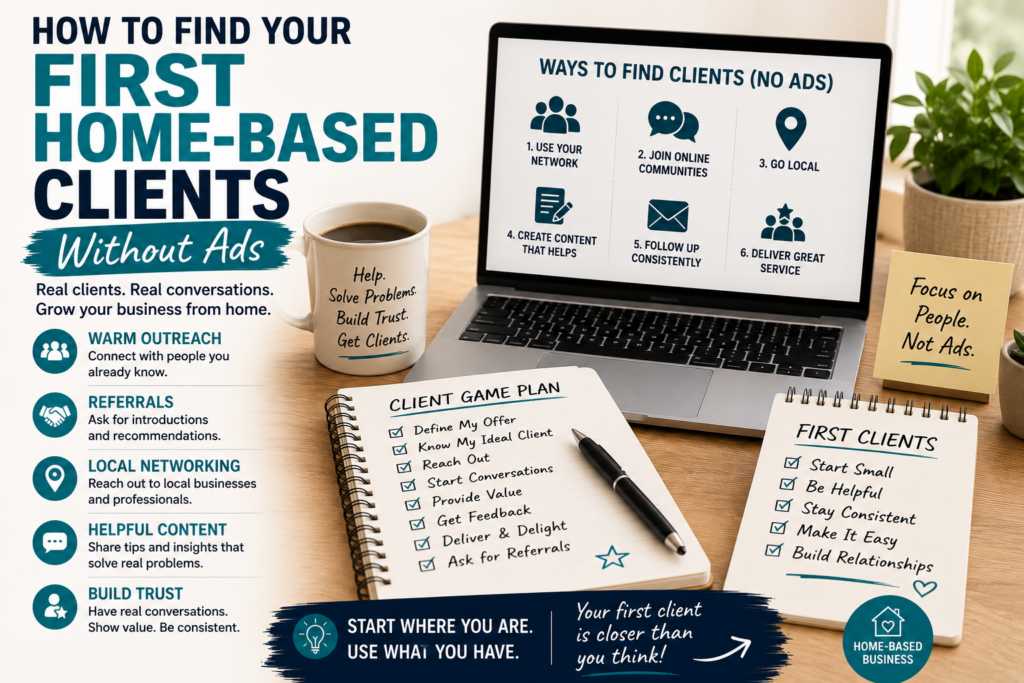
Your first home-based clients can often come from simpler methods:
Warm outreach
Referrals
Local contacts
Past colleagues
Helpful content
Online communities
Direct conversations
Simple follow-up
Clear offers
Trust-building
This guide shows you how to find your first home-based clients without ads.
Affiliate disclosure: This post contains affiliate links. If you make a purchase through one of these links, ProBusinessStrategy may earn a small commission at no extra cost to you. We only recommend tools we genuinely believe in.
Why Ads Are Not the Best First Step
Ads can work, but they are not always the best tool for a brand-new home-based business.
The problem is not that ads are bad.
The problem is that ads amplify what already exists.
If your offer is unclear, ads will not fix it.
If your audience is too broad, ads will not fix it.
If your landing page is weak, ads will not fix it.
If you do not know what customers care about yet, ads can become expensive market research.
Before spending money on ads, it is smarter to get your first clients through direct, human methods.
This helps you learn:
Who actually needs your service
What words people use to describe their problem
What objections they have
What price feels realistic
What result they want most
Which offer is easiest to sell
Which type of client is best to work with
Your first clients are not only revenue.
They are feedback, proof and confidence.
That is why no-ad client acquisition is so valuable in the beginning.
Step 1: Choose One Clear Service Offer
Before looking for clients, you need to know what you are offering.
Many home-based business owners start too broadly.
They say:
“I can help with admin, social media, writing, email, customer service and websites.”
That sounds flexible, but it can be confusing.
A potential client should understand your offer quickly.
Instead of offering everything, start with one clear service.
Examples:
Virtual assistant support for small business owners
Social media captions for local businesses
Bookkeeping cleanup for freelancers
Website homepage review for new entrepreneurs
Email inbox organization for busy consultants
Simple logo and brand kit setup
Content calendar planning for coaches
Customer service email templates for ecommerce stores
Resume improvement for job seekers
Pinterest Pin creation for bloggers
Product description writing for online shops
Appointment scheduling support for service businesses
A clear offer makes outreach easier.
Weak offer:
“I help with business tasks.”
Better offer:
“I help small business owners organize their inbox, calendar and weekly admin tasks so they can spend less time chasing details.”
Weak offer:
“I do marketing.”
Better offer:
“I create simple social media content plans for home-based service providers who never know what to post.”
Your first offer does not need to be perfect.
It needs to be clear enough for someone to say:
“Yes, I understand what you do.”
Step 2: Define Your First Client Type
After choosing your offer, define who it is for.
Do not try to reach everyone.
A home-based business grows faster when the first audience is specific.
Examples:
New coaches
Local service providers
Freelancers
Small ecommerce sellers
Real estate agents
Wellness professionals
Wedding vendors
Personal trainers
Online course creators
Busy consultants
Cleaning companies
Virtual assistants
Home-based entrepreneurs
Bloggers
Creators
Small nonprofits
A specific audience helps you write better messages.
For example:
“I help businesses with content” is too broad.
“I help local service businesses create simple weekly social media posts” is much clearer.
“I help people with admin” is broad.
“I help solo consultants organize client communication, scheduling and follow-up” is more specific.
The more specific your first client type is, the easier it becomes to find them.
You can always expand later.
At the beginning, focus is your friend.
Step 3: Create a Simple Trust Page
You do not need a complicated website to get your first clients.
But you do need a simple place where people can understand what you do.
This could be:
A one-page website
A simple landing page
A LinkedIn profile
A Google Doc service page
A PDF offer sheet
A Facebook business page
A Notion-style page
A simple portfolio page
The page should answer:
Who do you help?
What problem do you solve?
What service do you offer?
What is included?
How does the process work?
What result can people expect?
How can someone contact you?
You can keep it simple.
If you want to look professional from the beginning, you can register a domain through Namecheap or WordPress.com Domains. If you want to build a small WordPress site, Bluehost can be used for hosting.
But do not spend weeks building the perfect website before talking to people.
A simple trust page is enough to start.
Your first clients usually come from conversations, not from a perfect homepage.
Step 4: Start With People Who Already Know You
The easiest first clients often come from your existing network.
That does not mean begging friends and family to buy.
It means letting people know what you are now offering.
Start with:
Friends
Family
Former colleagues
Old classmates
Local contacts
Past employers
Business acquaintances
Social media connections
People you have helped before
Community members
People in your existing professional network
Send a short, clear message.
Example:
“Hi [Name], I recently started helping [type of client] with [specific service]. I’m currently looking for my first few clients and thought of you because [reason]. Would it be useful if I sent you a short overview?”
Another version:
“Hi [Name], I’m starting a home-based service helping [audience] with [problem]. You may not need this yourself, but do you know anyone who might be a good fit?”
This is simple and respectful.
The goal is not to pressure people.
The goal is to open conversations.
Many first clients come through second-degree connections.
Someone may not need your service, but they may know someone who does.
Step 5: Ask for Referrals the Right Way
Referrals are powerful for a home-based business because they come with trust.
But many beginners ask too vaguely.
They say:
“Let me know if you know anyone.”
That is too broad.
Make the referral request specific.
Better:
“Do you know any small business owners who need help organizing their weekly admin, inbox or calendar?”
Or:
“Do you know any local service providers who need simple social media captions written each week?”
Or:
“Do you know any freelancers who are behind on basic bookkeeping or invoice organization?”
A specific referral request is easier to answer.
People can search their memory better when they know exactly who you are looking for.
You can also give them a short referral sentence they can forward.
Example:
“I know someone who helps small business owners organize their inbox, calendar and weekly admin tasks from home. Want me to connect you?”
Make it easy for people to refer you.
Do not expect them to explain your business perfectly.
Give them the words.
Step 6: Use Local Business Outreach
A home-based business does not have to find clients only online.
Local businesses can be excellent first clients.
Look around your area for:
Hair salons
Cafes
Cleaning companies
Plumbers
Electricians
Real estate agents
Fitness trainers
Beauty professionals
Small shops
Local consultants
Wedding vendors
Pet businesses
Tutors
Therapists
Local ecommerce sellers
Many local businesses need help with simple tasks:
Website updates
Google Business Profile improvements
Social media posts
Email responses
Customer follow-up
Appointment reminders
Basic admin
Flyer design
Local content
Review request templates
Product descriptions
Service page copy
You can contact them with a simple, specific message.
Example:
“Hi [Name], I saw your business online and noticed you offer [service]. I help local businesses with [specific problem]. I had one small idea that might help you get more inquiries from your website. Would you like me to send it over?”
This works better than a generic sales message.
Do not say:
“I offer marketing services.”
Say something specific.
For example:
“I noticed your website does not clearly show how people can book an appointment. I help local service businesses make that process clearer.”
Specific outreach feels more thoughtful.
Step 7: Join Online Communities Where Your Clients Already Are
Online communities can be useful if you approach them correctly.
Do not join groups and immediately promote yourself.
That usually fails.
Instead, join communities where your ideal clients ask questions.
Examples:
Facebook groups
LinkedIn groups
Reddit communities
Local business groups
Entrepreneur communities
Niche forums
Industry-specific communities
Online course communities
Membership groups
Creator groups
Look for questions related to your service.
If you offer content planning, find people asking what to post.
If you offer admin support, find people overwhelmed by client tasks.
If you offer bookkeeping support, find people confused about invoices.
If you offer website help, find people asking about homepage structure.
Answer helpfully.
Do not pitch immediately.
A useful answer can lead to a conversation.
Example:
Instead of:
“I can help you. DM me.”
Write:
“One simple way to fix this is to separate your homepage into three parts: who you help, what problem you solve and what the next step is. If your visitors cannot understand those three things quickly, they may leave.”
That shows expertise.
People are more likely to trust someone who helps first.
Step 8: Create Simple Content That Attracts the Right People
You do not need to become a full-time content creator.
But simple content can help people understand what you do.
Post content around your service and audience.
Examples:
Common mistakes your clients make
Before-and-after tips
Simple checklists
Questions you often hear
Behind-the-scenes work
Small lessons from your business journey
Examples of problems you solve
Short how-to posts
Client education posts
Myth vs reality posts
Beginner-friendly guides
If you are a virtual assistant, you can post:
“5 admin tasks small business owners should stop doing manually.”
If you write social media captions, you can post:
“3 reasons your captions are not getting responses.”
If you help with websites, you can post:
“Before you redesign your homepage, check this first.”
If you help with bookkeeping organization, you can post:
“Simple weekly finance routine for freelancers.”
The purpose of content is not always to go viral.
The purpose is to make your expertise visible.
A potential client may see one post, check your profile and send a message.
That is how simple content can support a home-based business.
Step 9: Offer a Small Starter Package
For first clients, a small starter package can be easier to sell than a large service.
People may not be ready to commit to a big monthly package.
But they may say yes to a smaller first step.
Examples:
Website homepage review
One-week admin cleanup
Five social media captions
One-hour business organization session
Basic inbox cleanup
Product description rewrite for 5 products
Google Business Profile review
One-page offer clarity review
Simple content calendar for one week
Client follow-up email template pack
Mini brand audit
First 10 customer outreach plan
A starter package should be:
Easy to understand
Affordable enough to test
Useful to the client
Clear in scope
Quick to deliver
Connected to your larger service
For example:
Starter offer:
“€79 homepage clarity review”
Larger offer:
“Website copy improvement package”
Starter offer:
“€99 content idea session”
Larger offer:
“Monthly social content support”
The starter package lowers the risk.
It also gives you a chance to prove your value.
Step 10: Use Direct Outreach Without Being Pushy
Direct outreach can work when it is personal and relevant.
It fails when it feels spammy.
Bad outreach:
“Hi, I offer business services. Let me know if you are interested.”
Better outreach:
“Hi [Name], I came across your business and noticed you offer [service]. I work with [type of business] on [specific problem]. One thing I noticed is [specific observation]. Would it be helpful if I sent you a quick idea?”
This message works because it is:
Short
Relevant
Specific
Low-pressure
Focused on one problem
Do not send long paragraphs.
Do not attach files immediately.
Do not pressure people to book a call.
Start a conversation.
Your goal is not to close the client in the first message.
Your goal is to see whether the problem is relevant.
Step 11: Follow Up Professionally
Many first clients come from follow-up.
People are busy.
A lack of reply does not always mean no.
Use a simple follow-up schedule:
First message
Follow-up after 3–4 days
Final follow-up after 7–10 days
Example follow-up:
“Hi [Name], just wanted to quickly follow up. No pressure at all. I thought this might be useful because [specific reason]. Happy to send a short overview if it helps.”
Final follow-up:
“Hi [Name], I’ll leave this here for now. If help with [specific problem] becomes useful later, feel free to reach out.”
Keep it polite.
Do not guilt people.
Do not send endless messages.
Professional follow-up shows confidence and respect.
Step 12: Turn Conversations Into Client Calls
When someone shows interest, do not jump straight into a pitch.
Ask questions first.
You want to understand:
What are they struggling with?
What have they tried already?
Why is this problem important now?
What would a good outcome look like?
What is taking too much time?
What is confusing or stressful?
What would they like to make easier?
What budget or timeline are they thinking about?
This helps you avoid selling the wrong thing.
Sometimes the service you planned is not what they need most.
For example, you may offer social media captions, but the client may actually need a clearer offer first.
You may offer admin support, but the real issue may be poor client follow-up.
You may offer website help, but they may need a simple booking process.
Good questions help you make a better offer.
Step 13: Make a Clear Offer
After the conversation, present a simple offer.
Your offer should include:
What you will do
What is included
What is not included
Timeline
Price
Next step
Expected result
How communication works
Example:
“I can help you organize your client follow-up process. The starter package includes a review of your current process, three follow-up email templates and a simple weekly tracking sheet. I can deliver it within five business days. The price is €149.”
This is much better than:
“I can help with admin stuff.”
A clear offer gives the client confidence.
They know what they are buying.
Step 14: Deliver Well and Ask for Proof
Your first clients matter.
Treat every first client as a foundation.
Deliver clearly.
Communicate on time.
Meet deadlines.
Explain what you are doing.
Keep the process simple.
Ask for feedback.
Make small improvements if needed.
End the project professionally.
After the work is complete, ask for a testimonial.
Example:
“I’m glad this was helpful. Since I’m building this service, would you be comfortable sharing a short testimonial about your experience?”
You can also ask:
“What was the problem before working with me?”
“What changed after the service?”
Would you recommend this to someone else?”
Testimonials help future clients trust you faster.
Your first home-based clients can help you get your next clients.
Step 15: Build a Simple Referral Loop
After a successful project, ask for referrals.
Example:
“Do you know one or two other small business owners who might need help with [specific problem]?”
Make it easy.
You can also write:
“If someone comes to mind, you can simply tell them: ‘I worked with someone who helps with [specific result]. I can introduce you.’”
Referrals work well when your service is specific and the client had a good experience.
Do not wait months to ask.
Ask while the result is fresh.
Step 16: Track Your Client Search
Do not rely on memory.
Use a simple tracking sheet.
Track:
Name
Business
Contact method
Date contacted
Follow-up date
Response
Needs
Offer made
Result
Notes
Referral potential
This helps you stay organized.
It also shows your numbers.
For example:
30 people contacted
12 replies
5 conversations
3 offers
1 client
That is useful information.
If nobody replies, your message may need work.
If people reply but do not book, your offer may be unclear.
If people book calls but do not buy, your pricing or sales conversation may need improvement.
Tracking turns client search into a system.
A Simple 14-Day Plan to Get Your First Home-Based Clients
Here is a practical two-week plan.
Day 1: Choose One Offer
Write one clear service offer for one type of client.
Day 2: Define Your Ideal First Client
Choose a specific group of people or businesses you want to help.
Day 3: Create a Simple Trust Page
Make a one-page service page, profile, PDF or Google Doc.
Day 4: Write Your Outreach Message
Create one warm outreach message and one direct outreach message.
Day 5: Contact 10 Warm People
Tell your existing network what you offer and ask for referrals.
Day 6: Build a List of 25 Potential Clients
Find local or online businesses that match your offer.
Day 7: Contact 5 Potential Clients
Send thoughtful, specific messages.
Day 8: Post One Helpful Content Piece
Share a practical tip related to your service.
Day 9: Follow Up With Warm Contacts
Send polite follow-ups to people who did not respond.
Day 10: Contact 5 More Potential Clients
Keep outreach specific and relevant.
Day 11: Join Two Online Communities
Answer useful questions without pitching aggressively.
Day 12: Create a Starter Package
Make a simple low-risk offer people can say yes to.
Day 13: Follow Up Again
Follow up with interested people and book conversations.
Day 14: Make Offers
For anyone with a clear need, present a simple offer with price, scope and next step.
Repeat the cycle.
Client acquisition is not one big dramatic action.
It is a series of small consistent actions.
Common Mistakes to Avoid
Waiting Until Everything Is Perfect
You do not need a perfect website, logo or brand before talking to potential clients.
You need a clear offer.
Offering Too Many Services
Too many options can confuse people.
Start with one clear service.
Being Too Vague
“Let me know if you need help” is weak.
Be specific about the problem you solve.
Only Posting and Hoping
Content is useful, but do not hide behind posting.
Have direct conversations.
Not Following Up
Many beginners lose clients because they never follow up.
Charging Too Little
A starter price can be accessible, but do not make it so low that you resent the work.
Forgetting to Ask for Testimonials
Your first clients should help build proof for future clients.
Trying to Sell Before Listening
Ask questions before offering a package.
Good discovery creates better offers.
Final Thoughts
You do not need ads to find your first home-based clients.
You need clarity, conversations and consistency.
Start with one clear offer.
Choose one specific client type.
Create a simple trust page.
Tell your existing network.
Ask for referrals.
Reach out to local and online businesses.
Share helpful content.
Offer a small starter package.
Follow up professionally.
Deliver well.
Ask for testimonials and referrals.
This is not flashy.
But it works because business begins with trust.
Your first clients may come from a message, a referral, a local connection, a helpful post or a simple conversation.
You do not need thousands of followers.
You do not need an ad budget.
You do not need a complicated funnel.
You need to make your offer clear and put it in front of the right people.
That is how a home-based business starts getting real clients.
One conversation at a time.
Related Articles
The First 10 Customers Plan: A Step-by-Step Guide for New Business Owners