A funnel sounds complicated when you first hear the word.
It can sound like something only advanced marketers use.
You may imagine expensive software, complicated automation, email sequences, landing pages, tracking dashboards, split tests, lead magnets, webinars, checkout pages, and technical systems that are difficult to understand.
But the basic idea of a funnel is much simpler.
A funnel is just the path someone takes from discovering your business to taking action.
That action could be:
- buying a product
- booking a call
- joining an email list
- requesting a quote
- downloading a guide
- visiting a service page
- starting a free trial
- sending you a message
- becoming a repeat customer
A funnel is not only technology.
A funnel is a customer journey.
Someone sees your content.
They become curious.
They learn more.
They begin to trust you.
They see an offer.
They take the next step.
That is a funnel.
This beginner’s guide explains funnels in a simple, no-tech version. The goal is to help you understand how funnels work before you worry about tools, software, automation, or complicated marketing systems.
Affiliate disclosure: This post contains affiliate links. If you make a purchase through one of these links, ProBusinessStrategy may earn a small commission at no extra cost to you. We only recommend tools we genuinely believe in.
What Is a Funnel?
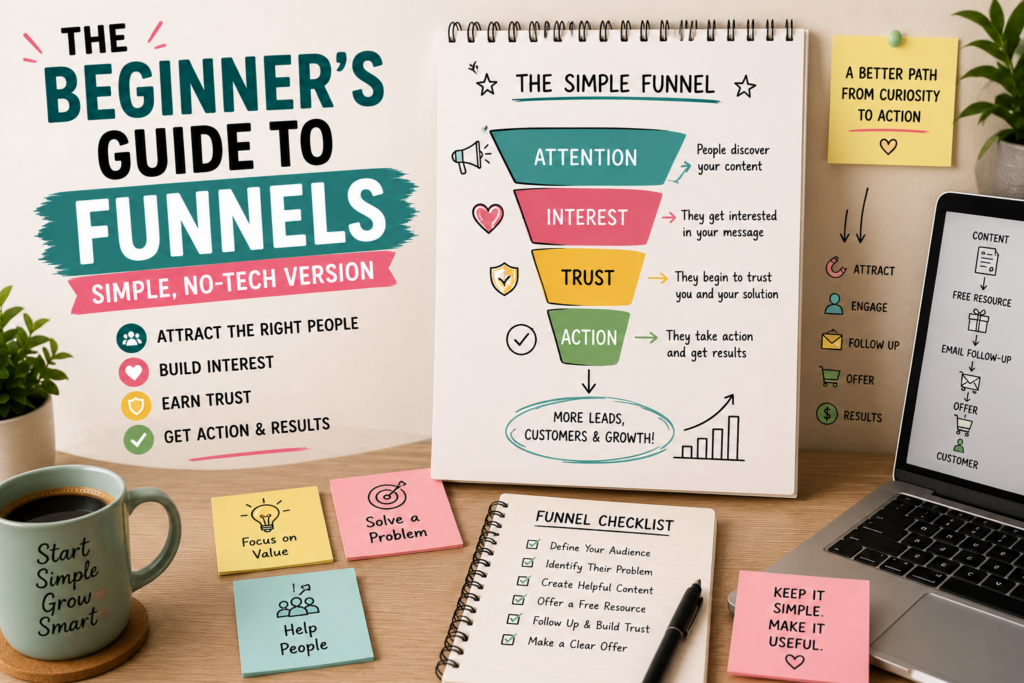
A funnel is a simple marketing path that moves a person from awareness to action.
At the top of the funnel, many people may see your business.
At the bottom of the funnel, fewer people take action.
That is why it is called a funnel.
More people enter at the top.
Fewer people come out at the bottom as customers, subscribers, leads, or buyers.
For example:
100 people see your social media post.
30 people visit your website.
10 people read your offer.
3 people join your email list.
1 person buys your product.
That is a simple funnel.
It does not need to be perfect.
It does not need complicated software.
It only needs a clear path.
A funnel answers one practical question:
“What should happen after someone discovers me?”
Without a funnel, people may find your content and then leave.
With a funnel, you guide them toward a next step.
Why Beginners Need Funnels
Many beginners create content without a clear next step.
They post on social media.
They write blog articles.
They create videos.
They share tips.
They make Pins.
They publish useful content.
But then nothing happens because the audience has nowhere to go.
There is no next step.
That is where a funnel helps.
A funnel gives direction.
It helps turn attention into action.
For example, if someone reads your blog post, what should they do next?
Should they read another article?
Download a checklist?
Join your email list?
Book a call?
View your product?
Ask for a quote?
Follow you on social media?
A funnel does not force people.
It guides them.
When done well, a funnel feels natural because it helps the reader move to the next useful step.
The Simplest Funnel Formula
A simple funnel has four parts:
1. Attention
People need to discover you first.
This can happen through:
- blog posts
- Pinterest Pins
- YouTube videos
- TikTok videos
- Instagram Reels
- Facebook posts
- Google search
- local flyers
- referrals
- LinkedIn posts
- podcast interviews
- community groups
Attention is the top of the funnel.
This is where people first notice your business.
2. Interest
After people notice you, they need a reason to care.
Interest is created by useful content, clear messaging, and relevant problems.
For example:
- “How to start a home business under $100”
- “15 MVP examples you can launch this week”
- “How to build a Pinterest business without followers”
- “How to test a business idea before spending money”
These topics create interest because they solve specific problems.
3. Trust
People rarely buy immediately.
They need trust.
Trust can come from:
- helpful articles
- clear explanations
- examples
- case studies
- personal experience
- testimonials
- useful free resources
- consistent content
- simple language
- honest expectations
Trust is what makes someone think:
“This person or business understands my problem.”
4. Action
Finally, the person needs a clear next step.
This could be:
- read another related article
- download a checklist
- join an email list
- buy a template
- book a call
- request a quote
- start a trial
- visit a product page
- contact you
A funnel without an action step is incomplete.
The action step does not always have to be a sale.
For beginners, the first action may simply be an email signup or a message.
A No-Tech Funnel Example
Here is a very simple no-tech funnel.
Imagine you have a blog about starting a home business.
Your funnel could look like this:
Step 1: Blog Article
Someone finds your article:
“Home Business Ideas With Low Startup Costs Under $100”
This creates attention.
Step 2: Helpful Content
The article gives useful ideas, examples, and a simple launch plan.
This creates interest and trust.
Step 3: Free Checklist
At the end of the article, you offer:
“Download the Home Business Starter Checklist.”
This gives the reader a useful next step.
Step 4: Email Follow-Up
After they download the checklist, you send a few simple emails:
- email 1: deliver the checklist
- email 2: explain how to choose one idea
- email 3: share mistakes to avoid
- email 4: recommend a useful product, service, or paid guide
This builds more trust.
Step 5: Offer
Later, you offer a paid product:
“Home Business Launch Planner”
Or:
“Business Idea Review Call”
Or:
“Low-Cost Home Business Template Pack”
That is a funnel.
It can start very simply.
You do not need advanced software to understand the structure.
Funnels Are Not Just for Online Businesses
Many people think funnels are only for online businesses.
That is not true.
A local business can also have a funnel.
Example:
A local cleaning business posts before-and-after photos on Facebook.
People see the photos.
They visit the business page.
They read reviews.
They send a message.
The business replies with prices.
The customer books a cleaning.
That is a funnel.
Another example:
A local dog walker leaves flyers in a neighborhood.
A homeowner scans a QR code.
They visit a simple service page.
They read the offer.
They send a WhatsApp message.
They book a trial walk.
That is also a funnel.
A funnel is simply the path from attention to action.
The Most Common Beginner Funnel
For beginners, one of the easiest funnels is:
Content → Free Resource → Email List → Offer
This works because it is simple.
Content
The content attracts the right audience.
Examples:
- blog post
- Pinterest Pin
- YouTube Short
- TikTok video
- Instagram Reel
- Facebook post
Free Resource
The free resource gives people a reason to stay connected.
Examples:
- checklist
- guide
- template
- worksheet
- cheat sheet
- planner
- resource list
- mini-course
- email series
Email List
The email list allows you to follow up.
This is important because most people do not buy the first time they see you.
Offer
The offer gives people a paid next step.
Examples:
- digital product
- template bundle
- service
- consultation
- course
- membership
- affiliate recommendation
- local service
- product
This funnel can work for many small businesses.
The No-Tech Funnel Map
Before using software, draw the funnel on paper.
Write down these five questions:
1. Who Do I Want to Reach?
Be specific.
Not “everyone who wants to start a business.”
Better:
“Beginners who want to start a home business with less than $100.”
Or:
“Solopreneurs who want to test a business idea before building a full product.”
A funnel works better when the audience is clear.
2. What Problem Do They Have?
People move through funnels because they want a result or solution.
Examples:
- they do not know what business to start
- they do not have much money
- they need more leads
- they do not understand marketing
- they want to grow traffic
- they need a simple website
- they want to sell digital products
- they do not know how to test an idea
The clearer the problem, the stronger the funnel.
3. What Content Will Attract Them?
Choose content that matches the problem.
If the problem is “I do not know how to start,” create beginner content.
If the problem is “I need leads,” create lead generation content.
If the problem is “I need traffic,” create traffic content.
The content should create a bridge from problem to solution.
4. What Free Step Will Help Them?
The free step should be useful and connected to the offer.
Examples:
- checklist
- worksheet
- short guide
- calculator
- template
- email series
- mini training
- resource list
Do not create a random freebie.
If your paid offer is about starting a home business, the free resource should help with that same topic.
5. What Paid Offer Comes Next?
The paid offer should feel like the next logical step.
For example:
Article: “Home Business Ideas Under $100”
Free resource: “Home Business Starter Checklist”
Paid offer: “Home Business Launch Planner”
That makes sense.
But if the paid offer is unrelated, the funnel becomes weak.
A funnel should feel connected.
Simple Funnel Examples
Here are several simple funnel examples for different business types.
Example 1: Blog Funnel
Blog article:
“15 MVP Examples You Can Launch This Week”
Free resource:
“MVP Launch Checklist”
Email follow-up:
“How to choose one MVP idea”
Paid offer:
“MVP Planning Template Pack”
This funnel works because every step is related.
Example 2: Service Business Funnel
Social media post:
“5 signs your website homepage is confusing visitors”
Free resource:
“Homepage Review Checklist”
Email follow-up:
“Common homepage mistakes”
Paid offer:
“Website Homepage Review Service”
This works well for consultants, designers, and marketers.
Example 3: Local Business Funnel
Flyer:
“Need help organizing your home office?”
Free resource:
“Home Office Setup Checklist”
Follow-up:
Phone call or message
Paid offer:
“Home Office Setup Consultation”
This is a no-tech or low-tech local funnel.
Example 4: Pinterest Funnel
Pinterest Pin:
“Business Ideas You Can Start From Your Phone”
Blog article:
Detailed guide with examples
Free resource:
“Phone Business Idea Checklist”
Email follow-up:
More business ideas and tools
Paid offer:
Digital guide, template, or affiliate recommendation
This type of funnel can work well for content sites.
Example 5: Coaching Funnel
Short video:
“Why most beginners choose the wrong business idea”
Free resource:
“Business Idea Clarity Worksheet”
Email follow-up:
Tips, examples, and mistakes
Paid offer:
“Business Idea Review Call”
This works because the free resource helps people identify their problem before booking help.
What Makes a Funnel Work?
A funnel works when every step makes sense.
The audience should not feel confused.
They should not wonder:
“Why am I seeing this?”
“Why am I being offered this?”
“What does this have to do with the article?”
A good funnel has alignment.
The audience, content, free resource, emails, and offer all fit together.
For example:
Audience: beginners starting a business
Content: beginner business idea articles
Free resource: startup checklist
Email follow-up: simple startup steps
Offer: beginner business planning template
That is aligned.
A weak funnel looks like this:
Audience: beginners starting a business
Content: home business ideas
Free resource: random social media calendar
Offer: expensive advanced marketing course
That is confusing.
People are more likely to take action when the next step feels natural.
The Biggest Funnel Mistake Beginners Make
The biggest mistake is trying to build a complicated funnel before understanding the customer journey.
They worry about:
- automation
- software
- email sequences
- design
- tracking
- countdown timers
- upsells
- downsells
- sales pages
- webinar platforms
- integrations
Those things can matter later.
But they are not the starting point.
The starting point is much simpler:
Who is the person?
What problem do they have?
What content attracts them?
What useful next step can I offer?
What paid offer makes sense after that?
Answer those questions first.
The software comes later.
Do You Need a Website for a Funnel?
You do not always need a full website to create a funnel.
A funnel can begin with:
- social media post
- Google Form
- WhatsApp message
- booking link
- PDF download
- simple landing page
- email reply
- local flyer
- direct message
- marketplace listing
But a website can help if you want to build a long-term content business or professional brand.
For example, if you are creating blog articles, lead magnets, affiliate content, digital products, or service pages, a simple website can become the center of your funnel.
For beginners who want to set up a simple site, a domain from Namecheap and hosting from Bluehost can be enough to start.
The website does not need to be complicated.
It only needs to help the visitor understand:
- what you offer
- who it is for
- why it matters
- what to do next
Do You Need an Email List?
You can start without an email list, but an email list is useful for many funnels.
Why?
Because most people do not buy immediately.
They may need more time.
They may want to learn more.
They may not be ready today.
An email list lets you continue the conversation.
A very simple beginner email funnel could be:
Email 1: Deliver the Free Resource
Give the checklist, guide, template, or worksheet.
Keep it clear and helpful.
Email 2: Explain the Problem
Talk about the common problem your audience faces.
Help them understand why it matters.
Email 3: Share a Simple Solution
Give practical steps, examples, or a useful framework.
Email 4: Introduce the Offer
Show the paid next step.
Explain who it is for and what result it helps create.
That is already a funnel.
It does not need 25 emails.
Start simple.
How to Build a Funnel Without Tech Overwhelm
Use this simple process.
Step 1: Choose One Audience
Do not build a funnel for everyone.
Choose one audience.
Example:
“Beginners who want to start a business from home.”
Step 2: Choose One Problem
Choose one problem.
Example:
“They do not know which business idea to test first.”
Step 3: Create One Helpful Content Piece
Create one article, video, post, or Pin that speaks to that problem.
Example:
“15 MVP Examples You Can Launch This Week.”
Step 4: Create One Free Resource
Create one useful next step.
Example:
“MVP Launch Checklist.”
Step 5: Create One Offer
Create one paid next step.
Example:
“MVP Planning Template.”
Step 6: Connect the Steps
Add the free resource to the content.
Send a simple follow-up.
Mention the offer naturally.
That is enough for a beginner funnel.
A Simple Funnel You Can Build This Week
Here is a funnel you can create in seven days.
Day 1: Choose the Audience
Pick one group.
Example:
“People who want to start a low-cost home business.”
Day 2: Choose the Content Topic
Pick one article or video topic.
Example:
“Home Business Ideas With Low Startup Costs Under $100.”
Day 3: Create the Free Resource
Create a checklist.
Example:
“Home Business Starter Checklist.”
Day 4: Create the Signup Method
Use a simple landing page, form, or email signup.
Day 5: Write Three Follow-Up Emails
Email 1: deliver the checklist
Email 2: explain how to choose one idea
Email 3: introduce a related paid offer
Day 6: Create the Offer
Create a small paid product or service.
Example:
“Home Business Idea Review” or “Home Business Planner.”
Day 7: Publish and Share
Share the article, Pin, post, or video.
Then watch what happens.
Track signups, replies, clicks, questions, and purchases.
What to Measure in a Simple Funnel
You do not need advanced analytics at the beginning.
Start with basic signals.
Measure:
- how many people see the content
- how many click
- how many sign up
- how many reply
- how many ask questions
- how many buy
- where people stop
- which topic gets attention
- which offer gets interest
These numbers help you improve.
If people see the content but do not click, the headline may need work.
If people click but do not sign up, the free resource may not be strong enough.
If people sign up but do not buy, the offer may need improvement.
If people ask questions but do not act, the next step may be unclear.
A funnel is not something you build once and forget.
You improve it over time.
Final Thoughts
A funnel does not need to be complicated.
At its core, a funnel is simply the path from attention to action.
Someone discovers your business.
They become interested.
They begin to trust you.
They take a next step.
That is the foundation.
Before you worry about advanced tools, build the simple version first.
Choose one audience.
Choose one problem.
Create one helpful piece of content.
Offer one useful next step.
Follow up.
Then make one relevant offer.
That is a beginner funnel.
No complicated tech required.
No advanced marketing language required.
Just a clear path that helps the right person move from curiosity to action.
Once you understand that, funnels become much easier.
They are not magic.
They are not only for experts.
They are not only for big companies.
A funnel is simply a better way to guide people who are already interested in what you do.
Start simple.
Make it useful.
Connect the steps.
Then improve the funnel as you learn.
Related Articles