Taxes can feel intimidating when you become a new business owner.
You may be excited about your first sale, your first client, your first invoice, or your first online payment.
Then the serious question appears:
“What do I need to do about taxes?”
Many beginners avoid this question for too long.
They focus on building the website, finding customers, posting on social media, creating products, or improving the offer.
That is understandable.
Taxes are not usually the exciting part of starting a business.
But ignoring taxes can create problems later.
You do not need to become a tax expert on day one.
You do not need to understand every tax rule immediately.
You do not need complicated accounting software before you have real business activity.
But you do need a basic system.
A simple tax system helps you:
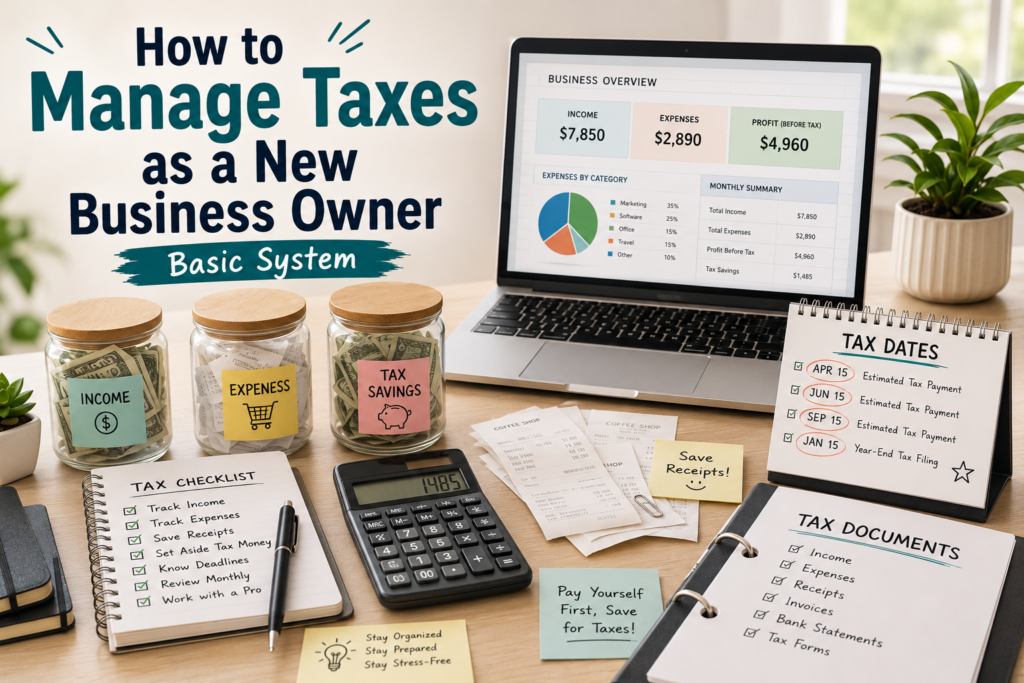
- separate business and personal money
- track income
- record expenses
- save receipts
- set aside money for taxes
- understand profit
- prepare for tax deadlines
- work better with an accountant or tax professional
- avoid last-minute panic
This guide explains how to manage taxes as a new business owner using a basic system.
It is not tax, legal, or accounting advice. Tax rules depend on your country, state, business structure, income level, industry, and personal situation. Always check your local rules or speak with a qualified tax professional.
But the basic system below can help almost any new business owner become more organized.
Affiliate disclosure: This post contains affiliate links. If you make a purchase through one of these links, ProBusinessStrategy may earn a small commission at no extra cost to you. We only recommend tools we genuinely believe in.
Why New Business Owners Struggle With Taxes
New business owners often struggle with taxes for one simple reason:
They do not have a system.
They may receive money in different places.
A client pays by bank transfer.
Another customer pays through PayPal.
A marketplace sends payments.
A freelance platform pays out monthly.
A product sale goes through Stripe.
Some expenses are paid with a personal card.
Other expenses are paid with a business account.
Receipts are in emails, apps, wallets, and screenshots.
By the end of the year, everything is scattered.
This creates stress.
The problem is not always that the business owner is bad with money.
The problem is that the business owner never created a clear flow.
A basic tax system creates that flow.
It gives every financial item a place.
Income goes here.
Expenses go there.
Receipts are saved here.
Tax money is set aside there.
Important dates are tracked here.
That is the goal.
Step 1: Separate Business and Personal Money
The first step is to separate business and personal money as early as possible.
This does not always mean you need a complex corporate structure immediately.
But you should avoid mixing everything together.
When business and personal money are mixed, it becomes harder to know:
- how much the business earned
- how much the business spent
- which expenses were business-related
- how much profit you made
- how much tax you may owe
- whether the business is actually working
A simple starting system could include:
- one separate bank account for business income and expenses
- one payment method used mainly for business costs
- one folder for business receipts
- one spreadsheet or bookkeeping tool for tracking income and expenses
Keeping things separate makes your life easier.
It also makes tax preparation much cleaner.
If you are serious about the business, do not treat business money like random personal cash.
Give the business its own financial space.
Step 2: Track Every Source of Income
Many beginners only think about expenses.
But income tracking is just as important.
You should know where your business money comes from.
Income can include:
- client payments
- product sales
- digital product sales
- affiliate income
- advertising income
- consulting fees
- coaching payments
- marketplace sales
- subscription income
- freelance platform payments
- local service payments
- deposits
- retainers
- tips where applicable
- refunds or reimbursements in some cases
Create a simple income tracker.
At minimum, record:
- date received
- customer or platform
- amount
- payment method
- invoice number if used
- product or service sold
- fees deducted by payment processors
- notes
For example:
Date: March 12
Source: Client A
Amount: $250
Method: Bank transfer
Type: Website review service
Invoice: 003
This does not have to be complicated.
But it must be consistent.
If money comes into the business, record it.
Step 3: Track Business Expenses
Business expenses reduce your profit and may affect your tax position, depending on your local rules.
But you need records.
Do not rely on memory.
Track expenses as they happen.
Common business expenses may include:
- domain name
- website hosting
- business email
- software subscriptions
- design tools
- office supplies
- advertising
- freelance help
- professional services
- payment processing fees
- shipping supplies
- business phone costs
- internet costs where allowed
- education and training
- business travel
- mileage where allowed
- home office costs where allowed
- equipment
- marketplace fees
- bookkeeping software
Not every expense is automatically deductible.
Rules differ by location.
But if you do not track the expense, you may lose the opportunity to discuss it properly with your accountant or tax professional.
A basic expense tracker should include:
- date
- vendor
- amount
- category
- payment method
- receipt saved
- business purpose
- notes
For example:
Date: April 3
Vendor: Website hosting provider
Amount: $95
Category: Website / Hosting
Business purpose: Hosting for business website
Receipt: Saved
This simple habit can save a lot of stress later.
Step 4: Save Receipts Immediately
Receipts are easy to lose.
That is why new business owners need a receipt system from the beginning.
Do not wait until tax season.
Create a simple folder structure.
For example:
Business Taxes
→ 2026
→ Income
→ Expenses
→ Receipts
→ Invoices
→ Bank Statements
→ Tax Forms
→ Accountant
Inside the receipts folder, create monthly folders:
January
February
March
April
Whenever you buy something for the business, save the receipt immediately.
You can save:
- PDF receipts
- email confirmations
- screenshots
- invoices
- payment confirmations
- scanned paper receipts
Use clear file names.
For example:
2026-04-03-hosting-business-website.pdf
Or:
2026-05-11-design-software-subscription.pdf
A good receipt system is boring.
That is why it works.
Step 5: Set Aside Money for Taxes
One of the biggest mistakes new business owners make is spending all the money that comes in.
Business revenue is not the same as personal income.
If a client pays you $1,000, that does not mean you can spend the full $1,000.
Some of that money may need to cover:
- tax
- software
- tools
- business expenses
- payment fees
- future investments
- emergency reserves
A simple beginner habit is to move a percentage of each payment into a separate tax savings account.
The exact percentage depends on your country, business structure, income, deductions, and tax situation.
Because rules vary, ask a tax professional what percentage makes sense for you.
But the habit is what matters:
Money comes in.
A portion goes to tax savings.
The rest is used for business and personal income.
This prevents the painful situation where tax time arrives and the money is already gone.
Step 6: Understand Profit, Not Just Revenue
Revenue is the money your business brings in.
Profit is what remains after business expenses.
Many beginners focus only on revenue.
They say:
“I made $5,000 this month.”
But if expenses were $3,500, the profit is not $5,000.
Profit matters because it helps you understand the real health of the business.
A simple monthly calculation:
Business income
minus business expenses
equals business profit
You can track this in a spreadsheet.
Example:
Income: $2,000
Expenses: $450
Profit before tax: $1,550
This number helps you make better decisions.
It helps you understand:
- whether the business is growing
- whether expenses are too high
- whether pricing is too low
- whether you can pay yourself
- how much tax money may need to be saved
- whether the business model is healthy
Revenue feels exciting.
Profit tells the truth.
Step 7: Choose Simple Expense Categories
Expense categories help you organize your business spending.
Do not create 50 categories at the beginning.
Start simple.
Possible categories:
- Advertising and marketing
- Website and hosting
- Software and subscriptions
- Office supplies
- Professional services
- Payment processing fees
- Education and training
- Travel and mileage
- Equipment
- Shipping and packaging
- Phone and internet
- Contractors and freelancers
- Bank fees
- Other business expenses
Use categories that match your business.
A blogger may need categories for hosting, software, writing help, images, SEO tools, and email marketing.
A local service business may need categories for supplies, fuel, phone, uniforms, flyers, and equipment.
An ecommerce business may need categories for inventory, packaging, shipping, payment fees, marketplace fees, and returns.
The goal is not perfection.
The goal is consistency.
Step 8: Create a Monthly Tax Routine
Do not wait until the end of the year.
Create a monthly tax routine.
Once per month, review your business finances.
This can take 30 to 60 minutes if you stay organized.
Your monthly routine could include:
- record all income
- record all expenses
- save missing receipts
- reconcile bank transactions
- update profit calculation
- move tax savings
- check unpaid invoices
- review upcoming tax dates
- send questions to your accountant
- back up your files
Put this routine on your calendar.
For example:
“Business finance check — first Monday of every month.”
This small habit prevents a big mess.
Step 9: Know Your Tax Deadlines
Tax deadlines matter.
Depending on your country and business type, you may have deadlines for:
- annual income tax
- estimated or preliminary tax payments
- sales tax or VAT
- payroll tax
- self-employment tax
- corporate tax
- local business taxes
- information forms
- employer filings
Do not assume that taxes only happen once per year.
Some businesses may need to pay or report taxes quarterly, monthly, or at other intervals.
Create a simple tax calendar.
Add:
- filing deadlines
- payment deadlines
- accountant appointment dates
- bookkeeping review dates
- sales tax or VAT deadlines if relevant
- payroll deadlines if you have employees
- reminder dates two weeks before each deadline
A deadline missed by accident is still a missed deadline.
A calendar is part of your tax system.
Step 10: Understand Sales Tax or VAT Early
If you sell products or services, you may need to understand sales tax, VAT, or similar transaction taxes.
This can be especially important if you sell:
- digital products
- physical products
- online courses
- software
- subscriptions
- services across borders
- marketplace products
- ecommerce items
Rules can be complicated because they may depend on:
- where your business is located
- where your customer is located
- what type of product or service you sell
- your revenue level
- whether a marketplace handles tax collection
- whether you sell locally, nationally, or internationally
Do not guess.
If you sell across borders or through marketplaces, ask a qualified professional or check the official tax authority guidance for your location.
Sales tax and VAT mistakes can become expensive if ignored.
Step 11: Keep Invoices Organized
If you send invoices, keep them organized from the beginning.
Each invoice should have:
- invoice number
- invoice date
- your business details
- client details
- description of product or service
- amount
- payment terms
- tax information if required
- payment instructions
- due date
Use a consistent numbering system.
Example:
INV-001
INV-002
INV-003
Or:
2026-001
2026-002
Save every invoice in an invoice folder.
Also track whether it has been paid.
A simple invoice tracker can include:
- invoice number
- client
- amount
- date sent
- due date
- paid date
- status
- notes
This helps you avoid forgotten payments.
Step 12: Do Not Rely on Payment Apps Alone
Payment apps and platforms can be useful, but they are not your full tax system.
You may receive payments through:
- PayPal
- Stripe
- bank transfer
- marketplace platforms
- affiliate networks
- ecommerce platforms
- freelance sites
- cash
- checks
- local payment systems
Each platform may show reports differently.
Some may deduct fees before sending money.
Some may hold payments.
Some may issue tax forms.
Some may not.
You still need your own overview.
Your business records should show the complete picture.
Do not rely on one app to tell you everything.
Step 13: Save for Professional Help
A tax professional can be one of the smartest business expenses.
Many new business owners wait until they are confused.
A better approach is to ask for help early.
You may need help with:
- choosing a business structure
- understanding tax registration
- setting up bookkeeping
- knowing what expenses to track
- handling sales tax or VAT
- estimated or preliminary payments
- payroll
- cross-border sales
- home office rules
- vehicle expenses
- contractor payments
- annual tax filing
Professional advice can help you avoid mistakes.
Even one consultation may give you a clearer system.
Do not see tax help only as a cost.
See it as risk reduction.
Step 14: Build a Simple Tax Dashboard
A tax dashboard does not need to be fancy.
You can create one in a spreadsheet.
Track these numbers:
- total income this month
- total expenses this month
- profit before tax
- tax savings set aside
- unpaid invoices
- upcoming tax deadlines
- receipts missing
- estimated tax payments made
- sales tax or VAT collected if relevant
- cash reserve
This dashboard helps you see the business clearly.
You do not need to open 10 different tools.
One page can show the most important numbers.
Step 15: Avoid These Beginner Tax Mistakes
New business owners often make predictable tax mistakes.
Mistake 1: Mixing Personal and Business Money
This makes everything harder.
Separate money as early as possible.
Mistake 2: Forgetting to Save for Taxes
Do not spend everything that comes in.
Move tax money aside.
Mistake 3: Losing Receipts
Receipts should be saved immediately.
Do not rely on memory.
Mistake 4: Not Tracking Small Expenses
Small expenses add up.
Track them.
Mistake 5: Ignoring Deadlines
Use a tax calendar.
Add reminders.
Mistake 6: Guessing Instead of Asking
Tax rules are specific.
Ask a professional when unsure.
Mistake 7: Waiting Until Tax Season
Monthly organization is easier than yearly panic.
Mistake 8: Confusing Revenue With Profit
Revenue is not what you keep.
Profit is what remains after expenses.
A Simple Weekly Tax Habit
If monthly bookkeeping feels too much, start weekly.
Every Friday, spend 15 minutes doing this:
- record new income
- record new expenses
- save receipts
- check unpaid invoices
- move tax savings
- update your spreadsheet
- write down questions for your accountant
That is enough to stay in control.
Small habits beat tax panic.
Basic Tax System Checklist
Here is a simple checklist for new business owners:
- Open a separate business bank account or dedicated account
- Track every income source
- Track every business expense
- Save every receipt
- Use simple expense categories
- Set aside money for taxes
- Review profit monthly
- Create a tax deadline calendar
- Understand sales tax or VAT if relevant
- Keep invoices organized
- Save bank statements
- Review finances monthly
- Ask a tax professional when unsure
- Back up your records
- Do not wait until tax season
This checklist is not complicated.
But it can protect you from chaos.
Final Thoughts
Taxes are part of running a business.
They may not be exciting, but they cannot be ignored.
As a new business owner, your goal is not to know every tax rule immediately.
Your goal is to build a basic system that keeps you organized.
Separate your money.
Track your income.
Record your expenses.
Save receipts.
Set aside tax money.
Review your numbers monthly.
Know your deadlines.
Ask for professional help when needed.
That simple system can make tax time much less stressful.
A business becomes easier to manage when the money is clear.
And taxes become less scary when your records are already organized.
Start simple.
Stay consistent.
Build the habit early.
Your future self will thank you.
Related Articles