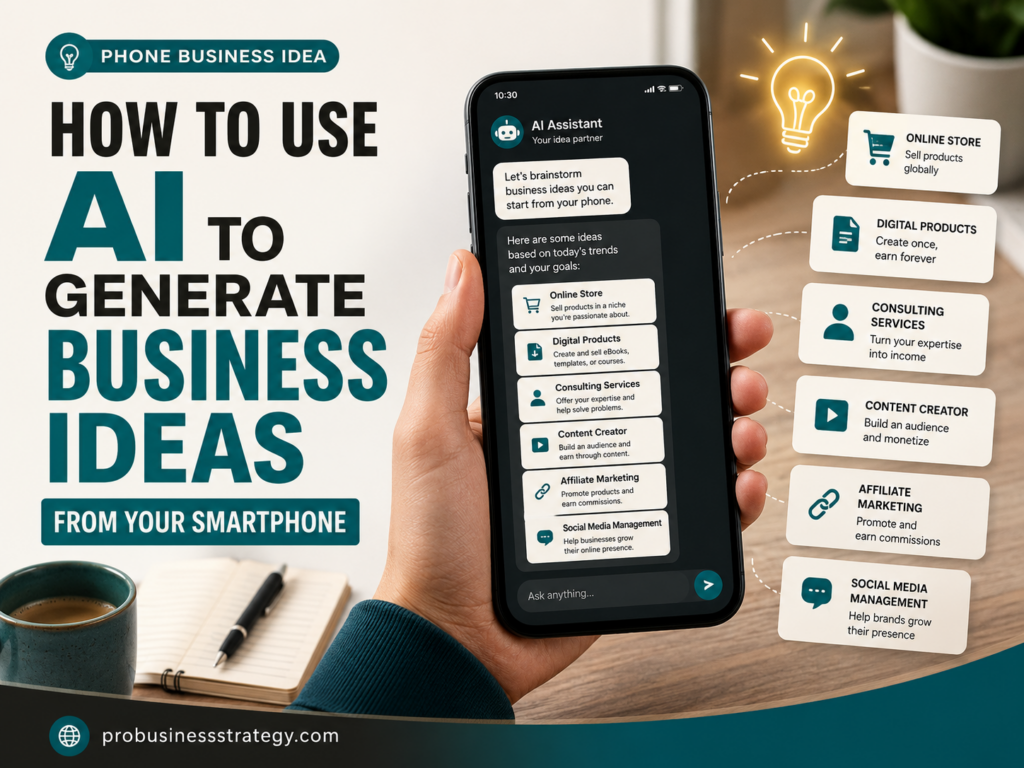
Most people think business ideas come from long brainstorming sessions, expensive courses, big notebooks or complicated market research.
But today, you can start generating serious business ideas from something you already carry in your pocket: your smartphone.
With AI tools like ChatGPT, Perplexity and other mobile-friendly research tools, your phone can become a small business idea lab. You can use it to brainstorm ideas, research problems, compare niches, create business models, find content angles and turn vague thoughts into practical business opportunities.
This does not mean AI will magically build the business for you.
It means AI can help you think faster, ask better questions and organize your ideas in a way that makes it easier to take action.
For someone who wants to start a small online business, side hustle or phone-based business, this is powerful. You do not need a full office. You do not need expensive software. You do not even need to know exactly what business you want yet.
You only need your phone, an AI tool and a simple system.
In this guide, you will learn how to use AI from your smartphone to generate business ideas that actually make sense.
Affiliate disclosure: This post contains affiliate links. If you make a purchase through one of these links, ProBusinessStrategy may earn a small commission at no extra cost to you. We only recommend tools we genuinely believe in.
Why Your Smartphone Is Enough to Start Brainstorming Business Ideas
Your smartphone is not just a communication device anymore. It is a research tool, writing tool, video studio, design assistant, note-taking system, marketing dashboard and AI business assistant in one.
That makes it perfect for the early stage of business idea generation.
At the beginning, you are not trying to build a full company. You are trying to answer simple questions:
What problems do people have?
What skills do I already have?
What can I learn quickly?
What can I sell online?
What can I start with low cost?
What kind of business fits my life?
What kind of audience could I serve?
Before AI, answering these questions often took a lot of time. You had to search Google, watch many videos, read blog posts, write notes and organize everything manually.
Now you can use AI to speed up the thinking process.
For example, from your smartphone you can ask:
“Give me 20 low-cost business ideas I can start from my phone.”
“Give me business ideas for someone who likes writing, research and digital products.”
“What are common problems small business owners have that I could solve with a simple service?”
“Give me business ideas for beginners who do not want to show their face online.”
“Turn my interests into possible online business ideas.”
This is where AI becomes useful. Not because every answer will be perfect, but because it gives you starting points.
And starting points are often the hardest part.
Step 1: Start With Your Personal Situation
The biggest mistake people make when using AI for business ideas is asking too broadly.
For example:
“Give me business ideas.”
That will usually produce generic answers like dropshipping, freelancing, affiliate marketing, print-on-demand or social media management.
Those ideas are not necessarily bad, but they are too broad.
A better method is to give AI your personal situation first.
Use a prompt like this:
Prompt:
“I want to start a small online business from my smartphone. I have limited money, limited time and I am a beginner. I am interested in [your interests]. I have some experience with [your skills]. Give me 25 realistic business ideas that fit this situation.”
This works better because AI now has context.
Instead of giving you random ideas, it can connect the ideas to your skills, interests and limitations.
You can also make the prompt more specific:
“I work full time and only have one hour per day. Give me simple phone-based business ideas I can build slowly.”
“I do not want to show my face online. Give me business ideas that can be built with writing, AI tools and content.”
“I want business ideas that can become blog posts, digital products or affiliate content.”
“I want to help beginners start small businesses. Give me phone-based business ideas around that audience.”
The more specific you are, the better the ideas become.
AI works best when you treat it like a business brainstorming partner, not like a magic answer machine.
Step 2: Ask AI for Problems, Not Only Business Ideas
Many beginners search for business ideas.
But experienced entrepreneurs often search for problems.
A business idea becomes stronger when it solves a real problem.
For example, “start a blog” is not really a business idea by itself.
But “create a simple blog that helps beginners find phone-based business ideas they can start with low startup costs” is much clearer.
The second version has:
A target audience.
A problem.
A content direction.
A possible monetization angle.
A reason to exist.
So instead of only asking AI for business ideas, ask for problems.
Use prompts like:
Prompt:
“Give me 30 common problems beginners face when trying to start an online business from their phone.”
Prompt:
“What problems do people have when they want to start a side hustle but have no money, no website and no experience?”
Prompt:
“What problems do small business owners have that could be solved with a simple service from a smartphone?”
This is where the quality of your ideas improves.
AI might give you problems like:
People do not know what business to start.
People do not know how to create content consistently.
People do not know how to choose a niche.
People do not know how to make simple graphics.
People do not know how to write product descriptions.
People do not know how to answer customer messages.
People do not know how to set up basic email campaigns.
Each problem can become a business idea.
For example:
Problem: Small business owners do not have time to write social media posts.
Business idea: Offer weekly social media caption packages from your phone.
Problem: Beginners do not know what business to start.
Business idea: Create a digital guide with 100 phone-based business ideas.
Problem: Local businesses do not respond quickly to customer questions.
Business idea: Set up AI-assisted customer reply templates for them.
This is much stronger than simply collecting random ideas.
Step 3: Use AI to Match Ideas With Your Skills
A business idea is only useful if you can actually do something with it.
That does not mean you need to be an expert. But the idea should connect to something you can learn, create or deliver.
From your phone, you can ask AI to match business ideas with your current skills.
Use this prompt:
Prompt:
“Here are my skills: [list your skills]. Here are my interests: [list your interests]. Give me business ideas that match both. For each idea, explain why it fits me, how I could start from my phone and how it could make money.”
This gives you a more useful list.
For example, if you are good at writing, AI might suggest:
Blog content services.
Newsletter writing.
Pinterest pin description writing.
Digital guide creation.
Affiliate content websites.
AI-assisted copywriting services.
If you like research, AI might suggest:
Niche research reports.
Product comparison content.
Business idea databases.
Trend research newsletters.
Affiliate product research.
If you like design, AI might suggest:
Canva template shops.
Social media post packages.
Pinterest pin design services.
Digital product mockups.
Simple branding kits.
The goal is not to choose the most exciting idea immediately.
The goal is to find ideas that match your energy.
A simple business idea that fits you is usually better than a trendy business idea you will quit after three days.
Step 4: Ask AI to Turn One Idea Into Multiple Versions
Sometimes one idea is too broad.
For example:
“Start a digital product business.”
That is too vague.
What kind of digital product? For whom? About what topic? At what price? Sold where?
This is where AI can help you create variations.
Use this prompt:
Prompt:
“Take this business idea: [your idea]. Give me 20 smaller, more specific versions of this idea that I could start from my smartphone.”
For example, if your idea is “digital products for beginners,” AI might suggest:
A checklist for starting a phone-based business.
A beginner guide to using AI for business ideas.
A Notion template for tracking business ideas.
A Canva template pack for social media posts.
A spreadsheet of niche business ideas.
A simple workbook for choosing your first business idea.
A prompt pack for generating blog post ideas.
A content calendar for new entrepreneurs.
Now the idea becomes clearer.
Instead of trying to build a huge business, you can start with one small asset.
That asset can become a blog post, digital product, lead magnet, social media series or affiliate article.
This is especially useful for a phone-based business because small digital products can often be planned, written and promoted from a smartphone.
Step 5: Use AI to Filter Bad Ideas
Not every AI-generated idea is good.
Some ideas are too competitive.
Some require money you do not have.
Some require technical skills.
Some sound interesting but have no clear buyer.
Some are just trendy but not practical.
That is why you should not only ask AI to generate ideas. You should also ask AI to criticize them.
Use this prompt:
Prompt:
“Review these business ideas. For each one, rate it from 1 to 10 for beginner-friendliness, startup cost, phone-based potential, monetization potential and difficulty. Then tell me which 5 ideas are the most realistic.”
This helps you avoid falling in love with a bad idea too quickly.
You can also ask:
Prompt:
“Which of these ideas are too difficult for a beginner and why?”
Prompt:
“Which ideas could be started with less than $100?”
Prompt:
“Which ideas could be tested in 7 days?”
Prompt:
“Which ideas could become blog posts, affiliate articles or digital products?”
This is a simple way to make AI more useful.
Do not only use AI for imagination.
Use it for judgment.
Step 6: Use Perplexity or Search-Based AI for Research
Tools like ChatGPT are useful for brainstorming and structuring ideas.
Search-based AI tools, such as Perplexity, can be useful for research because they can help you explore what people are already searching for, discussing and buying.
From your smartphone, you can research questions like:
Are people interested in this topic?
Are there existing products?
Are there blogs or YouTube channels around this niche?
Are people asking questions about this problem?
Are companies already spending money in this space?
For example, if AI gives you the idea “AI-powered resume writing service from your phone,” you could research:
What do people struggle with when writing resumes?
Are there popular resume tools?
Are job seekers searching for resume help?
Are there affiliate programs in the career niche?
What kind of content already ranks on Google?
This helps you separate a fun idea from a real opportunity.
A business idea does not need to be completely original. In fact, if there are already products, services and content around the topic, that may be a good sign.
It means people care.
The goal is not to find an idea nobody has ever seen before.
The goal is to find a useful angle you can execute better, simpler or more specifically.
Step 7: Turn AI Ideas Into Content Ideas
One of the easiest ways to test a business idea is to create content around it.
You do not need to build the full business first.
You can create a blog post, Pinterest Pin, YouTube Short, TikTok video, Facebook post or simple guide around the idea and see if people respond.
For example, if AI gives you the idea:
“Use your phone to create digital products for local businesses.”
You can turn that into content like:
“How to Create Simple Digital Products From Your Phone”
“5 Digital Products Local Businesses Might Pay For”
“How to Use AI and Canva to Create Business Templates”
“Can You Start a Digital Product Business From Your Smartphone?”
“Simple Digital Product Ideas for Beginners With No Experience”
Each content piece tests the market.
If people click, save, comment or search for the topic, that gives you a signal.
This is one reason phone-based business ideas work well with content marketing. Your phone can help you brainstorm, write, design, publish and promote.
For a deeper starting point, you can also connect this with your broader phone-based business strategy through articles like 50 Businesses You Can Run from Your Phone and How to Use ChatGPT from Your Phone for Business.
Step 8: Ask AI for a Simple Business Model
A business idea is not complete until you understand how it could make money.
So after AI gives you an idea, ask it to create a simple business model.
Use this prompt:
Prompt:
“Turn this idea into a simple business model: [idea]. Explain the target audience, the problem, the offer, the price range, the first product or service, the easiest way to promote it from a phone and the first 7 steps to test it.”
This turns an idea into a plan.
For example, if the idea is “AI-assisted social media captions for small businesses,” the model might look like this:
Target audience: Local business owners.
Problem: They do not have time to post consistently.
Offer: Weekly caption packs.
Price: Monthly package.
Promotion: Facebook groups, Instagram outreach, local networking.
First step: Create sample captions for three types of businesses.
Now the idea is no longer just an idea.
It has shape.
You can then ask AI:
“Make this simpler.”
“Make this more beginner-friendly.”
“Make this possible from only a smartphone.”
“Give me a 7-day test plan.”
“Give me a content plan to promote this.”
This is where AI becomes a practical business planning tool.
Step 9: Build an Idea List on Your Phone
One of the best habits you can create is keeping a business idea list on your phone.
Use Notes, Google Docs, Notion, a spreadsheet or any simple app you like.
Every time AI gives you an interesting idea, save it.
But do not only save the title.
Save it in a simple format:
Business idea.
Target audience.
Problem solved.
Possible offer.
Startup cost.
Difficulty.
Monetization method.
First test.
Content ideas.
This creates your personal business idea database.
Over time, you will start seeing patterns.
Maybe you keep saving ideas around AI.
Maybe you keep saving ideas around digital products.
Maybe you keep saving ideas around helping beginners.
Maybe you keep saving ideas around content creation or affiliate marketing.
That pattern matters.
It tells you what kind of business direction naturally fits you.
Your best idea may not come from one AI prompt.
It may come from looking at 50 ideas and noticing the same theme again and again.
Step 10: Do Not Let AI Replace Your Own Judgment
AI can generate ideas quickly, but you still need to think.
You need to ask:
Would I actually enjoy working on this?
Can I start this with my current time and money?
Do people already pay for this problem?
Can I create content around this for months?
Can this become a product, service or affiliate business?
Is the idea simple enough to test?
Would this help a real person?
AI can help you organize the thinking, but it cannot care for you.
It cannot know your real life fully.
It cannot guarantee that an idea will work.
That is why the best method is not to ask AI for one perfect business idea.
The best method is to use AI to create options, filter them, test them and improve them.
Your smartphone becomes the control center.
AI becomes the assistant.
You are still the entrepreneur.
Example: A Complete Smartphone AI Brainstorm
Here is what a simple AI brainstorming session could look like from your phone.
First prompt:
“I want to start a low-cost online business from my smartphone. I am a beginner and I like AI tools, writing and helping people find business ideas. Give me 25 ideas.”
Second prompt:
“Choose the 10 most realistic ideas for someone with limited time and no big budget.”
Third prompt:
“For each idea, explain how it could make money.”
Fourth prompt:
“Which 3 ideas could be tested with blog posts and Pinterest Pins?”
Fifth prompt:
“Create a 7-day test plan for the best idea.”
Sixth prompt:
“Give me 10 article titles for this idea.”
Seventh prompt:
“Give me a simple offer I could create around this idea.”
In less than one hour, you could have:
A list of possible business ideas.
A filtered shortlist.
A simple business model.
A content plan.
A test plan.
A first offer.
That is the real power of AI on your phone.
Not instant success.
But faster thinking.
Simple AI Prompt Pack for Business Ideas
You can copy these prompts into ChatGPT or another AI tool from your phone.
Prompt 1: Personal idea generation
“Give me 30 business ideas I can start from my smartphone. I am a beginner, I have limited money and I want ideas that can be started online.”
Prompt 2: Skill-based ideas
“Here are my skills: [add skills]. Here are my interests: [add interests]. Give me phone-based business ideas that match both.”
Prompt 3: Problem-based ideas
“Give me 25 problems people have in [niche] that could become simple online business ideas.”
Prompt 4: Low-cost filter
“Which of these ideas can be started for less than $100 and tested in 7 days?”
Prompt 5: Monetization
“For each idea, explain how it could make money through services, digital products, affiliate marketing or content.”
Prompt 6: Content testing
“Turn this business idea into 10 blog post ideas, 10 Pinterest Pin ideas and 10 short video ideas.”
Prompt 7: Business model
“Turn this idea into a simple business model with target audience, offer, price, promotion method and first 7 steps.”
Prompt 8: Reality check
“Criticize this business idea. What are the risks, weaknesses and reasons it might fail?”
Prompt 9: Simpler version
“Make this business idea easier, cheaper and more beginner-friendly.”
Prompt 10: First action
“What is the first small action I can take today from my smartphone to test this idea?”
Best Types of Business Ideas to Generate With AI From Your Phone
AI can help with almost any idea, but some categories work especially well for smartphone-based business brainstorming.
1. Content Businesses
These include blogs, YouTube channels, TikTok accounts, Pinterest accounts, newsletters and niche media sites.
AI can help you generate topics, outlines, hooks, captions and content calendars.
A good example is building a focused content channel around one subject, such as phone-based business ideas, AI tools for beginners or simple online income models.
You can also connect this direction with How to Create a YouTube Affiliate Channel from Your Smartphone.
2. Digital Product Ideas
AI can help you brainstorm checklists, templates, guides, spreadsheets, prompt packs and planners.
These are attractive because they can often be created once and sold many times.
Your phone can be used for research, writing, editing, designing and publishing the first version.
3. Simple Service Businesses
AI can help you create service ideas like:
Social media caption writing.
Blog post outlining.
Email newsletter drafting.
Customer reply templates.
Local business content packages.
Research summaries.
Product description writing.
These services can often be started without a big budget.
4. Affiliate Content Ideas
AI can help you brainstorm comparison articles, buyer guides, tutorials and niche content around products or tools.
The key is to focus on helping the reader make a better decision, not just promoting products.
5. AI-Assisted Local Business Services
Many local businesses do not know how to use AI yet.
You could use your phone to create simple offers around:
AI content ideas.
Google Business Profile post ideas.
FAQ writing.
Social media planning.
Customer message templates.
Simple website content drafts.
This can become a practical service business if you can show clear examples.
Final Thoughts
Using AI to generate business ideas from your smartphone is not about collecting random ideas all day.
It is about building a simple system.
Start with your personal situation.
Ask AI for problems.
Match ideas with your skills.
Create specific versions.
Filter the weak ideas.
Research the strongest ones.
Turn them into content.
Create a simple business model.
Test one small idea before moving to the next.
That is how your smartphone becomes more than a device for scrolling.
It becomes a business idea machine.
You do not need to know the perfect idea before you start. You only need a process that helps you find, shape and test better ideas.
With AI in your pocket, that process is now easier than ever.
Related Articles
50 Businesses You Can Run from Your Phone
How to Use ChatGPT from Your Phone for Business
How to Create a YouTube Affiliate Channel from Your Smartphone


This is a practical guide. Starting with your personal situation instead of asking generic prompts makes a big difference. For anyone looking for an all-in-one tool, DeepAI is worth checking out—it covers chat, image and video generation, which is handy for brainstorming and visualizing ideas right from your phone. The key is to treat AI as a thinking partner, not a magic solution. Good read.
Great breakdown of how simple prompt context can turn a phone into a practical brainstorming tool. The tip about giving AI your personal situation instead of asking for generic ideas is especially useful — it works for visual concepts too, not just business plans. Along the same lines, you can explore original tattoo concepts with an tattoo-ai.app before deciding on a final design. That kind of quick visual iteration fits perfectly with the low-cost, phone-first approach you describe.
The emphasis on controllability is well placed. Consistent composition is often a stronger test than the single best-looking sample. That is where AI starts to feel like a workflow tool rather than a novelty.