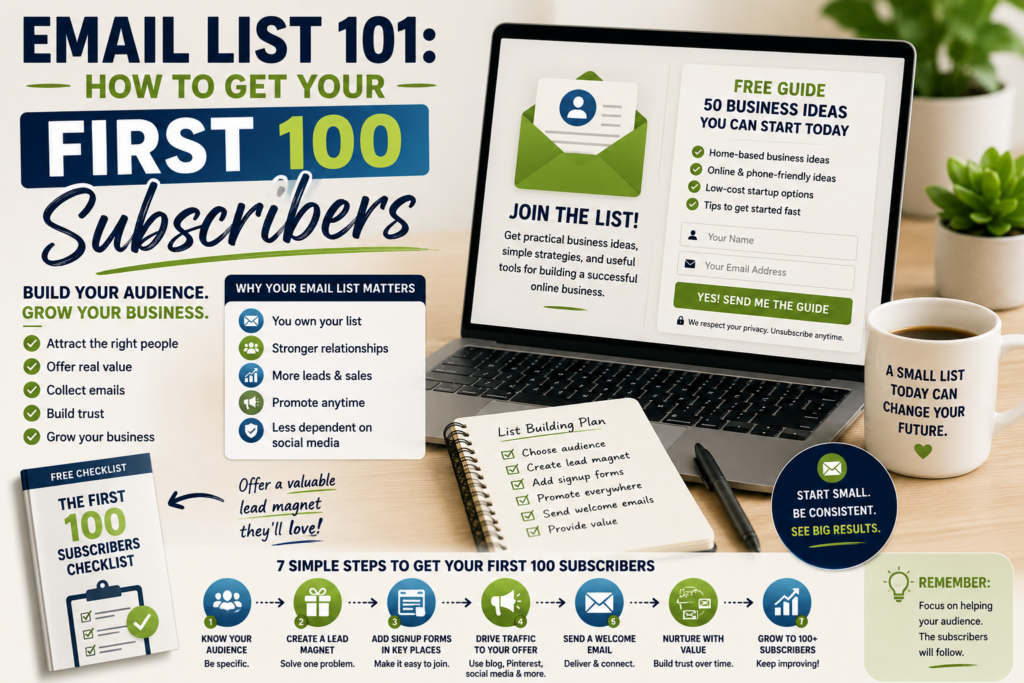
Getting your first 100 email subscribers can feel harder than getting your first 1,000 social media views.
A post can get likes.
A Pin can get impressions.
A TikTok can get views.
A YouTube Short can get attention.
But an email subscriber is different.
Someone who joins your email list is giving you permission to contact them again. That is a much stronger relationship than a casual social media view.
This is why your first 100 subscribers matter.
Not because 100 is a huge number.
But because it proves something important:
People are interested enough in your topic to stay connected.
For a beginner entrepreneur, blogger, affiliate marketer, digital product creator, service provider, or home-based business owner, that is a serious milestone.
You do not need a massive audience to start building an email list.
You need a clear promise, a useful reason to subscribe, and a simple system that turns visitors into subscribers.
Affiliate disclosure: This post contains affiliate links. If you make a purchase through one of these links, ProBusinessStrategy may earn a small commission at no extra cost to you. We only recommend tools we genuinely believe in.
Why Your First 100 Subscribers Matter
Many beginners think email marketing only matters after they already have traffic.
That is a mistake.
You do not build an email list after the business becomes successful.
You build the email list so the business has a better chance of becoming successful.
Your first 100 subscribers can help you:
Send traffic back to new articles
Promote affiliate products naturally
Test business ideas
Launch digital products
Ask your audience questions
Build trust over time
Create repeat visitors
Reduce dependence on social media
Turn casual readers into loyal followers
Social media platforms are useful, but they are not fully yours.
Your Pinterest account is on Pinterest.
Your TikTok account is on TikTok.
Your YouTube channel is on YouTube.
Your LinkedIn profile is on LinkedIn.
Your email list gives you more control.
That does not mean email replaces social media.
It means social media should help feed your email list.
The Biggest Mistake Beginners Make
The biggest mistake is adding a generic signup form that says:
“Subscribe to our newsletter.”
That is weak.
Most people do not wake up thinking:
“I hope I can subscribe to another newsletter today.”
They need a reason.
A better email signup promise would be:
“Get simple business ideas you can start from home.”
Or:
“Get the free checklist for choosing your first online business idea.”
Or:
“Get weekly ideas for building a small business with AI, Pinterest, affiliate marketing, and digital products.”
The more specific the promise, the better.
People subscribe when they understand what they will get.
Step 1: Choose One Clear Audience
Before building your email list, decide who it is for.
Not everyone.
One clear audience.
Examples:
Beginner entrepreneurs
Solopreneurs
People starting a business from home
People who want phone-based business ideas
People interested in affiliate marketing
People building a Pinterest business
People creating digital products
People who want AI business ideas
People who want out-of-the-box business ideas
If your site is about business ideas, your email list should not feel random.
A strong direction could be:
Join the list for practical business ideas, simple startup strategies, and tools for building a small online business.
That is clear.
It tells the visitor what they are signing up for.
Step 2: Create a Simple Lead Magnet
A lead magnet is a free resource someone receives after joining your email list.
It does not need to be complicated.
In fact, simple usually works better.
Good beginner lead magnets include:
Checklist
One-page guide
PDF list
Worksheet
Template
Resource list
Mini planner
Cheat sheet
Email course
Starter guide
The goal is not to create a 100-page e-book.
The goal is to solve one small problem quickly.
For example:
“50 Business Ideas You Can Start From Home”
“Business Idea Validation Checklist”
“First 100 Subscribers Checklist”
“Pinterest Business Starter Checklist”
“AI Business Ideas Starter Guide”
“Phone Business Setup Checklist”
“Affiliate Website Starter Checklist”
A lead magnet should be easy to understand and easy to use.
If the visitor has to think too hard, they may not subscribe.
Step 3: Put the Signup Form in the Right Places
A signup form only works if people see it.
Good places to add an email signup form include:
Top of relevant articles
Middle of long articles
End of articles
Sidebar
Homepage section
Resource page
About page
Exit-intent popup
Landing page
Pinterest traffic page
Footer
For a blog, the end of an article is especially important.
If someone reads the full article, they are more interested than a random visitor. That is a good time to invite them to subscribe.
Example:
“If you enjoyed this guide, join the email list for more practical business ideas and simple growth strategies.”
You can also create topic-specific signup boxes.
For example:
On Pinterest articles:
“Get more Pinterest business ideas and traffic tips.”
On Phone Business articles:
“Get business ideas you can build from your phone.”
On AI articles:
“Get AI business ideas and simple tools for solopreneurs.”
Specific signup forms can convert better than generic ones.
Step 4: Use Your Blog Posts to Collect Subscribers
Every article should have a job.
Some articles attract traffic.
Some build trust.
Some recommend affiliate products.
Some explain business ideas.
Some should also help grow your email list.
A blog post about home-based business can invite readers to join a list about starting from home.
A blog post about Pinterest affiliate marketing can invite readers to get a Pinterest checklist.
A blog post about AI from your phone can invite readers to get an AI mobile business starter guide.
This is how content becomes a list-building machine.
The formula is simple:
Article topic
Relevant lead magnet
Signup form
Welcome email
Future follow-up
Do not treat the email list as separate from the content.
The content should feed the list.
Step 5: Create a Dedicated Landing Page
A landing page is a page with one purpose:
Get subscribers.
It should be simple.
A good landing page includes:
Clear headline
Short explanation
What the subscriber gets
Signup form
Simple visual
Trust-building sentence
No distractions
Example headline:
Get Simple Business Ideas You Can Start From Home
Subheadline:
Join the email list and get practical ideas, tools, and beginner-friendly strategies for building a small business online.
Bullet points:
Business ideas
Affiliate marketing tips
AI tools for entrepreneurs
Pinterest traffic ideas
Home-based business strategies
Digital product ideas
Then the signup form.
This page can be shared from Pinterest, TikTok, LinkedIn, YouTube descriptions, blog posts, and your site menu.
If someone is serious about building an online business, they need a website that can host landing pages, articles, resource pages, and signup forms. A domain from Namecheap and hosting through Bluehost can create that foundation.
Step 6: Promote the Lead Magnet on Pinterest
Pinterest can be a strong list-building tool because people use it to search for ideas.
You can create Pins that promote your lead magnet directly or indirectly.
Examples:
Free Business Idea Checklist
Start a Business From Home: Free Guide
Pinterest Business Starter Checklist
50 Business Ideas for Beginners
AI Business Ideas for Solopreneurs
Phone Business Starter Guide
Affiliate Website Checklist
The Pin should send people to a landing page or a relevant article with a signup form.
Do not send Pinterest traffic to a confusing page.
Make the next step obvious.
Pinterest works best when the promise is clear and visual.
Step 7: Use Social Media to Drive Subscribers, Not Just Views
Social media views are nice, but they can disappear fast.
A better strategy is to use social media as a path to your email list.
For example:
TikTok video: “3 business ideas you can start without showing your face.”
Call-to-action: “Get the full list on my site.”
Pinterest Pin: “50 business ideas you can run from your phone.”
Call-to-action: “Read the full guide and join the list.”
LinkedIn post: “Why cold DM spam is not the only way to build a LinkedIn business.”
Call-to-action: “Get more ethical business growth ideas by email.”
YouTube Short: “One business idea from your phone.”
Call-to-action: “Full guide linked in the description.”
The goal is not only platform growth.
The goal is business growth.
Email helps connect the platforms to your own system.
Step 8: Create a Welcome Email
When someone subscribes, do not leave them waiting.
Send a welcome email.
This first email should do three things:
Deliver the promised resource
Tell them what to expect
Invite them to take one simple next step
A simple welcome email could say:
“Thanks for joining. Here is your checklist. I will send you practical business ideas, simple marketing strategies, and tools for building a small online business. A good place to start is this guide.”
Then link to one strong article.
This is important because the first email sets the tone.
Do not make it too complicated.
Make the subscriber feel they made a good decision.
Step 9: Build a Simple 5-Email Welcome Sequence
After the first welcome email, you can create a short sequence.
Example:
Email 1: Welcome and free resource
Email 2: Best beginner business idea guide
Email 3: Common mistake beginners make
Email 4: Helpful tools and resources
Email 5: Your next step
This builds trust automatically.
You do not need to manually email every new subscriber.
A sequence helps new subscribers understand your site, your topics, and your value.
If you are writing from your phone, AI can help draft and improve these emails. That connects well with the process explained in How to Use AI to Write Email Campaigns from Your Phone.
Step 10: Make Your Signup Promise Specific
A specific promise beats a vague promise.
Weak:
“Join my newsletter.”
Better:
“Get beginner-friendly business ideas and simple growth strategies.”
Even better:
“Get weekly ideas for starting a small online business with AI, Pinterest, affiliate marketing, and digital products.”
Specificity creates trust.
It tells people why they should join.
The best email list promise answers:
Who is it for?
What will they receive?
How often will they receive it?
Why should they care?
Example:
Join the ProBusinessStrategy email list for practical business ideas, simple marketing strategies, and tools for building a small business online.
That is clear and connected to the site.
Step 11: Use Content Upgrades
A content upgrade is a lead magnet that matches one article.
For example:
Article: How to Separate Work & Life When You Work From Home
Content upgrade: Work-from-home boundary checklist
Article: Pinterest Affiliate Marketing Ideas for Home Office Products
Content upgrade: Home office affiliate content idea list
Article: How to Use AI for Market Research from Your Smartphone
Content upgrade: AI market research prompt sheet
Article: TikTok Business Ideas for People Who Hate Being on Camera
Content upgrade: Faceless TikTok content checklist
Content upgrades can work well because they are highly relevant.
The reader is already interested in the topic.
The free resource helps them take the next step.
Step 12: Ask for Subscribers at the Right Moment
Do not be afraid to ask.
If your content is useful, it is normal to invite readers to join your list.
Good places to ask:
After explaining a key idea
After giving a checklist
At the end of an article
Inside a resource page
On your homepage
In your Pinterest profile
In your social media bio
In your YouTube video description
But keep the tone natural.
Do not pressure people.
Invite them.
Example:
“If you want more beginner-friendly business ideas and simple marketing strategies, join the email list.”
That is enough.
Step 13: Track What Works
To get your first 100 subscribers, you need to pay attention.
Track:
Which articles bring subscribers
Which signup forms convert
Which lead magnet works best
Which Pins send traffic
Which landing page gets signups
Which email subject lines get opens
Which links get clicks
You do not need advanced analytics at the beginning.
Even simple observation helps.
If your Pinterest articles bring the most subscribers, create more Pinterest content.
If phone business articles work well, create more phone-based lead magnets.
If AI articles get attention, build an AI business starter guide.
The market will show you what people want.
Step 14: Do Not Wait for Perfect Design
Many beginners delay list-building because they want the perfect email design.
You do not need perfection.
You need:
A useful promise
A simple form
A helpful lead magnet
A welcome email
Consistent traffic
A plain email with useful content is better than a beautiful design with no value.
Start simple.
Improve later.
If you need help with lead magnet design, email templates, landing page graphics, or branding, Fiverr can be useful for small outsourced tasks.
But do not let design stop you from starting.
Step 15: Create a Weekly Email Habit
Once people subscribe, you need to stay in touch.
You do not need to email every day.
A simple weekly email can be enough.
A good weekly format:
One useful business idea
One practical tip
One new article
One recommended tool
One question to think about
This keeps your list alive.
If subscribers do not hear from you for months, they may forget why they joined.
Consistency builds familiarity.
Familiarity builds trust.
Trust creates clicks, sales, replies, and long-term value.
How to Get Your First 100 Subscribers Step by Step
Here is a simple plan.
Subscribers 1 to 10
Start with your existing website visitors.
Add signup forms to your best articles.
Create one simple lead magnet.
Add the form to your homepage.
Add a link in your site menu or footer.
Send traffic from Pinterest or social media.
Subscribers 11 to 25
Create a dedicated landing page.
Promote it from Pinterest, blog posts, and social bios.
Create several Pins for the lead magnet.
Mention the email list in related articles.
Subscribers 26 to 50
Add content upgrades to high-traffic articles.
Create topic-specific signup forms.
Test different headlines.
Improve the welcome email.
Subscribers 51 to 100
Publish more articles connected to the lead magnet.
Create more Pins.
Mention the list consistently.
Add a simple weekly email.
Create a second lead magnet if needed.
This is not complicated.
It is repetition.
Traffic plus a clear signup offer equals subscribers.
What to Send Your First 100 Subscribers
Your first subscribers do not need fancy campaigns.
They need useful content.
You can send:
New article announcements
Business idea breakdowns
Beginner tips
Checklists
Tool recommendations
Affiliate resources
Behind-the-scenes lessons
Common mistakes
Simple action plans
Questions for feedback
Do not only sell.
Help first.
If you help consistently, people are more likely to trust your recommendations later.
Common Mistakes to Avoid
Mistake 1: No Clear Reason to Subscribe
“Subscribe” is not enough.
Give people a reason.
Mistake 2: Hiding the Signup Form
If the form is only in the footer, many visitors will never see it.
Place it inside relevant content.
Mistake 3: Creating a Lead Magnet Nobody Wants
Do not create a random freebie.
Match it to your audience’s problem.
Mistake 4: Not Sending a Welcome Email
A subscriber should hear from you immediately.
Mistake 5: Only Chasing Social Media Followers
Followers are useful, but subscribers are more valuable for long-term business.
Mistake 6: Making Emails Too Sales-Heavy
Your list should not feel like a constant sales channel.
Teach, guide, and recommend naturally.
Best Lead Magnet Ideas for a Business Ideas Website
For a site like ProBusinessStrategy, strong lead magnets could include:
50 business ideas you can start from home
AI business ideas starter guide
Phone business checklist
Pinterest business starter checklist
Affiliate marketing beginner checklist
Digital product idea worksheet
Business idea validation checklist
Home-based business setup checklist
First website planning worksheet
Out-of-the-box business ideas list
These fit the site naturally.
They are also useful for beginners.
Why 100 Subscribers Is a Real Milestone
Your first 100 subscribers prove that your topic has interest.
They also give you a small audience to learn from.
You can ask:
What kind of business are you trying to start?
What is your biggest problem right now?
Which topic do you want more help with?
Are you interested in affiliate marketing, digital products, AI, or home-based business ideas?
The answers can help shape future content.
That is the hidden value of an email list.
It is not only for sending.
It is also for listening.
Final Thoughts
Getting your first 100 email subscribers does not require a huge audience.
It requires a simple system.
Choose a clear audience.
Create a useful lead magnet.
Add signup forms to your best content.
Build a landing page.
Promote it with Pinterest and social media.
Send a welcome email.
Stay consistent.
Your first 100 subscribers may not make you rich.
But they can give your business something very important:
A direct connection with people who want to hear from you again.
That is the beginning of real audience ownership.
And for a beginner entrepreneur, that is worth building as early as possible.
Internal Linking
Related Articles:
How to Use AI to Write Email Campaigns from Your Phone
How to Use ChatGPT from Your Phone for Business