Working from home sounds like freedom.
No commute.
No office noise.
No manager walking past your desk.
No fixed lunch break.
No need to dress formally every day.
No wasted time in traffic.
For many people, that sounds like the perfect business lifestyle.
But there is another side.
When your home becomes your workplace, work can slowly enter every part of your life.
Your laptop stays open at dinner.
Your phone keeps buzzing in the evening.
You answer emails from the sofa.
You think about clients while spending time with family.
You check messages before bed.
You feel guilty when you rest because there is always something else to do.
That is the hidden challenge of working from home.
The problem is not only productivity.
The real problem is separation.
If you do not create boundaries, your home business can take over your home life.
That is why learning how to separate work and life when you work from home is one of the most important skills for home-based entrepreneurs, freelancers, solopreneurs, remote workers, bloggers, consultants, and digital business owners.
You do not need a perfect office.
You need a clear system.
Affiliate disclosure: This post contains affiliate links. If you make a purchase through one of these links, ProBusinessStrategy may earn a small commission at no extra cost to you. We only recommend tools we genuinely believe in.
Why Work-Life Separation Matters
When you work outside the home, separation happens naturally.
You leave the house.
You arrive at work.
You do your job.
You leave the workplace.
You return home.
The building creates a boundary.
When you work from home, that boundary disappears.
Your desk may be next to your bed.
Your kitchen table may become your office.
Your phone may be both personal and professional.
Your living room may become your meeting room.
Your family may see you at home and assume you are available.
Without structure, everything blends together.
This can create several problems:
You work longer than planned.
You rest less than you need.
You feel distracted during work.
You feel guilty during free time.
You struggle to switch off.
You lose focus because home tasks interrupt work.
You lose peace because work tasks interrupt home life.
A home-based business should give you more freedom, not less peace.
But that only happens when you protect both sides: your work and your personal life.
The Biggest Mistake: Thinking Flexibility Means No Structure
Many people start working from home because they want flexibility.
That is understandable.
But flexibility does not mean having no structure.
If every hour is open, every hour can become work.
That is not freedom.
That is quiet chaos.
A flexible work-from-home life still needs rules.
Not rigid corporate rules, but personal operating rules.
For example:
When do you start work?
When do you stop work?
Where do you work?
When do you answer messages?
When are you unavailable?
What counts as real work?
What can wait until tomorrow?
What time belongs to your family?
What time belongs to rest?
If you do not decide these things, your business will decide for you.
And your business will usually ask for more.
Create a Physical Work Zone
The first step is creating a physical work zone.
This does not have to be a full office.
It can be:
A small desk
A corner of the bedroom
A kitchen table during certain hours
A foldable desk
A chair near a window
A specific part of the living room
A small shelf with your work tools
A mobile setup you put away after work
The point is not luxury.
The point is association.
Your brain needs a signal:
“This is where work happens.”
When you always work from bed, the sofa, the dining table, and the kitchen counter, your brain never knows when work is finished.
A defined work zone helps you start and stop.
If you have a small home, make the work zone temporary.
For example:
You open your laptop at 9 AM.
You place your notebook, mouse, and phone stand on the table.
You work there during your work block.
At the end of the day, you put everything away.
That simple ritual tells your brain:
Work is done.
If you are building a home-based business and need a basic website to support your work, a simple domain from Namecheap and a WordPress setup through Bluehost can help you create a business home online, while your physical home stays more organized.
Set Clear Work Hours
One of the most dangerous things about working from home is the feeling that you can always work later.
You may say:
“I will finish it tonight.”
Then tonight becomes late night.
Then late night becomes normal.
Then your workday never really ends.
Set work hours, even if they are flexible.
For example:
9 AM to 1 PM for deep work
2 PM to 4 PM for admin and email
Evening only for light planning
No client messages after 6 PM
No work on Sunday morning
No laptop in bed
Your schedule does not have to look like a normal office schedule.
It only needs to be clear.
If you work around a full-time job, children, family, or other responsibilities, your work hours may be unusual. That is fine.
You might work:
6 AM to 8 AM
8 PM to 10 PM
Saturday morning
Three focused blocks per week
One hour every evening
The key is to define the block.
A defined work block is easier to protect than vague ambition.
Use a Start Ritual and Stop Ritual
When you work from home, you need signals.
A start ritual tells your brain:
Now I am working.
A stop ritual tells your brain:
Now I am finished.
Your start ritual could be:
Make coffee
Open your notebook
Write the top three tasks
Put your phone on focus mode
Open only the tools you need
Start a timer
Play the same background music
Your stop ritual could be:
Close all work tabs
Write tomorrow’s first task
Check your calendar
Shut down the laptop
Clear the desk
Put work materials away
Take a short walk
Change clothes
This may sound small, but it is powerful.
When you do not commute, you need another way to transition between work mode and life mode.
A ritual creates that transition.
Separate Your Work Phone and Personal Phone Habits
You may not need two phones.
But you do need separation.
If the same smartphone handles family messages, business emails, social media, content creation, banking, client messages, and entertainment, it can become a constant source of stress.
Create rules for your phone.
For example:
Turn off non-essential notifications.
Use focus mode during work blocks.
Check business email only at set times.
Do not answer business messages during dinner.
Keep work apps off the home screen.
Use separate folders for business tools.
Avoid checking analytics before bed.
If your business is phone-based, this is especially important.
Your phone can help you build a business, but it can also make the business follow you everywhere.
A smartphone is a tool.
It should not become your boss.
Define What Counts as “Work”
One reason work-from-home life becomes messy is that people confuse activity with work.
Scrolling LinkedIn can feel like networking.
Watching YouTube can feel like research.
Checking analytics can feel like strategy.
Rewriting the logo can feel like progress.
Moving tasks around can feel like planning.
But not everything that feels business-related is real work.
Define your real work.
For a blogger, real work may include:
Writing articles
Creating images
Publishing posts
Updating internal links
Creating Pinterest Pins
Researching keywords
Improving existing content
For a service provider, real work may include:
Client delivery
Sales calls
Follow-ups
Proposals
Portfolio updates
Invoicing
For a digital product creator, real work may include:
Product creation
Sales page writing
Customer research
Email campaigns
Product updates
Launch content
When you know what real work is, you waste less time.
This also helps you stop working.
If the important tasks are done, you can close the laptop without guilt.
Protect Your Personal Time Like a Business Asset
Many entrepreneurs protect work time but not personal time.
That is a mistake.
Rest is not laziness.
Rest is part of the system.
If you are tired, irritated, distracted, or constantly available, your business suffers too.
Protect personal time with the same seriousness you protect client work.
Schedule:
Meals
Family time
Exercise
Sleep
Personal errands
Quiet time
Hobbies
Non-business evenings
Phone-free moments
If you do not schedule personal time, work will expand into it.
A home-based business should support your life, not replace it.
Communicate Boundaries With Family
When you work from home, people may think you are always available.
They may ask quick questions.
They may interrupt for small tasks.
They may assume you can run errands at any time.
They may not understand that you are working because you are physically at home.
This is common.
You need to explain your work blocks clearly.
For example:
“From 9 to 11, I am working and should not be interrupted unless it is important.”
Or:
“When the laptop is open and headphones are on, I am in work mode.”
Or:
“I can help after 3 PM, but not during my writing block.”
Do not expect people to guess.
Tell them.
You can also use visual signals:
Closed door
Headphones
Desk lamp on
Sign on desk
Calendar on the wall
Work timer visible
Boundaries work better when others understand them.
Avoid the “Always Available” Trap
When you work from home, it is tempting to reply quickly to everything.
A client emails at night.
A customer sends a message on the weekend.
A business idea appears during dinner.
A notification pops up while you are resting.
If you always respond immediately, you train people to expect immediate access.
That can become exhausting.
Set response expectations.
For example:
“I usually respond within one business day.”
Or:
“Messages received after 5 PM will be answered the next working day.”
Or:
“I check email twice daily.”
You do not need to be rude.
You need to be consistent.
Professional boundaries make your business stronger.
Create a Weekly Planning Session
A weekly planning session helps reduce mental clutter.
Instead of carrying every task in your head, put it into a simple plan.
Once per week, decide:
What articles need to be written?
What client work must be delivered?
What content needs to be published?
What emails need to be sent?
What personal appointments matter?
What home tasks need attention?
What are the top three business priorities?
This makes the week less chaotic.
If you work from home without planning, everything feels urgent.
If you plan the week, you can separate tasks more clearly.
Business tasks go into business blocks.
Home tasks go into home blocks.
This helps you stop mixing everything all day.
Use Separate Tools Where Possible
If you can, separate your tools.
That might mean:
Business email separate from personal email
Business calendar separate from family calendar
Business bank account separate from personal spending
Business folder separate from personal documents
Business browser profile separate from personal browsing
Business notebooks separate from personal notes
This reduces confusion.
It also makes the business feel more professional.
Even if you are a beginner, small separations matter.
A home business becomes easier to manage when it is not mixed with every personal detail of your life.
Do Not Turn Every Room Into an Office
This is important.
When you work from home, it is easy for work to spread.
Laptop in the bedroom.
Notebook on the sofa.
Business papers on the kitchen table.
Phone calls in the garden.
Ideas on sticky notes everywhere.
Soon, your entire house feels like work.
Try to keep work contained.
Even if you only have a small space, decide where work belongs.
When the workday ends, remove work items from shared spaces.
This helps your home feel like home again.
Batch Similar Tasks
Task switching makes work-from-home life feel chaotic.
Instead of jumping between work and home tasks all day, batch similar tasks.
For example:
Write articles in one block.
Answer emails in one block.
Create images in one block.
Schedule Pins in one block.
Do home chores in one block.
Make phone calls in one block.
Batching helps your brain stay in one mode.
This is better than:
Write for 10 minutes.
Check laundry.
Answer email.
Make lunch.
Check analytics.
Reply to a message.
Try to write again.
That kind of day feels busy but not productive.
Batching creates cleaner separation.
Create a Shutdown List
A shutdown list helps you finish the day properly.
At the end of your work block, write:
What did I finish?
What still needs attention?
What is tomorrow’s first task?
Are there any urgent messages?
What can wait?
Then close everything.
This prevents the feeling that you must keep thinking about work all evening.
Your brain relaxes more easily when it knows the next step is written down.
A shutdown list can be very simple:
Published article
Created Pin
Checked email
Tomorrow: write intro for next post
No urgent tasks left
That is enough.
Build a Business That Fits Your Home Life
Not every business model fits every home situation.
If you have young children, constant live calls may be difficult.
If you share a small apartment, a business that needs inventory may create stress.
If you work full-time, a client service business with instant response expectations may be too heavy.
If your home is noisy, video calls may be harder than writing or digital products.
Choose a business model that fits your reality.
Home-based business ideas can include:
Blogging
Affiliate marketing
Digital products
Pinterest business
Email newsletter
Freelance writing
Virtual assistance
Consulting
Online tutoring
Print-on-demand
Content repurposing
Website setup
AI-assisted services
Some need more quiet time.
Some need more storage.
Some need more calls.
Some can be done in short blocks.
Choose wisely.
A business that fits your life is easier to sustain.
When to Outsource Small Tasks
Sometimes the best way to protect your time is to stop doing everything yourself.
If you are spending too much time on design, editing, website setup, thumbnails, formatting, or small technical tasks, outsourcing can help.
For example, you can use Fiverr to find help with logos, website graphics, Pinterest templates, video editing, content formatting, or admin tasks.
Outsourcing does not mean you are lazy.
It means you are protecting your highest-value work.
For a home-based entrepreneur, time and focus are limited resources.
Use them carefully.
Common Mistakes to Avoid
Mistake 1: Working From Bed
This may feel comfortable, but it can damage separation.
Your bed should signal rest, not work.
Mistake 2: No Clear Stop Time
Without a stop time, the workday keeps expanding.
Even if your stop time changes, define it.
Mistake 3: Checking Messages All Day
Constant checking destroys focus.
Use message windows instead.
Mistake 4: Letting Home Tasks Interrupt Deep Work
Home tasks can wait during work blocks.
If you mix everything, nothing gets full attention.
Mistake 5: Feeling Guilty for Resting
Rest is necessary.
A tired entrepreneur makes worse decisions.
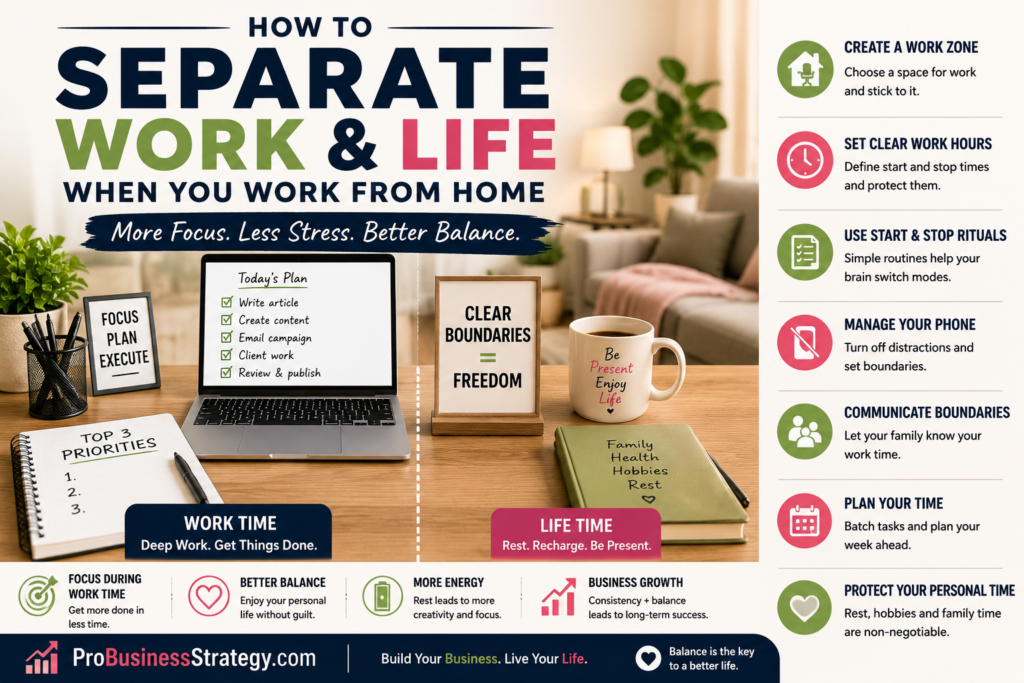
A Simple Work-From-Home Separation System
Here is a simple system you can use:
Choose one work zone.
Set work hours.
Create a start ritual.
Create a stop ritual.
Use focus mode on your phone.
Batch similar tasks.
Protect personal time.
Communicate boundaries.
Keep work tools contained.
Review your week every Sunday or Monday.
This does not need to be perfect.
It only needs to give your day structure.
Getting Started This Week
Do not try to change everything at once.
Start with three simple changes.
First, choose your work zone.
Even if it is only a corner of a table, make it your official work place.
Second, choose your stop time.
Decide when work ends today.
Third, create a shutdown list.
Before you stop, write tomorrow’s first task.
These three actions can already make a difference.
You will feel more in control because work has a place, a time, and an ending.
Final Thoughts
Working from home can be a powerful way to build a business.
It can save time, reduce costs, and give you more flexibility.
But without boundaries, it can also blur every line between work and life.
The goal is not to create a perfect schedule.
The goal is to create separation.
A place for work.
A time for work.
A time to stop.
A system for tasks.
A protected personal life.
When you separate work and life properly, your home-based business becomes healthier and more sustainable.
You can work with focus.
Then you can stop without guilt.
That is the real freedom of working from home.
Internal Linking
Related Articles:
50 Businesses You Can Run from Your Phone