If you look at the most successful digital business models of the last decade, they all share one major flaw: competition is global.
When you start a YouTube channel, you are competing with the entire world. When you do niche affiliate marketing, you are fighting against every other English-speaking marketer on the planet.
But there is one corner of the internet where the competition is surprisingly weak, the profit margins are high, and you can build assets that pay you every single month with almost zero maintenance.
It is called Local Lead Generation.
In 2026, many small local businesses—plumbers, roofers, landscapers, and house painters—are experts at their craft, but they are terrible at the internet. They need customers, and they are willing to pay a premium for them. In this blueprint, you will learn how to build simple digital assets that “rent” out leads to these businesses, all managed from your smartphone.
Affiliate disclosure: This post contains affiliate links. If you make a purchase through one of these links, ProBusinessStrategy may earn a small commission at no extra cost to you. We only recommend tools we genuinely believe in.
What is Local Lead Generation? (The Digital Real Estate Model)
Local lead generation is often described as “Digital Real Estate.”
The concept is simple:
You build a simple website targeting a specific service in a specific city (e.g., “Roofing Contractor in Austin, TX”).
You rank that website on the first page of Google.
When customers call the number or fill out the form on that site, those “leads” are sent directly to a local business owner.
The business owner pays you a flat monthly fee or a percentage of the jobs they close.
The reason this is an asset-based business is that once the site is ranking, it requires very little upkeep. It becomes a digital property that produces “rent” every month.
And because you are targeting local keywords (“Roofer Austin”), the competition is 100x easier than targeting global keywords (“Best SEO Tools”).
Step 1: Choosing the Right Niche and City (The “Goldilocks” Method)
You don’t want a niche that is too small (not enough calls) or too big (too much competition).
How to research from your phone:
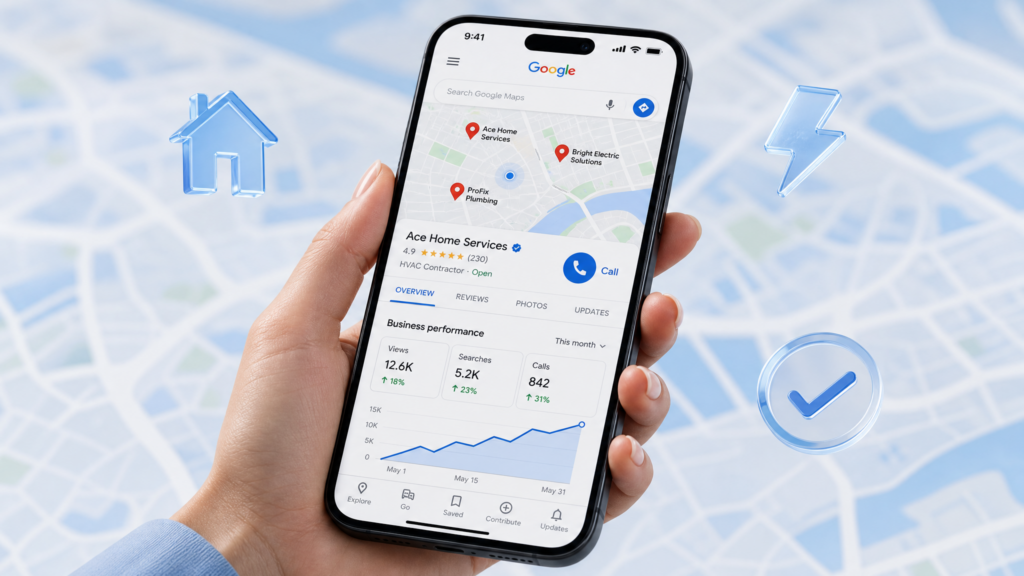
Use the Google Maps app and the Chrome browser on your phone to look for:
High Ticket Services: Services where a single job is worth €500 or more (e.g., roofing, foundation repair, tree removal, HVAC, kitchen remodeling).
City Size: Aim for cities with a population between 50,000 and 200,000. These are the “Goldilocks” zones where SEO is manageable but the lead volume is high.
The “Map” Gap: Look at the Google Maps results for a service. If the businesses on the first page have bad websites or very few reviews, that is your opportunity.
Step 2: Building Your Digital Asset
You are not building a complicated e-commerce site. You are building a “Lead Capture Machine.” It only needs two things: a clear call-to-action (phone number) and a simple contact form.
The Mobile-First Tech Stack:
Platform: WordPress is the industry standard for local SEO. It allows you to use plugins like Yoast or RankMath to handle your meta tags easily from your phone.
Hosting: You need fast, reliable hosting because local SEO depends on site speed. I always recommend Bluehost for this. It’s easy to manage through their mobile dashboard.
Design: Don’t waste time on custom coding. Use a lightweight theme and find a professional on Fiverr to set up a clean, high-conversion template for your lead gen sites.
Step 3: Local SEO Optimization (The Ranking Blueprint)
To rank a local site, you need to follow a specific “Google-friendly” recipe. You can manage this entire checklist from your phone:
GMB (Google Business Profile): This is the map listing. It is the most important part of local SEO. You will need a physical address in the city you are targeting (you can often partner with a local business for this).
Keyword Optimized Content: Your H1 tag should be “[City] [Service] Contractor.” Your text should sound like a local expert.
Citations: These are mentions of your Business Name, Address, and Phone number (NAP) on directories like Yelp, Yellow Pages, and local city directories. You can outsource the manual labor of building these citations to experts on Fiverr for very little cost.
Backlinks: Focus on local links. Sponsor a local Little League team or get featured in a local blog. These “local votes” are more powerful than generic backlinks.
Step 4: Tracking and Routing Leads
How do you prove to a business owner that the calls are coming from YOU?
You use “Call Tracking” software (like CallRail or Ringba). This gives you a local number that forwards the call to the business owner but records the data in your dashboard.
From your phone: You can see exactly how many calls your site generated this week.
The “Whisper” Message: You can set up a “whisper” that tells the business owner: “Lead coming from Pro Strategy Sites” right before they answer. This builds your brand authority on every single call.
Step 5: Finding and Closing the Partner
Most people wait until they have a partner to build a site. Don’t do that.
Build the site, get it ranking, and get a few leads coming in. This is called the “Rank and Rent” method. It is much easier to sell a “live phone that is already ringing” than a “promise of future leads.”
The “Sample Sale” Strategy:
Find a reputable local business owner with a decent Google reputation but a weak website.
Give them 3–5 leads for free.
Call them and ask: “How were those jobs? I have 20 more coming this month. If you want them exclusively, my fee is €X per month.”
At this point, if they say no, you simply call their competitor. You own the asset; you have all the leverage.
Step 6: Monetization Models
How do you want to get paid? There are three main ways:
1. The “Rent” Model (Recommended)
The business owner pays you a fixed fee (e.g., €500 or €1,000 per month) to have your site’s calls forwarded exclusively to them. This is the most “passive” version of the business.
2. Pay-Per-Lead (PPL)
You charge per qualified lead (e.g., €25 per call). This can make more money but requires more tracking and can lead to disputes about “bad leads.”
3. Revenue Share
You take a percentage (e.g., 10%) of every job they close. This is excellent for high-ticket niches like roofing, where one job could be €15,000, netting you a €1,500 commission.
Managing the Scale from Your Smartphone
Once you have one site working, the model is infinitely repeatable. You can have a “Roofer site” in Austin, a “Lumberjack site” in Seattle, and a “Painter site” in Miami.
Communication: Use WhatsApp Business to stay in touch with your partners.
Scaling: As you grow to 10+ sites, you cannot do the SEO and lead routing yourself. Hire a Virtual Assistant on Fiverr to handle the updates and tracking.
Infrastructure: As you launch more sites, ensure your Bluehost plan allows for multiple domains so you can manage your entire portfolio from one central login.
How this Ties into the “Local Ops & Real Estate” Hub
Local Lead Generation is the digital equivalent of being a “Property Manager.”
In our Local Ops & Real Estate Business Ideas Hub, we talked about how asset-based businesses build long-term wealth. A lead gen site is exactly that—an asset you built once that pays you “rent” indefinitely.
Unlike a social media business where you are at the mercy of the “latest trend,” local services are eternal. People will always need plumbers. People will always need their roofs fixed. By positioning yourself as the bridge between the customer and the local service provider, you are building a recession-proof business.
Final Thoughts: 2026 and Beyond
The “Local Lead Generation” model is the ultimate strategy for the “Quiet Expert.” You don’t need a personal brand. You don’t need to show your face. You just need to build functional digital assets that solve real-world problems for local business owners.
Starting this from your smartphone allows you to manage your portfolio during your commute, your lunch break, or your evenings. It’s about building a machine that works when you don’t.
If you are tired of the “influencer” rat race, look local. The gold is in the “boring” businesses.
Related articles to link internally: