There is a big difference between being a landlord and being a property manager.
A landlord owns the property, pays the mortgage, and takes the financial risk. A property manager provides the service and the system to make sure that property stays profitable, occupied, and well-maintained.
In the world of “Local Ops,” professional property management is the ultimate recurring revenue model. Unlike Airbnb management, where you are constantly dealing with check-ins and check-outs, long-term property management is about building a stable foundation. You manage tenants who stay for years, not days.
In 2026, you don’t need an office with filing cabinets to do this. You can manage an entire portfolio of long-term rentals using just your smartphone, some smart software, and a reliable local network.
This guide will show you how to start your management agency without owning a single house, how to automate the “boring” parts, and how to scale this into a legitimate asset-based business.
Affiliate disclosure: This post contains affiliate links. If you make a purchase through one of these links, ProBusinessStrategy may earn a small commission at no extra cost to you. We only recommend tools we genuinely believe in.
Why Property Management is a Recession-Proof Asset
While some industries fluctuate with the economy, the need for housing—and the need for people to manage that housing—is constant.
Stable Recurring Revenue: You typically charge a percentage of the monthly rent (usually 8-12%). This income is highly predictable.
Low “Churn” Rate: Once a landlord hires you and you do a good job, they rarely leave. Some managers keep the same clients for decades.
High Upsell Potential: You can make extra income from lease renewal fees, maintenance markups, and inspection fees.
The “Expert” Factor: Many landlords are “accidental landlords” (e.g., they inherited a house). They are desperate for someone to take the legal and operational stress off their plate.
Step 1: Defining Your Management Service
What exactly does a “Smartphone Property Manager” do? Your role is to be the buffer between the owner and the tenant.
Your core services will be:
Tenant Acquisition: Marketing the property and finding high-quality renters.
Tenant Screening: Running credit checks and background checks (vital for safety).
Leas Management: Handling the legal contracts and renewals.
Rent Collection: Ensuring the money hits the owner’s account on time.
Maintenance Coordination: Being the point of contact for repairs.
Step 2: The Core Infrastructure (From Your Phone)
To manage this professionally, you need a high-end agency website. This is where you explain your “Professional Management Protocols” to potential landlord clients.
1. Build Your Professional Site
Your agency website must look corporate and trustworthy. Use WordPress and Bluehost to create a dedicated page for “Landlord Services.” This is much more effective than just having a “Contact” page.
2. Management Software (The Mobile App)
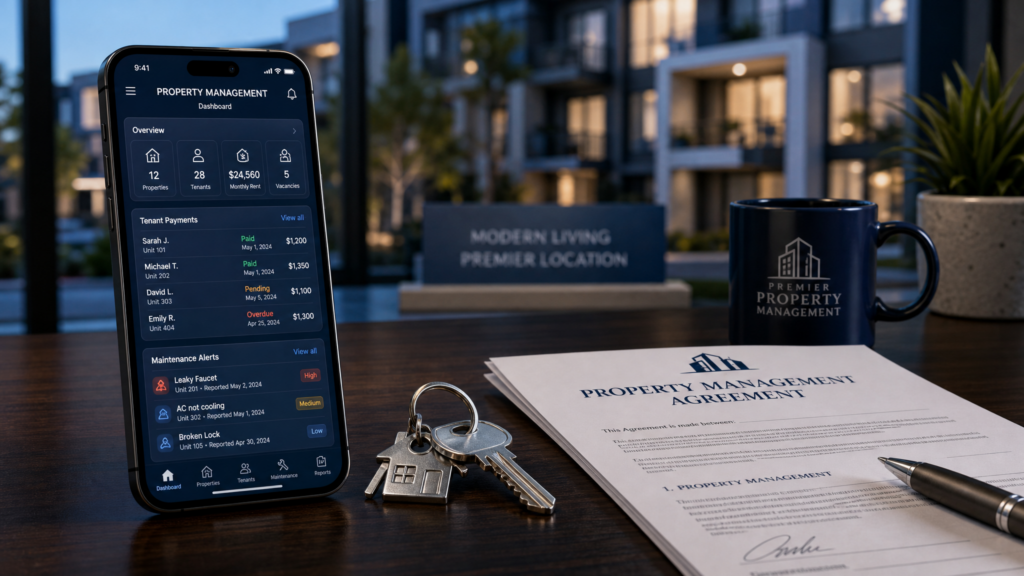
You need a Property Management App (like AppFolio, Buildium, or DoorLoop). These apps allow your tenants to pay rent through their phone, and you can see exactly who has paid and who is late. They also allow tenants to submit “Maintenance Requests” with photos, which you can then forward to your handyman with one tap.
Step 3: Finding Your Landlord Clients
The biggest challenge in property management is not managing the tenants—it’s finding the landlords.
Smartphone Outreach Strategies:
Niche Down: Don’t just be a “property manager.” Be the “Specialist in Modern Long-Term Rentals for Professionals in [City].”
The “Frustrated Landlord” Search: Look at local listing sites. If you see a house for rent that has bad photos and a poorly written description, that owner is likely stressed. Message them and offer a “Management Audit.”
LinkedIn B2B Outreach: Use the strategy we discussed in the LinkedIn Cornerstone to find local real estate investors and offer your services as a “Scalable Operator.”
Step 4: The Tenant Screening Process (Risk Mitigation)
One bad tenant can ruin your reputation with a landlord. This is the most critical part of your business.
Use your phone to manage the screening:
Credit Checks: Use integrated tools in your management software.
Employment Verification: A quick professional call or email is all it takes.
Past Landlord Checks: Never skip this. One 5-minute phone call can save you months of legal trouble.
Step 5: Maintenance and the “Local Service Network”
Just like in Airbnb Management, you need a local team. However, for long-term rentals, you need people who can handle bigger jobs:
Plumbers and Electricians.
General Handymen for “turn-overs” (fixing a house between tenants).
Legal experts who know the local “Landlord-Tenant Law.”
You can find and vet these professionals on Fiverr for administrative tasks like contract drafting or on local service marketplaces for the physical work.
Pro Tip: Charge an “Administrative Fee” (e.g., 10%) on top of maintenance invoices. The landlord gets a fixed house, the plumber gets a job, and you get paid for the coordination.
Step 6: Automating Communication
Tenant questions are usually predictable: “How do I pay rent?”, “When is the trash collected?”, “The heater is making a noise.”
Use your smartphone to set up “Automated Knowledge Bases” for your tenants. When they move in, send them a professional PDF (designed by a pro on Fiverr) that answers every FAQ. This reduces your “management time” by 80%.
Scaling to a Full Asset-Based Business
Property management is a “snowball” business.
1 Property: €150/month (A side hustle).
10 Properties: €1,500/month (A solid income).
50 Properties: €7,500/month (A full-scale agency).
By the time you reach 20 properties, you should consider hiring a Virtual Assistant to handle the daily data entry and tenant questions, allowing you to focus on acquiring new “Asset Owners.”
How this Ties into the “Local Ops” Hub
This article is the perfect “anchor” for our Local Ops & Real Estate Hub. It shows that while things like Local Lead Generation are great for cash flow, Property Management is about building a long-term service asset that lasts for years.
Final Thoughts
Property management is not about “fixing toilets.” It is about managing systems and protecting assets.
If you can use your smartphone to communicate better, organize faster, and screen tenants more effectively than the “old school” managers in your city, you will win. Focus on trust, leverage your WordPress site for credibility, and start building your recurring revenue empire, one property at a time.
Internal Linking: