The real estate world is changing.
Traditionally, if you wanted to make money in property, you needed two things: massive capital and local physical presence. You either had to buy the building yourself or spend your days driving between properties to manage keys, cleaning, and maintenance.
In 2026, both of those barriers have been dismantled by technology.
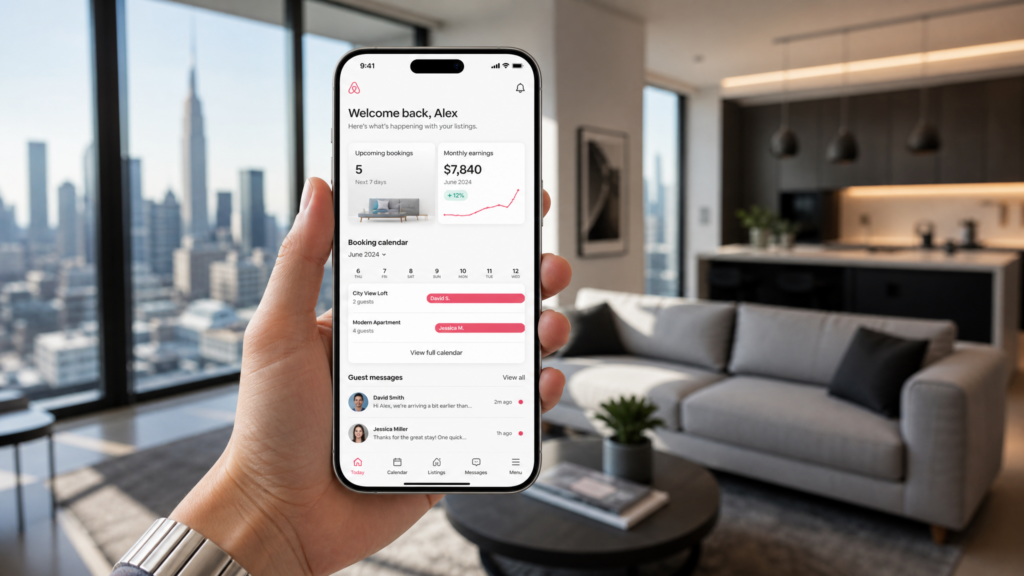
You can now build a highly profitable real estate business without owning a single square foot of land. Even more impressive, you can manage the entire operation—from guest acquisition to professional coordination—using nothing more than the smartphone in your pocket.
This model is known as Airbnb Management (or Co-hosting).
It is one of the most powerful “Local Ops” models because it leverages active real estate assets while allowing you to function as a digital operator. You solve a massive problem for property owners: they want the high returns of short-term rentals but they don’t want the 24/7 headache of managing them.
You provide the system. They provide the asset. You both share the profit.
In this cornerstone guide, we will break down exactly how to build this business from scratch, how to use your smartphone as your “command center,” and how to scale this into a legitimate asset-based business that produces predictable cash flow.
Affiliate disclosure: This post contains affiliate links. If you make a purchase through one of these links, ProBusinessStrategy may earn a small commission at no extra cost to you. We only recommend tools we genuinely believe in.
Why Airbnb Management is the Ultimate Smartphone Business
Most people looking for a “phone business” default to affiliate marketing or social media content. Those are great, but they can be volatile. Airbnb management is rooted in the physical world, which gives it a level of stability that purely digital models often lack.
Here is why this model is so effective:
High Demand: As travel continues to grow in 2026, more property owners are looking to convert long-term rentals into higher-yielding short-term stays. Most owners are busy professionals who have zero interest in answering guest messages at 10:00 PM.
No Capital Required: You are not buying the property. You are selling your management expertise. Your “startup costs” are essentially your time and a few software subscriptions.
Complete Location Independence: With the right team and systems in place, you can manage a property in Amsterdam while sitting on a beach in Spain.
Scalability: Once you have the system for one property, adding a second, fifth, or tenth property is simply a matter of repeating the process.
The “Smartphone Command Center” Concept
To run this business efficiently, your phone needs to be more than a communication device; it needs to be your headquarters. You will use it for:
Marketing: Finding and closing property owners (Lead Gen).
Operations: Scheduling cleaners and maintenance crews.
Guest Relations: 24/7 communication and automated check-ins.
Financials: Tracking payouts, expenses, and owner reports.
By the end of this guide, you will see how these layers fit together into a seamless workflow.
Step 1: The Foundation — Building Your Professional Presence
You cannot expect a property owner to hand over their €500,000 asset if you look like an amateur. Even if you are starting from your phone, you need to look like a professional agency.
1. Your Digital Home
The very first step is setting up a professional website. This acts as your “credibility card” when you approach owners. Your site should explain your services, show your professional approach, and have a clear “Work With Us” form.
For a business that relies on high trust and professional branding, I always recommend building your site on WordPress and hosting it with Bluehost. This setup gives you the professional “feel” that free builders lack, and it allows you to integrate the booking and management plugins you’ll need as you grow.
2. Branding and Identity
If you are not a designer, don’t try to “wing” your logo or business cards. A professional look matters in real estate. Use a platform like Fiverr to find a specialist who can create a sleek, modern brand package for your management company. This small investment pays for itself the first time you land a high-end property.
Step 2: Finding Your First “Anchor” Property
Your goal is to find property owners who currently have “passive” long-term rentals but are frustrated by the low returns or the management of tenants.
Strategies for Lead Generation from Your Phone:
Local Networking Groups: Join LinkedIn and Facebook groups for local property investors. Don’t be “salesy”—simply offer value and mention what you do.
Zillow/Pararius/Funda Outreach: Look for long-term rental listings that have been on the market for a long time. Contact the owner and propose a “Short-Term Rental Pilot.”
The “Zero-Risk” Offer: Tell the owner you will manage the property for a percentage of the extra profit you generate compared to their current long-term rent. This makes it impossible for them to say no.
Step 3: Setting Up the Remote Management System
This is the “secret sauce” that allows you to manage everything from your phone. You need a Property Management System (PMS).
A PMS allows you to:
Synchronize calendars across Airbnb, Booking.com, and VRBO (to avoid double bookings).
Automate guest messages (Welcome, Check-in, House Rules, Check-out).
Automate cleaner notifications.
Many professional managers use tools like Guesty or Hospitable, which have excellent mobile apps.
Automating the Physical Side
Since you are a “smartphone-first” manager, you cannot be there to hand over keys. You must implement smart-lock systems (like August or Nuki). These allow you to generate a unique code for every guest directly from your phone. The code expires the moment they check out.
Step 4: Building Your “Local Ops” Team
You might be managing the business from your phone, but the cleaning and maintenance happen in the real world. Your team is your most important asset.
Finding Reliable Staff
You need two reliable cleaners and one “handyman” on call.
Where to find them: Use local service apps, Facebook community groups, or specialized cleaning platforms.
The Workflow: When a guest books via your phone app, your cleaner automatically gets an email or SMS with the date and time. Once they finish the cleaning, they send you “completion photos” via WhatsApp.
By documenting this process, you are moving away from a “job” and toward a “local operation system.”
Step 5: Professional Listing Optimization
To get the highest returns for your owners, your Airbnb listings must be perfect.
Photography: Never use phone photos for the actual listing. Hire a professional real estate photographer on Fiverr to edit your photos or find a local pro. High-quality photos are the #1 factor in booking rates.
Copywriting: Your description needs to sell the experience. Highlight the “Local Ops” benefits—the proximity to coffee shops, the workspace, and the ease of check-in.
Pricing Strategy: Use dynamic pricing tools (like PriceLabs) which adjust your rates based on local demand, events, and hotel prices in real-time. This is all managed from your phone dashboard.
Step 6: Monetization and Financial Flow
How do you actually make money? Usually, an Airbnb manager takes 15% to 25% of the gross booking revenue.
On a property that generates €4,000 a month, a 20% fee is €800. If you manage 5 properties, you are earning €4,000 a month in high-margin revenue with very little overhead.
Managing Payments
Use a professional invoicing system to provide monthly reports to your owners. Show them the gross revenue, the cleaning fees, your management fee, and the net profit. Transparency is what keeps owners with you for years.
How this Ties into “Local Ops & Real Estate”
By starting an Airbnb management business, you have officially entered the “Asset-Based” world we discussed in the Local Ops & Real Estate Business Ideas Hub.
You are no longer just “making money online”; you are managing a physical asset-driven income stream. Over time, as your management company grows, you might even decide to take the profits and move into “Rental Arbitrage” (renting a property yourself to sublet) or eventually buying your own properties.
This is the natural evolution of a smartphone entrepreneur:
Digital Skills: Marketing, systems, and communication.
Service Business: Airbnb Management.
Asset Ownership: Owning the real estate.
Essential Tools for the Smartphone Airbnb Manager
To successfully run this from your phone in 2026, these are the pillars of your infrastructure:
The Hub: WordPress hosted on Bluehost for your agency website.
The Storefront: If you decide to sell “Welcome Packs” or digital guidebooks for your guests, you can even set up a small Shopify store to manage those digital assets.
The Support: Use Fiverr for everything from SEO audits of your website to creating professional “House Manual” PDFs for your properties.
Common Challenges and How to Solve Them (from your phone)
1. The “Emergency” Call: What if a pipe bursts at 2:00 AM?
Solution: You must have a “Maintenance Protocol.” Your handyman has a key (or code) and is authorized to handle emergencies up to a certain amount (e.g., €200) without calling you.
2. Bad Guests: What if someone throws a party?
Solution: Install noise sensors (like Minut) that sync with your phone. If the decibel level stays too high for 10 minutes, you get an alert and can immediately message the guest.
3. Scaling Pains: How do I manage 10 properties alone?
Solution: Automation is key, but eventually, you may need a Virtual Assistant (VA). You can find excellent VAs on Fiverr who can handle basic guest messaging while you focus on acquiring new owners.
Final Thoughts: The 2026 Real Estate Operator
Starting an Airbnb management business from your smartphone is the ultimate “bridge” business. It connects the digital world of systems and marketing with the physical world of real estate and hospitality.
It is a business that rewards organization, professionalism, and the ability to leverage technology. By building your foundation on a professional WordPress site and using your phone as a command center, you are building a scalable, asset-based business that can produce life-changing wealth.
Stop looking for “get rich quick” schemes and start looking for “problems to solve” for property owners. That is where the real money is.
Related articles to link internally: