The democratization of media began with the smartphone camera. It culminated with Artificial Intelligence. In 2026, the traditional “studio” is dead. You don’t need a $5,000 workstation or a team of editors to produce world-class videos, pixel-perfect graphics, or viral-ready articles.
You need a smartphone, a high-speed data connection, and a strategic AI production workflow.
Creating content with AI on your smartphone isn’t just about “making things faster.” It is about multi-modality. It is the ability to turn a single voice memo into a YouTube script, a set of Instagram captions, a Pinterest-worthy infographic, and a blog post—all while you are riding a bus or waiting for a meeting.
This guide is your 2026 blueprint for mastering the mobile AI content machine.
Affiliate disclosure: This post contains affiliate links. If you make a purchase through one of these links, ProBusinessStrategy may earn a small commission at no extra cost to you. We only recommend tools we genuinely believe in.
1. The Mobile AI Production Pipeline
To treat content creation like a business, you must stop thinking in “one-offs.” You need a pipeline where your smartphone acts as the central hub. A professional AI workflow follows four stages: Ideation, Generation, Refinement, and Distribution.
Ideation: Capturing the Spark
The biggest advantage of a phone is immediacy. When an idea strikes, you use AI to expand it instantly. Using voice-to-text AI tools, you can record a “brain dump” and ask the AI to categorize the points into a logical structure.
Generation: The Heavy Lifting
In 2026, the “heavy lifting” (writing first drafts, generating background music, or creating base imagery) is handled by specialized apps. These tools use the cloud to process complex generative tasks, meaning your phone stays cool while the AI works hard in the background.
Refinement: The Human Polish
This is where the smartphone entrepreneur wins. You use mobile editing apps to add your personal “brand voice” or aesthetic. AI gets you 90% of the way; your smartphone allows you to add the final 10% of human intuition.
Distribution: One Source, Ten Channels
Once a piece of content is ready, AI-driven scheduling apps adapt the format for different platforms. A long-form video is clipped into “Shorts,” and an article is turned into an aesthetic Pinterest pin.
2. Mastering AI Writing for Mobile
Writing on a phone used to be tedious. With AI, you are no longer “typing”—you are “directing.”
Voice-First Drafting
Use the ChatGPT or Claude mobile apps to narrate your thoughts.
The Workflow: “I want to write a post about [Topic]. Here are my three main points: A, B, and C. Please turn this into a 1,000-word blog draft with a professional tone and a strong call to action.”
The Result: You get a full draft in seconds. You can then use the copy-paste function to move it into your mobile-optimized WordPress editor.
SEO Real-Time Optimization
In 2026, SEO happens as you write. Mobile AI writing assistants allow you to paste your keyword list (like the one from our High-Paying Affiliate guide) and ask the AI to check for keyword density and readability without ever leaving your phone browser.
Micro-Copy for Social Hubs
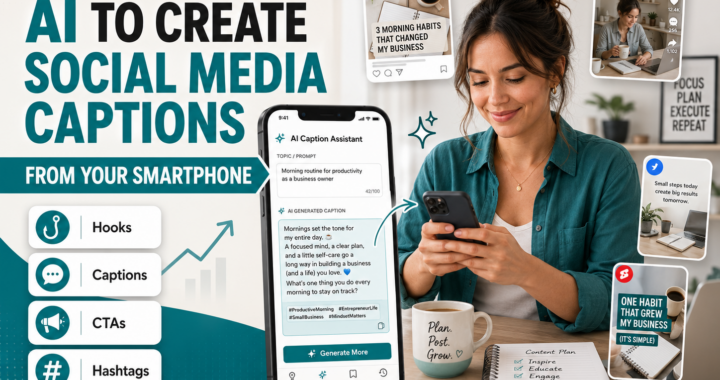
LinkedIn, TikTok, and Instagram require different tones. Instead of writing three different captions, ask the AI: “Aestheticize this text for Instagram and make it authoritative for LinkedIn.”
3. High-End Image Generation on the Go
Gone are the days of searching for mediocre stock photos. In 2026, you generate exactly what you need.
The “Aesthetic” Factor
Apps like Canva (with Magic Media) and dedicated mobile interfaces for engines like Midjourney allow you to create stunning visuals for your Pinterest Business.
Strategic Use: If you are writing about “AI in Business,” generate a futuristic, clean office image that matches your site’s color palette.
Image SEO: As we discussed in our recent image SEO tips, always ensure you export in WebP and name your files like
ai-content-creation-guide.webpbefore uploading.
Repurposing Content into Graphics
Take a quote from your latest article and paste it into an AI design app. Ask it to “Create a viral-style quote card for Instagram.” This takes less than 60 seconds.
4. Mobile AI Video: The Game Changer
Short-form video is the #1 traffic driver in 2026. AI has made it possible to produce professional clips without ever touching a desktop video editor.
AI Script-to-Video
Tools now exist where you input a text script on your phone, and the AI finds relevant B-roll, adds captions, and syncs an AI-generated voiceover.
The Faceless Angle: This is perfect for running a TikTok Business where you don’t necessarily want to appear on camera yourself.
Smart Captioning & Editing
Auto-captioning used to be a luxury; now it is an AI standard. Use mobile apps to automatically highlight keywords in your captions and add “emojis” based on the spoken sentiment.
5. Monetizing Your Mobile Content via Affiliates
Content is the “fuel,” but your affiliate partners are the “payout.”
The Tool Showcase: When creating a video about “Starting a Blog,” naturally mention that you handle the entire setup on Bluehost using their smartphone-friendly dashboard.
The E-commerce Angle: Use AI-generated product mockups to showcase how someone can launch a Shopify store from their phone.
The Freelance Loop: If your content strategy becomes too big, use Fiverr to hire an AI-specialist editor to handle the final polish of your smartphone-generated clips.
6. The “Holy Grail” of Mobile Content: Repurposing
The secret to 2026 content success is not creating more, but repurposing better.
Start with the Pillar: Write a long-form guide like this one.
Extract the Twitter/X Thread: Use AI to pull 10 short, punchy points.
Generate the Visuals: Create 10 Pinterest pins using the main headings.
Create the Video: Summarize the “Key Takeaway” into a 30-second TikTok script.
Schedule: Use a mobile social media manager to dri-feed this content over two weeks.
7. Connecting This Pillar to Your Hub
This article is the “Action Center” for your AI-Powered Mobile Business category.
Practical Tools: Readers who have learned the “How” should move to our guide on How to Use ChatGPT from Your Phone for Business Tasks for specific text workflows.
The Platform Strategy: If you want to see how this content works on specific platforms, check our TikTok Business guide or YouTube Business experiments for real-world applications.
Final Thoughts: The One-Person Global Agency
In the past, to produce at this level, you needed a massive budget. In 2026, you only need the smartphone in your hand and the ability to prompt effectively.
By combining AI’s generative power with your human unique perspective, you aren’t just a creator—you are a media entity. Start with one platform, master the workflow, and then use your AI tools to expand your footprint across the digital world.