If you look at YouTube in 2026, one thing becomes obvious very quickly: people are tired of generic advice.
They do not want another creator repeating the same “10 side hustles to start this year” list. They do not want vague motivation. They do not want fake screenshots, exaggerated income claims, or recycled business tips with no proof behind them.
What they do want is something far more interesting: real business experiments.
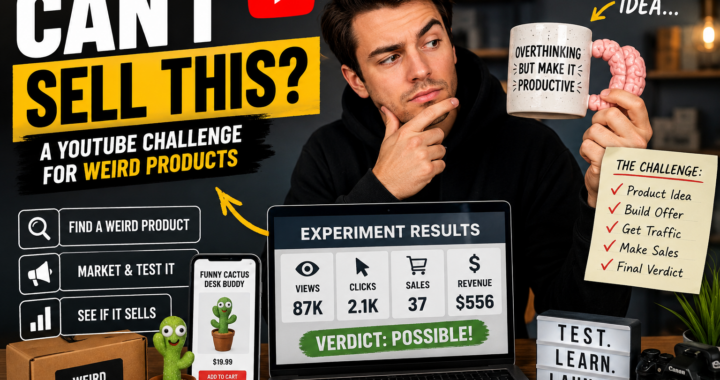
That is why a YouTube channel built around “weird” business experiments can become such a powerful content and income model. Instead of pretending to be an all-knowing expert, you become the person who tests unusual ideas, documents the process, shows the numbers, and explains what actually worked.
That approach is more transparent, more entertaining, and more trustworthy than most traditional “make money online” content.
It also fits perfectly inside the broader angle of out-of-the-box social media business ideas. A business experiment channel is not just another YouTube channel. It is a content business built on curiosity, testing, proof, and storytelling.
In this guide, you will learn how to build a YouTube channel around strange, surprising, or unconventional business experiments, how to structure your videos, how to document results, how to monetize the channel, and how to connect it to a larger website or mobile-first business strategy.
If you want to build authority while testing business ideas in public, this may be one of the smartest YouTube models you can start.
Affiliate disclosure: This post contains affiliate links. If you make a purchase through one of these links, ProBusinessStrategy may earn a small commission at no extra cost to you. We only recommend tools we genuinely believe in.
Why This Type of YouTube Channel Works So Well
Most YouTube business content falls into one of these categories:
education
commentary
case studies
tutorials
personal vlogs
A business experiment channel combines several of these at once.
You are teaching, but through action.
You are documenting, but with a clear goal.
You are entertaining, but with real numbers and outcomes.
You are building trust, because viewers can actually see the process unfold.
This gives the format several huge advantages.
1. It creates curiosity immediately
A title like How to Build a YouTube Channel is broad.
A title like I Tried Starting a €0 Business Using Only Pinterest for 14 Days is much more clickable.
Why? Because the viewer instantly wants to know:
Did it work?
What happened?
Was it a disaster?
Can I do this too?
Experiment-based content naturally creates open loops, and open loops drive clicks and watch time.
2. It feels more honest than guru content
A lot of business content sounds too polished. That can hurt trust.
But when you say:
“I tested this”
“These were the results”
“Here is what failed”
“Here is what I would change next time”
you immediately sound more credible.
Even a failed experiment can become a valuable video if the lessons are useful.
3. It gives you endless content ideas
One of the hardest parts of building a YouTube channel is consistency. Many creators run out of ideas because they build a channel around a narrow topic.
But with business experiments, the format itself generates content.
You can test:
a platform
a monetization model
a niche
an AI tool
a lead-generation strategy
a phone-only workflow
a faceless content system
an affiliate funnel
a local business angle
a digital product idea
That means the channel can keep growing without feeling repetitive.
4. It naturally supports affiliate marketing and products
This is a huge advantage.
If your experiment includes tools, platforms, or workflows, you can recommend what you actually used. That feels much more natural than randomly dropping affiliate links into generic tutorials.
For example, if you test building a small ecommerce store, mentioning Shopify makes sense in context. If you test setting up a website quickly, pointing to the WordPress website builder or Bluehost feels logical.
The key is that the recommendation comes from documented use, not from forced selling.
What Counts as a “Weird” Business Experiment?
“Weird” does not have to mean silly.
It does not mean you need to make absurd prank-style content or test nonsense just for clicks.
In this context, “weird” means:
unusual
specific
surprising
underexplored
creatively constrained
different from mainstream advice
A weird business experiment is one that makes people stop and think, That’s interesting. I haven’t seen someone test that before.
Here are examples of strong experiment angles:
Can you build an affiliate business using only your phone for 30 days?
Can a faceless Pinterest strategy outperform a TikTok strategy for beginners?
Can you create a digital product with AI and sell it through a simple content funnel?
Can you launch a business with zero budget using only free apps?
Can you drive traffic to a bridge page from Pinterest without getting flagged?
Can you start a small service business using only WhatsApp and a basic landing page?
Can you validate a niche product idea using only short-form content?
These are interesting because they combine business with constraints. Constraints make content stronger. They create tension, which creates story.
The Best Types of Experiments for This Channel Model
Not every experiment is equally good for YouTube. The best ones have three qualities:
they are easy to understand
they are visually documentable
they have a clear result or metric
Here are the strongest categories.
Platform experiments
These test whether a platform can generate attention, leads, or sales.
Examples:
starting a business through YouTube Shorts
using Pinterest for affiliate clicks
testing LinkedIn for consulting leads
using TikTok for product validation
Tool experiments
These focus on specific software or AI tools.
Examples:
testing AI website builders
comparing editing apps for short-form content
using automation tools to speed up business workflows
building a funnel with mobile apps only
This is where tools like Bluehost All Access AI or Fiverr can appear naturally, depending on the experiment.
Monetization experiments
These test ways of making money.
Examples:
affiliate marketing
print-on-demand
lead generation
digital products
template sales
micro-services
niche newsletters
Constraint experiments
These often perform especially well because the limitation creates drama.
Examples:
building a business using only a smartphone
starting with zero budget
completing the test in 7 days
using only one platform
using only AI tools
working only one hour a day
These are highly clickable because they instantly communicate the challenge.
How to Choose the Right First Experiment
The first experiment matters more than most people realize.
It sets expectations for your channel. It tells viewers what kind of creator you are. It also helps the algorithm understand the type of audience your content belongs to.
Your first experiment should not be the hardest or biggest one. It should be the clearest.
A good first experiment has:
a simple premise
a realistic timeframe
visible actions
measurable outcomes
an appealing title
Bad first experiment:
“I tested 14 side hustles and 22 AI tools across 6 platforms”
Why it is weak:
too broad
too messy
difficult to follow
no clear story
Better first experiment:
“I Tried Building a Phone-Only Affiliate Business in 14 Days”
Why it is strong:
clear challenge
clear constraint
easy to understand
results can be measured
Questions to ask before choosing your first experiment
Can I explain the idea in one sentence?
Will viewers instantly understand what is being tested?
Can I show the process visually?
Is the result interesting whether I succeed or fail?
Can I connect this experiment to a blog article or affiliate angle later?
If the answer is yes to all five, it is probably a strong candidate.
How to Structure the Channel Itself
Your channel should feel like a lab, not a random collection of uploads.
That does not mean it needs to look overly technical. It just means the viewer should quickly understand your identity.
Your channel positioning can be something like:
unusual business experiments
mobile-first business tests
social media business case studies
AI business experiments
low-budget side hustle tests
real-world business experiments for creators
The important part is consistency.
If your first 5–10 videos all revolve around testing creative business ideas with real data, people will understand the format quickly.
Channel branding tips
Keep it clean and simple.
Your channel art and description should communicate:
what you test
who it is for
what viewers can expect
For example:
Channel angle: I test unusual online business ideas, social media strategies, and mobile-first workflows to find out what actually works in 2026.
That is clear. It tells the viewer exactly why they should subscribe.
The Best Video Structure for Business Experiment Content
This is where many creators get it wrong.
They may have an interesting experiment, but they present it in a boring way. The result is low watch time and low return viewers.
A strong experiment video usually follows this structure.
1. The hook
This is the first 15–30 seconds.
It should answer:
what are you testing?
why is it interesting?
what is at stake?
Example:
“I wanted to know if I could build a real affiliate income stream using only my phone and free tools. So I gave myself 14 days, picked one traffic source, and tracked every result.”
That is clear and compelling.
2. The setup
Explain the rules.
What is the constraint?
What tools are allowed?
What counts as success?
How long will the test run?
This makes the experiment feel legitimate.
3. The process
This is where you show what you actually did.
Do not just summarize. Show the steps:
choosing the niche
setting up the platform
publishing content
testing creative angles
checking analytics
adjusting based on results
This is where screen recordings, smartphone shots, dashboards, and over-the-shoulder footage matter.
4. The struggle
This part is essential.
If everything looks too easy, the content feels fake.
Show:
what did not work
what took longer than expected
what confused you
what results were disappointing
This makes the final result much more satisfying.
5. The result
Now you reveal the outcome.
Use real numbers if possible:
views
clicks
signups
leads
commissions
traffic
conversion rates
Even if the numbers are small, they matter because they are real.
6. The lesson
Do not end with just “that was the result.”
End with:
what you learned
what you would do differently
whether the idea is worth trying
who should and should not attempt it
That is what turns the experiment into a useful piece of content instead of just a diary entry.
Why Failure Can Still Be Great Content
One reason this model is so powerful is that you do not need every experiment to succeed financially.
A failed experiment can still create:
views
trust
discussion
article ideas
internal links
affiliate clicks
audience loyalty
For example, imagine you test a social media method and it produces zero conversions. That can still become a fantastic video if you explain why it failed and how someone else can avoid the same mistake.
That kind of honesty is rare, and rarity builds authority.
It also connects naturally with educational articles like 15+ Affiliate Marketing Mistakes to Avoid on Your Phone (2026), because failed tests often reveal exactly where beginners go wrong.
Running the Channel from Your Smartphone
This is one of the most interesting angles for your site, because it overlaps with your broader mobile business content.
A lot of people assume YouTube requires expensive gear, a laptop-heavy workflow, or a full studio setup. That is no longer true.
You can run a serious channel from a phone if you are organized.
What you need
At minimum:
a decent smartphone camera
a tripod
a screen recording function
a mobile editing app
a notes app or content tracker
Optional upgrades:
external microphone
small light
cloud storage
thumbnail design app
What to record
For a business experiment channel, you do not need cinematic travel footage. You need clarity.
Useful footage includes:
talking to camera
showing your workspace
screen recordings of apps and dashboards
quick progress updates
whiteboard or notebook planning
result reveals
Why this phone-first angle is valuable
A lot of your audience will also be building from simple setups.
When they see that you are testing real ideas from a phone, it makes the content feel more accessible and more relevant.
It also creates strong internal linking opportunities to your smartphone business content, including your broader smartphone business category.
How to Monetize a Business Experiment Channel
This is where the model becomes especially attractive.
A business experiment channel does not need to rely only on ad revenue. In fact, YouTube ads may end up being one of the smaller income streams.
1. Affiliate marketing
This is the most natural first monetization path.
If your experiments involve real tools, platforms, or services, you can recommend them honestly.
Examples:
website setup tools
ecommerce tools
AI writing tools
hosting providers
freelance marketplaces
email marketing tools
design tools
If you used Shopify in a store experiment, say so.
If you outsourced a logo, thumbnail, or design system through Fiverr, say so.
If you built a site through Bluehost or the WordPress website builder, that fits naturally too.
The key is simple: only recommend what genuinely played a role in the experiment.
2. Templates and systems
Your audience often does not just want inspiration. They want shortcuts.
That means you can turn your workflow into products like:
planning templates
experiment scorecards
thumbnail packs
SOPs
tracking sheets
video structure frameworks
This works well because your product is based on proven usage, not theory.
3. Consulting or audits
Once you have tested enough ideas publicly, people will begin to see you as someone who can diagnose business opportunities.
That can lead to:
strategy calls
content audits
niche validation help
social media experiments for clients
offer-positioning support
4. Blog traffic and email list growth
This is one of the most overlooked benefits.
Each video can become:
a supporting article
a case study
a newsletter topic
a content upgrade
an internal link opportunity
This is especially smart if you already publish business content on your own site.
Turning Each YouTube Experiment into a Blog Post
This is one of the best long-term strategies for your site.
Every experiment video can be repurposed into a written article.
That article can include:
the premise
the steps
screenshots
key takeaways
tool recommendations
internal links to related posts
This creates a very strong content loop:
You run the experiment.
You film the process.
You publish the video.
You write the article.
You link to related guides.
You capture search traffic.
You recommend relevant tools.
That means one experiment becomes multiple assets.
For example, if an experiment touches on affiliate funnels, you could naturally connect it to your existing post about how to promote digital products as an affiliate from your phone.
If the experiment includes combining business models, it could also connect to content like combine affiliate marketing and dropshipping from your smartphone.
This is how a single YouTube video starts strengthening the whole site.
Common Mistakes to Avoid
A channel like this is powerful, but only if you avoid the usual traps.
Mistake 1: Choosing experiments that are too vague
If the audience cannot understand the test quickly, they will not care.
Mistake 2: Making everything about income claims
Money matters, but if every title screams revenue, the channel can start feeling low-trust.
Balance money-focused experiments with workflow, traffic, systems, and creative tests.
Mistake 3: Hiding the boring parts
If you only show dramatic highlights, the experiment may feel fake.
Show enough of the actual process to make the test believable.
Mistake 4: Testing too many things at once
A single experiment should focus on one main question.
Too many moving parts make the conclusion weak.
Mistake 5: Failing to define success
Before you start, know what you are measuring.
Otherwise the result will feel fuzzy and unsatisfying.
Mistake 6: Not linking the experiment to a bigger strategy
The best experiment channels are not random. They build around a theme:
mobile business
AI workflows
unusual monetization
creator business systems
social media business models
That theme is what gives the channel depth.
10 Strong Video Ideas for This Type of Channel
To help you get momentum, here are 10 strong ideas you could test.
I Tried Building an Affiliate Funnel Using Only My Phone
Can Pinterest Traffic Still Work for Beginners in 2026?
I Tested a Faceless Social Media Business Idea for 14 Days
Can AI Help Me Launch a Micro-Business Faster?
I Tried Selling a Digital Product with Only Organic Content
Can You Validate a Business Idea with Short-Form Video Alone?
I Tested Whether LinkedIn Can Generate Leads Without Cold DMs
Can a €0 Budget Business Experiment Actually Work?
I Tried Running a One-Person Content System from My Smartphone
Which Social Platform Is Best for Weird Business Ideas?
These are good because each one has:
a clear premise
a built-in question
a measurable result
strong repurposing potential
How to Build Momentum in the First 90 Days
The first 90 days are not about perfection. They are about finding repeatable patterns.
A realistic early plan looks like this:
Month 1: Establish the format
Publish 3–4 experiments.
Keep the editing simple.
Focus on clarity, not complexity.
Month 2: Improve the storytelling
Pay attention to:
which titles get clicks
where viewers drop off
which experiment angles create the most comments
Month 3: Build the content ecosystem
Start connecting videos to:
blog posts
internal links
affiliate recommendations
lead magnets
related article clusters
This is where the business starts to become much stronger than “just a YouTube channel.”
Why This Fits Perfectly in an Out-of-the-Box Social Media Hub
This type of content belongs naturally inside a hub about unusual social media business ideas.
Why? Because it is not a standard creator model.
You are not just becoming:
a vlogger
an educator
a lifestyle influencer
You are building a content-led business lab.
That is a much more interesting angle.
It also creates a bridge between:
social media
entrepreneurship
case studies
mobile-first workflows
affiliate monetization
educational content
That is exactly the kind of overlap that makes a website stronger topically.
It is also a smart entry point for visitors who are curious about YouTube but are not interested in becoming traditional creators. A lot of people do not want to build a personality brand. But they are willing to document experiments, test systems, and share real findings.
That makes this angle practical and scalable.
Final Thoughts
A YouTube channel built around weird business experiments is one of the smartest creator-business models you can start in 2026.
It combines:
curiosity
storytelling
proof
education
monetization
authority
Most importantly, it gives you a reason to publish content that people actually want to watch. You are not just talking about business ideas. You are testing them. That difference matters.
If you stay consistent, define your experiments clearly, and document the process honestly, you can build a channel that stands out in a crowded space.
And unlike many trendy content formats, this one can grow into something much bigger:
a content brand
a case study archive
an affiliate engine
a consulting funnel
a full business ecosystem tied to your website
That is what makes it so powerful.
The goal is not to look like an expert from day one.
The goal is to become trusted because you are willing to test what others only talk about.
Suggested internal links for this article