Many new business owners make the same pricing mistake.
They look at competitors, find the average price, and then go slightly lower.
That feels safe.
It feels logical.
It feels competitive.
It feels like the fastest way to get customers.
But it can quietly destroy the business before it has a real chance to grow.
Pricing only to compete is dangerous because your competitors may have different costs, different margins, different systems, different suppliers, different experience, different audiences, and different business goals.
A competitor’s price does not tell you whether your business will be profitable.
It only tells you what someone else is charging.
If you build your price only around the market, you may end up working hard, selling often, and still keeping very little money.
That is why you need to learn how to price for profit.
Not just to compete.
Affiliate disclosure: This post contains affiliate links. If you make a purchase through one of these links, ProBusinessStrategy may earn a small commission at no extra cost to you. We only recommend tools we genuinely believe in.
Why Pricing Matters More Than Beginners Think
Pricing is not just a number.
It affects everything.
Your profit.
Your cash flow.
Your confidence.
Your customer expectations.
Your brand position.
Your workload.
Your ability to invest.
Your ability to survive slow months.
A weak price can make a good business idea look bad.
For example, you may have a useful service, a strong product, or a valuable digital offer. But if the price is too low, you may not have enough margin to promote it, improve it, support customers, pay yourself, or stay consistent.
The problem is not always the business idea.
Sometimes the problem is the pricing model.
A business needs revenue, but revenue is not enough.
A business needs profit.
Revenue Is Not Profit
This is one of the most important lessons.
Revenue is the money that comes in.
Profit is what remains after costs.
If you sell a product for $50, that does not mean you made $50.
You may have costs such as:
Materials
Software
Payment fees
Shipping
Packaging
Advertising
Website costs
Freelancer help
Refunds
Taxes
Your own time
Customer support
Platform fees
After all of that, the real profit may be much smaller.
This is why pricing by emotion is risky.
A beginner might think:
“$50 sounds like a good price.”
But the better question is:
“How much profit is left after everything needed to deliver this product or service?”
That question changes the way you price.
The Problem With Competing on Price
Competing on price sounds simple.
Charge less and people will buy from you.
But this creates several problems.
First, there is always someone cheaper.
If your main advantage is price, another competitor can beat you by lowering their price even more.
Second, low prices attract price-sensitive customers.
These customers may compare everything, ask for discounts, expect more than they paid for, and leave quickly when they find a cheaper option.
Third, low prices reduce your ability to improve.
If your margins are too small, you cannot invest in better design, better tools, better support, better content, better packaging, better systems, or better marketing.
Fourth, low prices can damage perception.
Sometimes a very low price makes customers wonder:
“Is this actually good?”
That does not mean you should always charge premium prices.
It means your price should be intentional.
What It Means to Price for Profit
Pricing for profit means your price is based on more than what competitors charge.
It includes:
Your costs
Your time
Your desired margin
Your value to the customer
Your market position
Your business model
Your delivery method
Your long-term goals
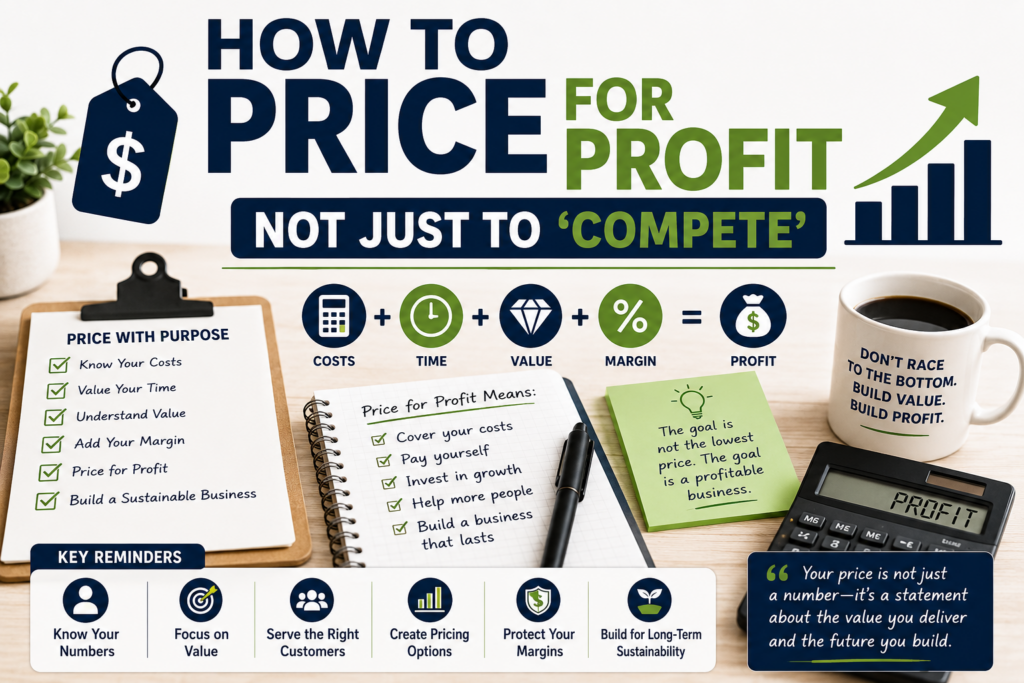
A profitable price should allow you to:
Cover your costs
Pay yourself
Handle refunds and mistakes
Improve the business
Market the offer
Serve customers well
Grow without constant stress
If a price only works when everything goes perfectly, it is too fragile.
Real businesses need margin.
Margin gives you room to breathe.
Step 1: Know Your Real Costs
Before choosing a price, write down the real costs.
For a physical product, costs may include:
Product materials
Manufacturing
Shipping
Packaging
Storage
Returns
Payment processing
Marketplace fees
Design
Marketing
Customer support
For a digital product, costs may include:
Design tools
Software subscriptions
Website hosting
Payment fees
Platform fees
Time to create
Updates
Customer questions
Refunds
Advertising
Mockups
Email tools
For a service, costs may include:
Your time
Admin work
Client calls
Software
Research
Delivery
Revisions
Project management
Taxes
Marketing
Sales time
Many beginners forget hidden costs.
They only count the obvious costs.
For example, a designer may charge $100 for a service and think it is pure profit. But if the work takes six hours, includes revisions, software, admin, communication, and taxes, the real hourly profit may be much lower.
Your price needs to reflect the full work, not only the visible work.
Step 2: Put a Value on Your Time
Your time is not free.
Even if you are just starting, your time matters.
This is especially important for service businesses.
If you charge $100 for a project that takes 10 hours, you are earning $10 per hour before costs and taxes.
That may not be sustainable.
When pricing a service, estimate:
Time for communication
Time for research
Time for delivery
Time for revisions
Time for admin
Time for follow-up
Then add a buffer.
Beginners often underestimate how long things take.
A “simple” project can become complicated when the client changes direction, asks questions, sends materials late, or requests revisions.
Your price should protect you from that.
Step 3: Decide Your Minimum Profitable Price
Your minimum profitable price is the lowest price that still makes sense for the business.
It should cover:
Costs
Time
Taxes
Fees
A profit margin
This is your floor.
You do not have to show this number to customers.
But you need to know it.
If your minimum profitable price is $75, and the market average is $50, you have a problem.
You cannot simply copy the market.
Instead, you must decide:
Can I reduce costs?
Can I improve the offer?
Can I target a better customer?
Can I bundle more value?
Can I make delivery more efficient?
Can I position the offer differently?
Can I sell a premium version?
If the market price does not allow profit, the answer is not always to lower your price.
Sometimes the answer is to change the business model.
Step 4: Understand Perceived Value
Customers do not buy based only on your costs.
They buy based on perceived value.
Perceived value means how valuable the offer feels to the customer.
For example, a simple checklist may seem cheap if it looks generic.
But if the checklist helps a beginner avoid costly mistakes, save time, make a decision, or complete an important task, it can be worth more.
Value can come from:
Saving time
Reducing stress
Making money
Avoiding mistakes
Improving appearance
Increasing confidence
Solving an urgent problem
Giving clarity
Creating convenience
Helping the customer reach a result faster
The stronger the perceived value, the easier it is to charge a profitable price.
This is why presentation matters.
A product with a weak title, weak images, weak description, and unclear benefits may feel cheap even if it is useful.
A product with a clear promise, strong examples, good visuals, and obvious benefits can feel more valuable.
Step 5: Do Not Only Sell Features
Features describe what the customer gets.
Benefits explain why it matters.
Example feature:
“20-page business planner.”
Example benefit:
“Helps you organize your business idea, target audience, offer, and first marketing steps before you waste money building the wrong thing.”
The benefit is stronger.
People pay for outcomes, not only files, pages, hours, or materials.
This matters for pricing.
If you only list features, customers compare you on quantity and price.
If you explain benefits, customers understand the value.
A profitable price usually needs clear benefits.
Step 6: Choose Your Positioning
Your price tells the market something.
A low price says one thing.
A mid-range price says another.
A premium price says something else.
None of them are automatically right or wrong.
But they attract different customers.
Low-cost positioning may work if you sell simple, high-volume products with low delivery cost.
Mid-range positioning may work if you offer practical value to a broad audience.
Premium positioning may work if you solve an important problem, offer strong results, save serious time, or provide high trust.
Do not choose a premium price without premium clarity.
Do not choose a low price just because you are afraid.
Choose a position intentionally.
Ask:
Do I want to be the cheapest?
Do I want to be the most practical?
Do I want to be the most specialized?
Do I want to be the easiest choice?
Do I want to be the premium expert?
Do I want to serve beginners or advanced buyers?
Your pricing should match your positioning.
Step 7: Create Pricing Tiers
One price can work, but pricing tiers often work better.
Tiers allow customers to choose based on their needs.
For example, a service provider could offer:
Basic: simple audit
Standard: audit plus action plan
Premium: audit, action plan, and implementation help
A digital product creator could offer:
Basic template
Template plus examples
Template bundle with guide and video walkthrough
A consultant could offer:
One-time strategy call
Monthly advisory
Done-with-you implementation
Pricing tiers can increase profit because not every customer wants the cheapest option.
Some customers want more support, speed, convenience, or confidence.
If you only offer one low price, you may be leaving money on the table.
Step 8: Bundle Value Carefully
A bundle can make your offer more attractive.
But it should not be random.
A good bundle helps the customer reach the result faster.
For example, if you sell a digital product about starting a home-based business, a strong bundle might include:
Business idea checklist
Startup cost worksheet
Simple pricing calculator
First customer plan
Email template
Website planning sheet
That bundle makes sense because the items support the same goal.
A weak bundle is just extra files added to make the offer look bigger.
Customers can feel the difference.
Bundling can support higher pricing when the bundle is useful, organized, and clearly connected to the customer’s outcome.
Step 9: Consider the Customer’s Cost of Doing Nothing
This is a powerful pricing idea.
What happens if the customer does not solve the problem?
If a business owner does not fix weak pricing, they may work harder and still earn too little.
If a beginner does not validate a business idea, they may waste months building the wrong thing.
If a customer does not organize their finances, they may stay confused and stressed.
If a company does not improve its website, it may lose leads.
When the problem is costly, the solution can be priced higher.
Your job is not to scare the customer.
Your job is to show the value of solving the problem.
A profitable price becomes easier when the customer understands what the problem is already costing them.
Step 10: Do Not Be Afraid to Raise Prices
Many beginners are afraid to raise prices.
They worry people will leave.
Some might.
But that does not always mean the price increase is wrong.
If your current price is too low, raising prices may be necessary.
You can raise prices when:
Demand increases
Your skill improves
Your offer becomes stronger
You add better support
You improve the product
Your costs increase
You are fully booked
You are attracting the wrong customers
Your current price does not leave profit
You do not need to double prices overnight.
You can test gradually.
For example:
Raise new client prices first.
Increase price on new product versions.
Add a premium tier.
Improve the offer before raising price.
Create a limited-time old price before changing.
Pricing is not permanent.
It can evolve.
Pricing for Different Business Types
Different business models need different pricing strategies.
Service Business Pricing
For services, do not price only by hours.
Hourly pricing can punish efficiency.
If you become faster and better, hourly pricing may make you earn less.
Consider value-based packages.
For example:
Instead of “$25 per hour for website help,” offer:
“Website setup package for beginner entrepreneurs.”
The package can include:
Homepage structure
Basic pages
Contact form
Simple SEO setup
Mobile-friendly layout
Launch checklist
A package is easier for customers to understand.
It also gives you better control.
If someone wants help with design, branding, website graphics, or business materials, Fiverr can be useful for outsourcing parts of the work or seeing how service packages are structured.
Digital Product Pricing
Digital products often have low delivery costs, but that does not mean they should always be cheap.
Price depends on:
Problem solved
Audience
Product depth
Design quality
Ease of use
Competition
Included support
Templates and examples
Time saved
Business value
A $7 checklist may work for a simple problem.
A $49 toolkit may work if it includes templates, instructions, and examples.
A $199 digital course may work if it helps solve a bigger business problem.
Do not price only based on the number of pages.
Price based on usefulness.
Affiliate Business Pricing
In affiliate marketing, you may not set the product price, but you still need to understand pricing.
Why?
Because your content should match the buyer’s decision.
If you recommend low-cost tools, explain why they are beginner-friendly.
If you recommend premium tools, explain why the extra cost may be worth it.
For example, if someone is starting a website, they may need a domain name from Namecheap and hosting through Bluehost. The value is not only the price. The value is having a real online home for the business.
Affiliate content works better when it helps readers understand value, not just discounts.
E-Commerce Pricing
E-commerce pricing must include more than the product cost.
You need to consider:
Product cost
Shipping
Packaging
Returns
Ad costs
Platform fees
Payment fees
Discounts
Damaged items
Customer service
Profit margin
If you use print-on-demand, tools like Printful can help avoid inventory, but you still need to price carefully because base costs, shipping, and platform fees affect profit.
If you build a store with Shopify, your pricing should include monthly tools, transaction fees, apps, marketing, and customer acquisition costs.
E-commerce can look simple from the outside, but the margin can disappear quickly if pricing is weak.
A Simple Pricing Formula for Beginners
Here is a simple way to think about pricing:
Costs + time + margin + value = price direction
This is not a perfect formula, but it gives you a starting point.
Ask:
What does it cost me to deliver?
How much time does it take?
What profit margin do I need?
How valuable is the result to the customer?
What alternatives does the customer have?
How can I make the offer more valuable?
Then choose a price that makes the business sustainable.
How to Test Your Price
Pricing is partly strategy and partly testing.
You can test price by:
Offering different packages
Raising prices for new customers
Creating a premium version
Testing bundles
Watching conversion rates
Tracking profit per sale
Asking why people did or did not buy
Comparing customer quality at different prices
Do not only ask:
“Did people buy?”
Ask:
“Was the business profitable after they bought?”
A cheap offer that sells many times but leaves no profit is not a success.
A higher-priced offer with fewer customers but better profit may be stronger.
Common Pricing Mistakes to Avoid
Mistake 1: Copying Competitors Blindly
Competitor prices are information, not instructions.
Study them, but do not let them control your business.
Mistake 2: Forgetting Your Time
If your price does not pay for your time, the business becomes a low-paid job.
Mistake 3: Underpricing Because You Are New
You may not charge premium prices immediately, but do not price so low that the business cannot survive.
Mistake 4: Offering Too Much for Too Little
Beginners often add too many bonuses, revisions, calls, and extras.
This can destroy profitability.
Mistake 5: Confusing Cheap With Attractive
Cheap is not always attractive.
Clear value is more attractive.
Mistake 6: Never Raising Prices
As your offer improves, your pricing should be reviewed.
Mistake 7: Ignoring Profit Per Customer
A sale is not enough.
You need to know what is left after the sale.
How to Know Your Price Is Too Low
Your price may be too low if:
You are always busy but not earning enough.
Customers do not respect your time.
You feel resentful after every sale.
You cannot afford better tools.
You cannot invest in marketing.
You attract people who constantly ask for discounts.
You have no money left after costs.
You dread delivering the work.
You need too many customers to survive.
These are warning signs.
Low pricing can create a business that looks active but feels exhausting.
How to Make a Higher Price Feel Fair
If you want to charge more, improve the offer.
You can increase perceived value by adding:
Clearer outcomes
Better examples
Better design
Better onboarding
A checklist
A template
A guide
A faster delivery option
Better support
Case studies
Testimonials
A stronger guarantee
A more specific audience
A more complete package
Do not just raise the price without improving clarity.
Customers need to understand why the price makes sense.
Pricing Is Also Confidence
Pricing is not only math.
It is also confidence.
Many entrepreneurs know their price should be higher, but they are afraid to say it.
They fear rejection.
But rejection is part of business.
Not everyone is your customer.
A profitable business is not built by serving everyone at the lowest possible price.
It is built by serving the right people at a price that supports quality, sustainability, and growth.
Getting Started This Week
If you want to improve pricing this week, start simple.
Choose one product or service.
Write down:
Current price
All costs
Time involved
Profit left
Customer result
Competitor prices
Possible premium version
Possible bundle
Possible price increase
Then ask:
Is this price sustainable?
If the answer is no, adjust.
You can:
Raise the price
Reduce the workload
Remove unnecessary extras
Create packages
Add a premium option
Improve the offer
Target a better customer
Create a more specific promise
Do not wait until the business feels painful.
Fix pricing early.
Final Thoughts
Pricing for profit is one of the most important skills in business.
It is easy to look at competitors and charge less.
But that is not always strategy.
Sometimes it is fear.
A profitable price should cover your costs, respect your time, create margin, reflect value, and support the future of the business.
You do not need to be the cheapest.
You need to be clear, useful, trustworthy, and profitable.
Competing only on price can trap you in endless work with little reward.
Pricing for profit gives your business room to grow.
And that is the real goal.
Not just to make sales.
But to build a business that is actually worth running.
Internal Linking
Related Articles:
50 Businesses You Can Run from Your Phone