Market research sounds like something big companies do.
They hire agencies.
They run surveys.
They buy reports.
They study competitors.
They analyze customer behavior.
They spend weeks collecting data before making a business decision.
But a beginner does not always need a full corporate research report.
Sometimes you just need to answer a few practical questions:
Is there demand for this idea?
Who is already selling something similar?
What are customers complaining about?
What keywords are people searching for?
What content already exists?
What problems are still not solved well?
Can this idea become a real business?
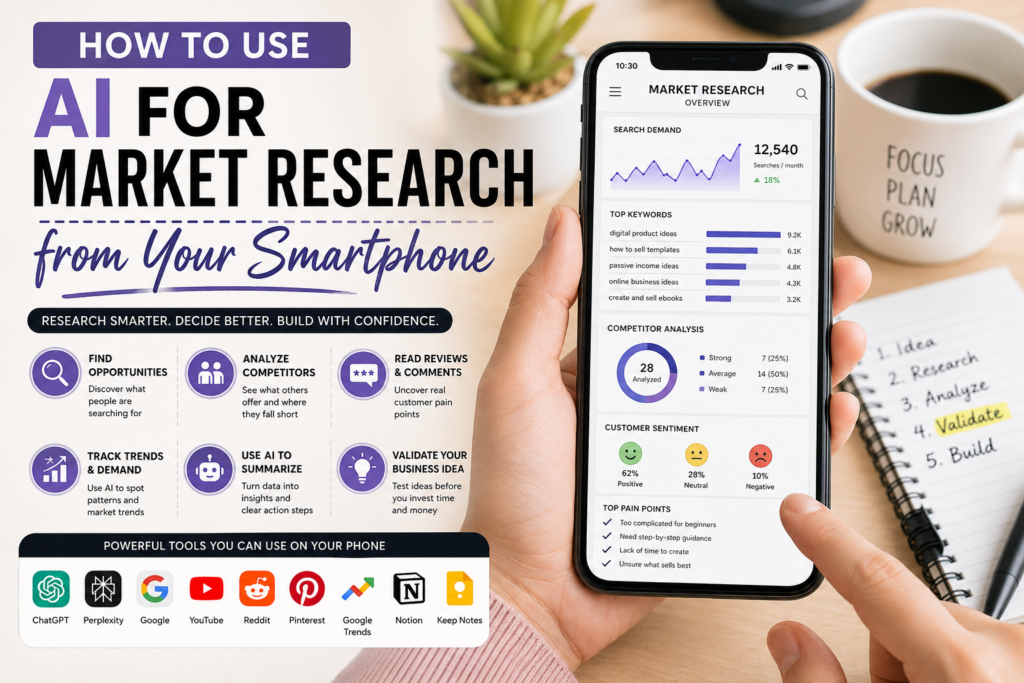
Today, you can start answering those questions from your smartphone.
With AI tools, search engines, social media platforms, review sites, marketplaces, and simple note-taking apps, your phone can become a small market research lab.
You do not need to wait until you have a perfect office, a laptop, or a big budget. You can begin testing ideas during a break, while commuting, sitting at home, or whenever inspiration appears.
That is what makes AI-powered mobile market research so interesting for beginner entrepreneurs.
You can use your phone to research a market before you waste time building the wrong business.
Affiliate disclosure: This post contains affiliate links. If you make a purchase through one of these links, ProBusinessStrategy may earn a small commission at no extra cost to you. We only recommend tools we genuinely believe in.
Why Market Research Matters Before Starting a Business
Many people start with excitement.
They get an idea.
They imagine the logo.
They think about the website.
They dream about the income.
They maybe even buy a domain name.
But they skip the most important question:
Do people actually want this?
Market research helps you avoid building a business only for yourself.
A business idea may sound good in your head, but the market decides whether it has value. If people are already searching for solutions, asking questions, buying products, complaining about existing options, or following creators in the niche, those are signals.
Market research does not guarantee success.
But it can reduce blind guessing.
It helps you understand:
Who the customer is
What problem they have
What they already buy
What competitors offer
What competitors miss
What language customers use
What content gets attention
What price points may exist
What objections people have
What angle may make your idea different
This is especially useful when you are choosing between several business ideas.
Instead of asking, “Which idea do I like most?” you can ask:
“Which idea has the clearest demand?”
That is a better question.
Why Your Smartphone Is Enough to Start
You do not need expensive software to begin.
Your phone already gives you access to:
Google search
YouTube
TikTok
Pinterest
Reddit
Amazon
Etsy
App stores
Review platforms
Competitor websites
AI chat tools
Notes apps
Spreadsheets
Voice recording
Screenshots
Social media comments
That is more than enough for early research.
The advantage of using a smartphone is speed. When you think of a business idea, you can immediately start checking it.
For example, if you are thinking about starting a digital product business for wedding planners, you can search Pinterest, Etsy, Google, YouTube, and TikTok from your phone. Then you can use AI to summarize patterns, organize ideas, and find possible content angles.
You are not trying to finish the entire business plan in one session.
You are collecting signals.
Small pieces of research can reveal a lot when you organize them properly.
What AI Adds to Market Research
AI is useful because it helps you turn scattered information into structure.
Without AI, market research can feel messy.
You search Google.
You save screenshots.
You watch videos.
You read comments.
You collect product ideas.
You open competitor websites.
You forget what you found.
AI helps you organize that chaos.
You can ask AI to:
Summarize competitor positioning
Turn customer complaints into business opportunities
Create audience personas
Identify common pain points
Compare business models
Suggest keyword clusters
Generate survey questions
Analyze product review patterns
Create content ideas
Build a simple market research report
List possible offers for a niche
Find gaps in existing content
AI does not replace your judgment.
It helps you think faster.
The important part is to feed it useful observations. AI works better when you give it real examples from your research instead of asking vague questions.
Instead of asking:
“Is this a good business idea?”
Ask:
“I found these five competitors, these customer complaints, and these common questions. What opportunities do you see?”
That produces better answers.
Step 1: Start With One Clear Business Idea
Do not research ten ideas at the same time.
Choose one.
For example:
AI wedding dress style finder
Pinterest management service
Digital product business from a phone
Mobile car wash business
Faceless YouTube channel
Local cleaning service
Print-on-demand store
Virtual assistant service
Niche affiliate website
Online course for beginners
Write the idea in one sentence.
Example:
“I want to research whether beginners need help choosing what digital product to sell first.”
Or:
“I want to research whether a wedding dress inspiration website could attract brides through Pinterest and Google.”
That one sentence gives your research direction.
If your idea is too broad, your research becomes vague.
“Online business” is too broad.
“Digital product templates for beginner Pinterest creators” is better.
The more specific the idea, the easier it is to research.
Step 2: Use Google to Understand Search Demand
Start with Google.
Type your main idea into the search bar and watch what appears in autocomplete.
For example:
“how to start a digital product…”
“wedding dress business ideas…”
“AI market research…”
“Pinterest business plan…”
“business from phone…”
Autocomplete suggestions are useful because they show what people may be searching for.
Then check:
People Also Ask questions
Related searches
Top ranking articles
Competitor titles
Common phrases
Repeated problems
Missing angles
You are not copying competitors.
You are studying the market.
Ask yourself:
What questions appear again and again?
Are the top articles detailed or weak?
Are they old or fresh?
Do they answer the beginner’s real problem?
Can I create something clearer, more practical, or more specific?
Then use AI to organize what you found.
Prompt example:
“Here are Google autocomplete suggestions and People Also Ask questions for this business idea. Organize them into customer problems, content topics, and possible product ideas.”
This turns search research into a usable plan.
Step 3: Research Competitors From Your Phone
Competitor research does not mean copying.
It means understanding what already exists.
Search for businesses, websites, YouTube channels, TikTok accounts, Pinterest profiles, newsletters, apps, digital products, or services in your niche.
For each competitor, note:
What do they sell?
Who do they target?
What words do they use?
What promise do they make?
What price range do they show?
What content do they publish?
What looks strong?
What looks weak?
What do customers ask in comments or reviews?
Your phone is perfect for this because screenshots are easy.
Create a folder for the idea and save screenshots of:
Website headlines
Pricing pages
Product descriptions
Customer reviews
Social media comments
Popular videos
Pinterest Pins
YouTube titles
FAQ sections
Then paste your observations into AI.
Prompt example:
“Analyze these competitor notes. What positioning patterns do you see? What customer segments are they targeting? What gaps could a beginner business explore?”
This gives you a clearer view of the market.
Step 4: Use Reviews to Find Real Customer Problems
Reviews are one of the best market research sources.
People reveal what they love, hate, expected, misunderstood, and wish existed.
You can find reviews on:
Amazon
Etsy
Google Business Profiles
App stores
Trustpilot
Product pages
Course platforms
YouTube comments
Reddit discussions
Facebook groups
Marketplace listings
Look for repeated phrases like:
“I wish…”
“I was confused by…”
“This helped me…”
“The problem is…”
“Too expensive…”
“Hard to use…”
“Not beginner-friendly…”
“Missing…”
“I needed…”
“Would be better if…”
These phrases are gold.
They show unmet needs.
For example, if many customers say a tool is too complicated, a business opportunity may be a beginner-friendly guide, template, service, or simplified alternative.
If buyers say a digital product is beautiful but hard to customize, maybe there is room for simpler templates.
If brides say they saved hundreds of dress photos but still feel overwhelmed, maybe a style finder or checklist could help.
Use AI to identify patterns.
Prompt example:
“Here are 20 customer review comments from this niche. Group them into pain points, desired outcomes, objections, and possible business opportunities.”
This is one of the strongest ways to use AI for research.
Step 5: Check Social Media Interest
Social media can show what people pay attention to.
You do not need to become active on every platform immediately. You can use them for research first.
Check:
TikTok videos in the niche
YouTube videos and comments
Pinterest Pins and boards
Instagram posts and reels
Facebook group discussions
Reddit threads
LinkedIn posts if it is a B2B niche
Look for:
Which topics get engagement
Which questions appear in comments
Which titles get attention
Which visuals work
Which problems get emotional responses
Which creators dominate the niche
Which content angles are overused
Which content angles are missing
For a phone-based business, this is very useful because you can research during small moments of the day.
If you find a strong TikTok video in your niche, read the comments.
The video gives you attention signals.
The comments give you customer language.
Then ask AI:
“Based on these social media comments, what does this audience seem to want, fear, misunderstand, or need help with?”
That can become blog content, product ideas, service offers, or lead magnets.
Step 6: Use AI to Build a Customer Persona
Once you collect enough signals, create a customer persona.
A persona is not a fantasy character. It is a summary of the type of person you are trying to help.
You can ask AI:
“Based on this market research, create three possible customer personas. Include their goals, frustrations, budget concerns, objections, and what kind of offer they might buy.”
For example, if you are researching digital products from a phone, AI might identify:
Beginner creator with no technical skills
Busy parent who wants a simple side income
Blogger who wants to sell templates
Small business owner who wants digital downloads
Affiliate marketer who wants bonus products
Each persona may need a different offer.
That matters because one business idea can serve different audiences.
A digital product business for teachers is different from a digital product business for wedding planners.
A market research process helps you choose who to serve first.
Step 7: Identify the Business Angle
After research, you should ask:
What is my angle?
Your angle is what makes the idea different or clearer.
For example, “market research service” is generic.
But these are more specific:
AI market research from your phone
Market research for beginner solopreneurs
Market research for wedding niche websites
Market research for digital product ideas
Competitor research for local service businesses
Pinterest-based market research for bloggers
AI-assisted product validation for beginners
A clear angle makes content easier.
It also makes marketing easier.
AI can help you compare angles.
Prompt example:
“Give me 10 possible positioning angles for this business idea based on the research. Rank them by beginner-friendliness, content potential, and monetization potential.”
This can reveal directions you may not have considered.
Step 8: Test the Idea With Content
Before building the full business, test the idea with content.
This is where your website becomes important.
Write one article.
Create one Pinterest Pin.
Make one short video.
Post one Facebook update.
Create one simple checklist.
See what people respond to.
If you are building a content-based business, you can use a simple WordPress site as your testing ground. A domain from Namecheap and hosting from Bluehost can give the business idea a real home base.
If you want to set up a site faster, WordPress AI Sitebuilder can help create a starting point without spending weeks on design.
The website does not need to be perfect.
It needs to help you publish, test, and learn.
Step 9: Turn Research Into an Offer
Market research should lead somewhere.
After studying the market, ask:
What could I offer?
Possible offers include:
A service
A digital product
A content website
A newsletter
A template
A checklist
A coaching session
A research report
An affiliate article
A comparison guide
A local business package
A niche directory
A short course
For example, if you research a niche and discover that beginners are confused, you could create a beginner guide.
If people want help comparing options, you could create a comparison template.
If businesses need research but do not want to do it themselves, you could offer a small market research service.
If you find strong affiliate opportunities, you could build comparison articles and resource pages.
If you need help turning your research into a polished presentation, workbook, brand identity, or website graphics, Fiverr can be useful for outsourcing small tasks.
The goal is not research forever.
The goal is better business decisions.
Step 10: Create a Simple Mobile Research System
To make this repeatable, create a simple system on your phone.
You need only a few folders or notes:
Business idea
Competitors
Customer problems
Keywords
Content ideas
Offer ideas
Screenshots
AI summaries
Next actions
Each time you research, save your findings in the same structure.
A simple workflow could be:
Search Google
Check competitors
Read reviews
Check social media
Save screenshots
Paste observations into AI
Summarize patterns
Choose one content angle
Create one test article or post
This makes research less overwhelming.
Instead of randomly browsing, you are building a research habit.
What AI Should Not Do
AI is powerful, but it has limits.
Do not let AI invent facts that you treat as market proof.
Do not ask AI if an idea is guaranteed to work.
Do not rely only on AI without checking real search results, competitors, comments, reviews, and customer behavior.
AI can organize, summarize, and suggest.
But real market signals come from people.
Searches.
Reviews.
Questions.
Comments.
Purchases.
Complaints.
Competitors.
Trends.
Communities.
The strongest research combines AI thinking with real-world evidence.
Common Mistakes to Avoid
Mistake 1: Researching Too Broadly
If your niche is too broad, your findings become useless.
Research “digital product ideas for beginner wedding planners” instead of only “digital products.”
Specific research produces better business ideas.
Mistake 2: Only Looking at Successful Competitors
Do not only study the biggest players.
Look at small creators, new websites, Etsy sellers, local businesses, and niche blogs too.
Smaller competitors often reveal realistic opportunities.
Mistake 3: Ignoring Customer Complaints
Complaints are not negative noise.
They are business clues.
Every repeated complaint may point to a better product, clearer guide, simpler service, or more useful content angle.
Mistake 4: Asking AI Vague Questions
Weak prompt:
“Is this a good idea?”
Better prompt:
“Based on these competitor notes, customer complaints, and search questions, what are three realistic business angles for a beginner?”
Better input creates better output.
Mistake 5: Never Testing
Research can become procrastination.
At some point, you need to publish something, offer something, or test something.
A small test is better than endless planning.
Who This Is Best For
AI-powered market research from a smartphone is useful for:
Beginner entrepreneurs
Solopreneurs
Bloggers
Affiliate marketers
Digital product creators
Service providers
YouTube creators
Pinterest marketers
Local business starters
People with many business ideas
People who want to validate before building
It is especially useful if you are still choosing between ideas.
Instead of guessing, you can compare markets from your phone.
Getting Started This Week
Start with one idea.
Do not make it complicated.
Open your phone and research for 30 minutes.
Search the idea on Google.
Check autocomplete and People Also Ask.
Find three competitors.
Read ten customer comments or reviews.
Save screenshots.
Paste your notes into AI.
Ask for patterns, customer problems, and possible content angles.
Choose one small test.
That test could be a blog post, Pinterest Pin, short video, simple landing page, or small service offer.
The goal is not to finish the entire business today.
The goal is to learn something useful before you build too much.
AI market research from your smartphone gives you a faster way to think.
It helps you move from random ideas to informed decisions.
And for a beginner entrepreneur, that can make the difference between building blindly and building with direction.
Internal Linking
Related Articles:
How to Use ChatGPT from Your Phone for Business
50 Businesses You Can Run from Your Phone
How to Create a YouTube Affiliate Channel from Your Smartphone