One of the biggest questions for new entrepreneurs is simple:
What should I sell first?
A service?
A physical product?
A digital product?
At first, this sounds like a small decision. But it can shape the entire direction of your business.
If you choose the wrong first offer, you may waste months building something nobody wants. You may spend money on inventory before you understand your customer. You may create a digital product before anyone trusts you. Or you may offer a service that takes too much time and leaves no room to grow.
The good news is that you do not need to choose perfectly forever.
You only need to choose the best first offer for your current situation.
A first offer is not your final business model. It is your starting point. It helps you learn what people want, what they are willing to pay for, and what kind of business you actually enjoy building.
This guide compares three common starting points: selling a service, selling a physical product, and selling a digital product.
By the end, you should have a clearer idea of which one makes the most sense for your first business move.
Affiliate disclosure: This post contains affiliate links. If you make a purchase through one of these links, ProBusinessStrategy may earn a small commission at no extra cost to you. We only recommend tools we genuinely believe in.
Why Your First Offer Matters
Many beginners start with the wrong question.
They ask:
“What business can make the most money?”
A better question is:
“What can I sell first that helps me learn fast, start realistically, and get closer to real customers?”
That matters because the beginning of a business is full of uncertainty.
You do not fully know your audience yet.
You do not know which offer will work.
You do not know your pricing.
You do not know which marketing channel will perform best.
You do not know what objections people will have.
Your first offer should help you discover these answers.
That is why the first offer does not need to be perfect. It needs to be practical.
A good first offer should be:
Easy enough to launch
Clear enough to explain
Useful enough that someone might pay
Simple enough to deliver
Flexible enough to improve
Connected to a real customer problem
This is why services are often easier to start with, physical products are often harder, and digital products are powerful but need the right positioning.
Option 1: Selling a Service First
A service is often the simplest first offer.
You sell your time, skill, knowledge, or help to another person or business.
Examples include:
Writing
Graphic design
Website setup
Social media management
Virtual assistance
Bookkeeping
Video editing
Consulting
Coaching
Cleaning
Lawn care
Mobile car wash
Photography
Tutoring
SEO services
Local marketing
The biggest advantage of a service is that you can often start before building a complicated system.
You do not need inventory.
You do not need a warehouse.
You do not need a full product line.
You do not need a large audience.
You do not need to create a course before knowing what people want.
You need one clear problem and one clear result.
For example:
“I help local businesses set up a simple website.”
“I create Pinterest Pins for bloggers.”
“I edit short videos for TikTok creators.”
“I help small business owners write blog posts.”
“I clean offices for local companies.”
That is why a service can be a strong first step.
Why Services Are Beginner-Friendly
Services create direct feedback.
When you work with clients, you quickly learn what people ask for, what they do not understand, what they value, what they complain about, and what they are willing to pay.
This is valuable.
A service business teaches you the market from the inside.
You learn the language customers use.
You learn common problems.
You learn which results matter.
You learn what people expect.
You learn what you can charge.
This knowledge can later help you create digital products, templates, courses, checklists, or software ideas.
A service can become the research phase for a larger business.
The Downside of Selling Services
The main downside is time.
When you sell a service, you often trade time for money.
If you stop working, income may stop.
A service business can also become stressful if you accept the wrong clients, undercharge, or fail to define the scope clearly.
That is why a service needs boundaries.
You should know:
What is included
What is not included
How much it costs
How long it takes
How many revisions are included
When payment is due
What result you are responsible for
A simple service can become difficult when expectations are unclear.
But as a first offer, services are still one of the fastest ways to enter the market.
Best for Beginners Who Have a Skill
A service is usually best if you already have a skill or can learn one quickly.
You do not need to be the world’s top expert.
You need to be good enough to help a specific type of customer with a specific problem.
For example, you may not be a full marketing agency, but you can help a local business create basic social media posts.
You may not be a professional web development company, but you can help a beginner set up a simple WordPress website.
If you need help with branding, website design, client materials, or logo creation, you can use freelancers on Fiverr to support parts of the process while you focus on selling and delivering the service.
That can make a small service business easier to start.
Option 2: Selling a Physical Product First
A physical product is something customers can touch, use, wear, eat, store, or receive.
Examples include:
Clothing
Accessories
Home decor
Beauty products
Food products
Fitness products
Tools
Pet products
Office products
Printed items
Handmade products
Subscription boxes
Physical products can be exciting because they feel real.
You can photograph them.
You can package them.
You can sell them online.
You can build a brand around them.
You can create an e-commerce store.
But physical products usually require more planning than services.
Why Physical Products Are Attractive
Physical products are easier for customers to understand.
A customer can look at a product and quickly decide if they want it.
A mug is a mug.
A shirt is a shirt.
A notebook is a notebook.
A phone case is a phone case.
This can make marketing easier in some ways.
Physical products are also good for visual platforms like Pinterest, Instagram, TikTok, and YouTube Shorts. You can show the product, demonstrate it, compare it, package it, or show how it solves a problem.
If your product has strong visual appeal, social media can help.
Physical products also have brand potential.
A small product can become a full store.
A store can become a niche brand.
A niche brand can expand into more products.
That is the dream many entrepreneurs like.
The Downside of Physical Products
The problem is that physical products often involve more risk.
You may need inventory.
You may need packaging.
You may need shipping.
You may need returns.
You may need product photos.
You may need suppliers.
You may need quality control.
You may need customer service.
If you buy inventory before testing demand, you could be stuck with products that do not sell.
That is why beginners should be careful.
A physical product can work, but it is usually safer to start small.
You can test demand before buying large quantities. You can use pre-orders, small batches, print-on-demand, or dropshipping-style validation before committing too much money.
For example, a beginner who wants to sell custom printed products could test designs through Printful instead of buying inventory upfront.
If you want to build an online store, Shopify can be a practical option for product-based businesses, especially when you want a dedicated e-commerce setup.
The key is to avoid turning your first product idea into a big financial risk too early.
Best for Beginners Who Understand a Niche
A physical product is usually best if you understand a specific niche.
For example:
Fitness beginners
Dog owners
Home office workers
New parents
Gardeners
Coffee lovers
Travelers
Students
Small business owners
People buying gifts
The more specific your audience, the easier it becomes to choose the right product, write better descriptions, design better Pins, create better videos, and understand what people want.
A physical product without a clear audience is just inventory.
A physical product with a clear audience can become a brand.
Option 3: Selling a Digital Product First
A digital product is something customers can buy and download, access, or use online.
Examples include:
E-books
Templates
Checklists
Spreadsheets
Planners
Courses
Printables
Notion templates
Canva templates
Swipe files
Guides
Workbooks
Digital art
AI prompts
Business plan templates
Digital products are attractive because they can be created once and sold many times.
There is no shipping.
No physical inventory.
No warehouse.
No packaging.
No restocking.
That makes digital products powerful for solopreneurs.
Why Digital Products Are Attractive
Digital products are scalable.
If you sell a service, you may need to do the work each time.
If you sell a digital product, the customer can buy it without you personally delivering the work again.
That is the big appeal.
A digital product can also be created around knowledge you already have.
For example:
A freelancer can sell client onboarding templates.
A blogger can sell content calendars.
A fitness coach can sell workout plans.
A business writer can sell business idea worksheets.
A Pinterest creator can sell Pin planning templates.
A YouTube creator can sell script templates.
A digital product is often the productized version of knowledge.
It takes something useful from your experience and turns it into a repeatable asset.
The Downside of Digital Products
The biggest challenge is trust.
People usually do not buy digital products from someone they do not trust.
If you have no audience, no website, no examples, no content, and no clear promise, selling a digital product can be difficult.
That does not mean you cannot start with a digital product.
But you need a strong problem and a clear result.
A weak digital product says:
“Here is my e-book.”
A stronger digital product says:
“Here is a 30-day plan to help you choose your first business idea.”
The second one is more specific.
Digital products also require traffic.
You need people to see the offer. That traffic can come from Pinterest, Google, TikTok, YouTube, email, partnerships, or paid ads.
This is why content and digital products work well together.
An article brings the visitor.
The digital product gives them the next step.
Best for Beginners Who Create Content
Digital products are often best for people who are already creating content.
If you write blog posts, make YouTube videos, post on Pinterest, or build an email list, you are already educating people.
A digital product can become the paid extension of that education.
For example:
A blog post explains the concept.
A checklist helps the reader apply it.
A video teaches the strategy.
A template helps the viewer implement it.
A guide gives the full system.
That is why digital products fit content businesses so well.
If you are building a website around your business idea, you can register a domain through Namecheap and use Bluehost to build a simple WordPress site where your articles and digital products can live.
Your website becomes the home for your content, products, and offers.
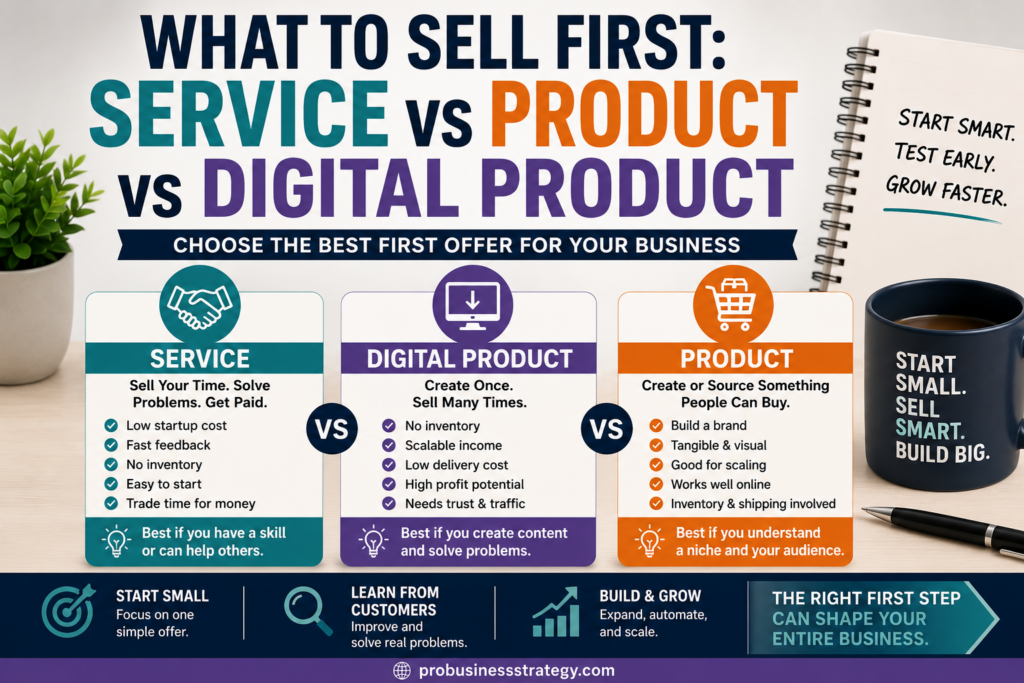
Service vs Product vs Digital Product
So which one should you sell first?
Here is the simple comparison.
Service
Best if you want to start fast, learn from customers, and earn with skills.
Advantages:
Low startup cost
Fast feedback
No inventory
Easy to customize
Good for beginners with skills
Can lead to digital products later
Disadvantages:
Harder to scale
Uses your time
Requires client communication
Can lead to scope creep
Income may stop when you stop working
Physical Product
Best if you understand a specific niche and want to build an e-commerce brand.
Advantages:
Easy for customers to understand
Visual and social media friendly
Can become a brand
Good for Pinterest, Instagram, TikTok, and ads
Can scale with systems
Disadvantages:
Inventory risk
Shipping and returns
Supplier issues
Customer service
Higher startup complexity
May require upfront money
Digital Product
Best if you create content, understand a problem, and can package knowledge into a useful resource.
Advantages:
No physical inventory
Scalable
Low delivery cost
Good for solopreneurs
Works well with blogs and email lists
Can become passive or semi-passive income
Disadvantages:
Needs trust
Needs traffic
Can be hard to sell without an audience
Requires clear positioning
Customers expect useful, polished resources
The Best First Choice for Most Beginners
For many beginners, the best first offer is a service.
Not always. But often.
Why?
Because a service lets you start with less money, talk to real customers, and learn quickly.
You can sell a service, understand the customer problem, and later turn that knowledge into a digital product.
For example:
You offer Pinterest management.
You learn what clients struggle with.
You create a Pinterest content calendar template.
Then you sell the template as a digital product.
Or:
You offer website setup services.
You learn what beginners do not understand.
You create a beginner website checklist.
Then you sell the checklist.
Or:
You offer blog writing.
You learn what business owners need.
You create blog post templates.
Then you sell those templates.
This is a powerful path:
Service first.
Digital product later.
Physical product only when the audience and demand are clearer.
But this is not the only path.
If you already have a strong product idea and know your audience, a physical product can work.
If you already have content and trust, a digital product can work.
The best choice depends on your situation.
A Simple Decision Framework
Use these questions before choosing what to sell first.
Do You Need Money Quickly?
If yes, consider a service first.
Services are often the fastest path to revenue because you can sell before building a complex product.
Do You Have an Audience Already?
If yes, a digital product may work.
If people already read your content, follow your videos, or trust your advice, a digital product gives them a next step.
Do You Have Money for Inventory?
If no, be careful with physical products.
Consider print-on-demand, pre-orders, or small tests before buying stock.
Do You Have a Clear Skill?
If yes, a service can be a strong starting point.
Sell the skill first. Productize the knowledge later.
Do You Want to Build a Brand?
If yes, physical products or digital products can both work, but they require a clear audience and consistent marketing.
Do You Want Low Complexity?
If yes, start with a simple service or a simple digital product.
Avoid complicated inventory, shipping, custom software, or large upfront systems at the beginning.
A Smart Path: Service to Digital Product
One of the best beginner paths is starting with a service and turning it into a digital product later.
This works because your service clients teach you what the market wants.
You discover repeated questions.
You notice repeated problems.
You create repeated solutions.
Those repeated solutions can become templates, guides, checklists, or courses.
For example:
A virtual assistant creates a client onboarding checklist.
A social media manager creates a content calendar.
A business coach creates a startup roadmap.
A web designer creates a website launch checklist.
A writer creates blog post templates.
A consultant creates a decision worksheet.
This is how a service becomes scalable.
You are no longer starting from theory.
You are building digital products from real customer problems.
Another Smart Path: Content to Digital Product
If you already enjoy writing, video, Pinterest, or social media, you can start with content and then create digital products.
This path looks like this:
Choose a niche
Publish helpful content
Build trust
Notice repeated questions
Create a simple digital product
Promote it inside related content
This path is slower than selling a service, but it can become powerful over time.
For example, a blog about business ideas can later sell:
Business idea worksheets
Startup checklists
Business plan templates
Affiliate marketing guides
Content calendars
AI prompt packs
Digital product planners
This model fits solopreneurs who want to build a long-term content asset.
When to Start With a Physical Product
Starting with a physical product can make sense when:
You understand the audience well
The product solves a clear problem
You can test demand cheaply
You have good visuals
You can handle fulfillment
You have a marketing plan
You are not risking too much money upfront
Print-on-demand can be useful because you can test designs without holding inventory. For example, Printful can help creators test custom products while avoiding large stock purchases.
If the product starts to sell, you can expand.
But do not let excitement replace validation.
A product that looks good to you still needs buyers.
The Biggest Mistake: Building Before Testing
Many beginners spend too much time building before selling.
They build a website.
They design a logo.
They create a product.
They buy inventory.
They write a long course.
They create business cards.
They set up tools.
They wait for everything to be perfect.
Then they finally show the offer to the market.
And nobody buys.
That is painful.
A better approach is to test earlier.
Talk to potential customers.
Publish content.
Offer a small service.
Create a simple landing page.
Test a small product batch.
Pre-sell a digital product.
Ask what people struggle with.
The market gives better feedback than your imagination.
Getting Started This Week
If you are not sure what to sell first, do not overcomplicate it.
Choose one small offer and test it.
If you have a skill, create a simple service offer.
Example:
“I help small business owners create 10 Pinterest Pins for one blog post.”
If you have a product idea, test interest before buying inventory.
Example:
Create a mockup, show it to the audience, and see if people respond.
If you want to sell a digital product, start with something small.
Example:
A checklist, worksheet, template, or short guide.
Do not start with a massive course unless you already know people want it.
Your first offer should help you learn.
That is the real purpose.
The first thing you sell may not be the thing that makes you rich.
But it can teach you what people want, what you enjoy, what problems matter, and where the business can go next.
Start small.
Sell something useful.
Listen carefully.
Improve the offer.
Then build from there.
Internal Linking
Related Articles:
50 Businesses You Can Run from Your Phone
How to Use ChatGPT from Your Phone for Business
How to Create a YouTube Affiliate Channel from Your Smartphone