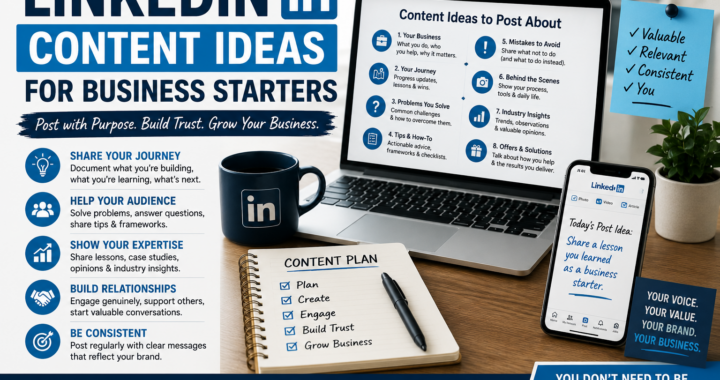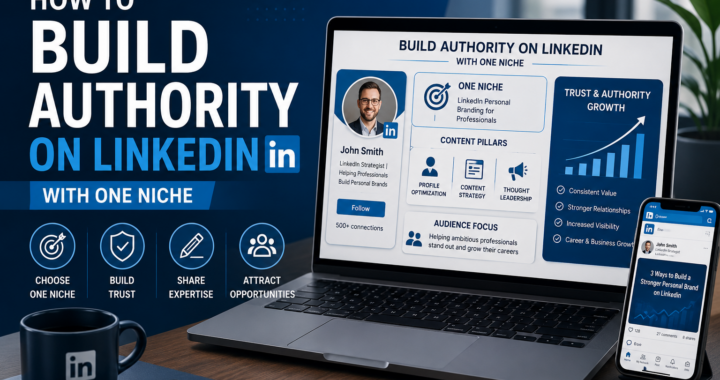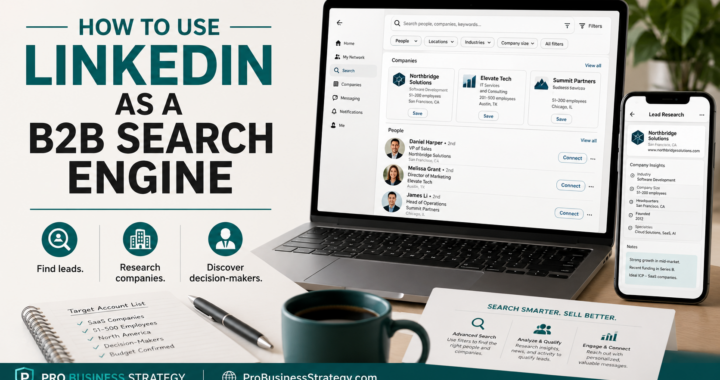
Many people avoid LinkedIn because they think business on LinkedIn means one thing:
Sending cold messages to strangers.
They imagine opening LinkedIn, connecting with random people, and immediately sending a sales pitch that nobody asked for.
That is exactly why many entrepreneurs never use LinkedIn properly.
They do not want to feel pushy.
They do not want to annoy people.
They do not want to become one of those accounts that sends fake-friendly messages and then immediately tries to sell something.
The good news is that LinkedIn business does not have to work that way.
You can build a real business presence on LinkedIn without cold DM spam. You can attract leads, start conversations, build authority, create trust, and become visible to the right people without sending aggressive outreach messages.
The better approach is simple:
Use LinkedIn as a trust-building platform, not as a spam machine.
That means your profile, content, comments, conversations, and offers all work together. Instead of chasing people with unwanted messages, you create enough clarity and value that the right people become interested in what you do.
This is where ethical LinkedIn marketing becomes a strong business idea.
Affiliate disclosure: This post contains affiliate links. If you make a purchase through one of these links, ProBusinessStrategy may earn a small commission at no extra cost to you. We only recommend tools we genuinely believe in.
Why Cold DM Spam Feels Wrong
Cold outreach is not always bad.
A respectful, relevant, well-researched message can sometimes open a real business conversation. But most cold DMs on LinkedIn are not like that.
They are often generic.
They sound automated.
They are sent to too many people.
They pretend to be personal.
They pitch too quickly.
They ignore the receiver’s actual situation.
They focus on the seller, not the buyer.
That is why people dislike them.
A typical bad message looks like this:
“Hi, I saw your profile and thought we should connect. I help business owners get more leads. Are you open to a quick call?”
The problem is not only the message.
The problem is that there is no trust yet.
The receiver does not know you. They did not ask for help. They do not know if you understand their business. They do not know if your offer is relevant.
So the message feels intrusive.
That is why a better LinkedIn business strategy starts before the message.
It starts with visibility and trust.
The Better Way to Use LinkedIn for Business
Instead of using LinkedIn as a cold message platform, use it as a business positioning platform.
Your goal is to make three things clear:
Who you help
What problem you solve
Why people should trust you
This can happen through:
Your profile headline
Your banner
Your About section
Your featured links
Your posts
Your comments
Your case studies
Your short stories
Your content topics
Your offers
Your website or landing page
When these pieces work together, people can understand what you do before you ever send them a message.
That changes the entire feeling of LinkedIn.
Instead of saying:
“Let me interrupt strangers and ask for a call.”
You are saying:
“Let me become visible to the right people and make it easy for them to understand how I can help.”
That is much stronger.
Business Idea 1: LinkedIn Content-to-Consulting Business
This is one of the best LinkedIn business models without cold DMs.
You publish useful posts around a specific problem your ideal client has. Over time, people begin to associate you with that topic.
For example:
A consultant writes about helping small businesses improve their website conversion.
A coach writes about helping new managers become better leaders.
A freelancer writes about helping founders turn rough ideas into clear content.
A marketing strategist writes about helping local service businesses get better leads.
The content does not need to be viral.
It needs to be clear.
The goal is to create posts that make the right person think:
“This person understands my problem.”
That is the beginning of trust.
A good content-to-consulting system includes:
Educational posts
Problem breakdowns
Simple frameworks
Before-and-after examples
Mistakes to avoid
Client lessons
Industry observations
Clear service offers
A profile that explains how to work with you
This can lead to consulting calls without spam because people already understand your value.
For a deeper strategy, this connects well with How to Turn LinkedIn Posts into Consulting Leads.
Business Idea 2: LinkedIn Profile Optimization Service
Many professionals have weak LinkedIn profiles.
Their headline is vague.
Their banner says nothing.
Their About section reads like a resume.
Their featured section is empty.
Their services are unclear.
Their profile does not explain what they actually help people do.
That creates a business opportunity.
You can offer LinkedIn profile optimization for:
Consultants
Coaches
Freelancers
Agency owners
Job seekers
Founders
Sales professionals
Personal brands
Solopreneurs
Service providers
This business does not require cold DM spam if you create content that shows profile mistakes and improvements.
For example:
“Your LinkedIn headline should not only say your job title. It should explain who you help and what result you create.”
Or:
“Your LinkedIn banner is free advertising space. Do not waste it.”
These posts attract people who realize their profile needs help.
You can also create before-and-after examples, profile checklists, and mini audits.
A natural affiliate placement here is Fiverr for people who need help with a LinkedIn banner, profile design, copywriting, or content templates.
Business Idea 3: LinkedIn Comment Authority Strategy
You do not have to post every day to build visibility on LinkedIn.
You can also grow through smart commenting.
This is one of the most underrated LinkedIn strategies.
Instead of sending cold messages, you leave thoughtful comments on posts from people in your niche.
Not generic comments like:
“Great post.”
But useful comments that add perspective.
For example:
“That is a strong point. I see the same issue with beginner consultants. They often try to sell the service before they have explained the problem clearly. A better first step is to define the pain point in the language the client already uses.”
That kind of comment can attract profile views.
When people click your profile and immediately understand what you do, some may follow, connect, visit your website, or start a conversation.
This can become a business model for people who do not want to create long content immediately.
You can build authority by showing your thinking in other people’s conversations.
This is especially useful for:
Consultants
Freelancers
Writers
Coaches
B2B service providers
Career experts
Marketing specialists
Business strategists
The key is consistency.
Comment daily on relevant posts, not random viral posts.
Business Idea 4: LinkedIn Lead Magnet Funnel
A lead magnet is a free useful resource people can download in exchange for an email address.
On LinkedIn, this can work very well when the resource solves a specific professional problem.
Examples:
LinkedIn profile checklist
Consulting offer worksheet
Client onboarding checklist
Freelancer pricing guide
Content calendar template
Cold DM alternative guide
Business positioning worksheet
B2B content strategy checklist
High-ticket client preparation guide
The LinkedIn content creates interest.
The lead magnet captures the relationship.
Then email can continue the conversation.
This is much better than pushing people directly into a sales call before they trust you.
A simple funnel could look like this:
LinkedIn post
Profile visit
Featured link
Lead magnet page
Email signup
Follow-up emails
Soft service offer
This is ethical because the person chooses to enter your world.
You are not forcing yourself into their inbox with a pitch.
If you want to make this stronger, you can create a simple website or landing page. A domain from Namecheap and hosting from Bluehost can give the funnel a proper home base.
Business Idea 5: LinkedIn Newsletter Business
LinkedIn newsletters can be used to build a recurring audience around a topic.
This can work well if you have a clear niche.
Examples:
Weekly LinkedIn tips for solopreneurs
Client acquisition lessons for consultants
Personal branding for service providers
B2B content ideas for founders
Freelance business growth
AI tools for professionals
Simple marketing for local businesses
A newsletter gives people a reason to follow you beyond one post.
The business model can include:
Consulting
Coaching
Affiliate links
Digital products
Sponsorships
Paid templates
Courses
Workshops
Community offers
The advantage is that you are building trust over time.
You are not trying to sell immediately.
You are becoming part of the reader’s routine.
That can be much more powerful than cold outreach.
Business Idea 6: LinkedIn Case Study Content Business
Case studies are powerful because they show proof.
You can build a business around creating or teaching case study content for professionals and companies.
Many businesses have results but do not know how to tell the story.
They may have helped clients save time, increase revenue, improve operations, build systems, or solve difficult problems. But they do not turn those wins into content.
A LinkedIn case study service can help them create:
Client success stories
Before-and-after posts
Project breakdowns
Lessons learned posts
Consulting result summaries
Founder story posts
Service proof content
Sales enablement content
This is valuable because case studies can support trust and sales.
You can attract clients by publishing your own case-study-style content.
For example:
“Most case studies are too vague. A better case study explains the problem, the process, the result, and the lesson.”
That kind of content speaks directly to business owners who need better proof.
Business Idea 7: LinkedIn Content Repurposing Service
Many entrepreneurs already create content somewhere else.
They have podcasts.
They have YouTube videos.
They have webinars.
They have blog posts.
They have newsletters.
They have client calls.
They have presentations.
But they do not have time to turn that content into LinkedIn posts.
That creates a service opportunity.
You can help them repurpose existing content into LinkedIn posts.
For example:
One podcast episode becomes five LinkedIn posts.
One webinar becomes ten short posts.
One blog article becomes a carousel.
One client lesson becomes a story post.
One YouTube video becomes a text post and newsletter.
This is a strong business idea because you are not asking clients to create more.
You are helping them use what they already have.
This also avoids cold DM spam because your own LinkedIn content can show examples of repurposing.
You can post:
“Here is how I would turn a 20-minute podcast into five LinkedIn posts.”
That demonstrates the service.
Business Idea 8: LinkedIn Soft Networking System
Networking does not have to mean spamming.
A soft networking system is based on genuine interaction.
It works like this:
Follow relevant people
Read their content
Leave thoughtful comments
Share useful resources when appropriate
Connect after real interaction
Continue the conversation naturally
Offer help only when relevant
This is slower than blasting messages, but it is more human.
A business can be built around teaching this system.
Possible offers:
LinkedIn networking workshop
Soft outreach templates
Relationship-building playbook
Ethical LinkedIn marketing course
B2B conversation starter guide
LinkedIn warm lead system
This is a good niche because many people want to use LinkedIn but hate aggressive selling.
You can position the business as:
“LinkedIn growth without becoming annoying.”
That message has strong appeal.
Business Idea 9: LinkedIn Personal Brand for High-Ticket Services
High-ticket services often require trust.
People do not usually buy expensive consulting, coaching, or strategy work from a stranger after one message.
They need confidence.
LinkedIn can help build that confidence.
A personal brand for high-ticket services should show:
Expertise
Point of view
Proof
Clarity
Values
Process
Client understanding
Specific problems solved
Reasons to trust you
This does not mean becoming a motivational influencer.
It means becoming known for solving a specific problem.
For example:
“I help B2B consultants turn their expertise into clear service offers.”
Or:
“I help small business owners build simple content systems.”
Or:
“I help founders explain complex products in simple language.”
This connects well with LinkedIn Personal Branding for High-Ticket Clients From Your Phone.
The business opportunity can be either using LinkedIn for your own high-ticket service or helping others build that positioning.
Business Idea 10: LinkedIn Educational Carousel Business
Carousels can work well on LinkedIn when they explain a useful idea clearly.
A carousel is not just a pretty design.
It is a mini-lesson.
A business can be built around creating LinkedIn carousels for consultants, coaches, SaaS companies, agencies, or creators.
Possible carousel topics:
Common mistakes
Step-by-step frameworks
Before-and-after explanations
Industry myths
Simple checklists
Decision trees
Process breakdowns
Client education
Product education
This business can include writing, design, strategy, and repurposing.
Again, no cold spam is required.
You can publish examples on your own profile.
If people like the way you explain ideas, they may ask for help.
Why a Website Makes LinkedIn Stronger
LinkedIn is powerful, but it should not be your only asset.
Your profile and content live on LinkedIn’s platform.
A website gives you more control.
It can hold:
Your service page
Case studies
Lead magnets
Blog articles
Contact forms
Affiliate links
Digital products
Portfolio examples
Newsletter signup
Resource pages
LinkedIn creates attention.
Your website turns that attention into a business asset.
This is especially useful if you are building a service business or content business. Your LinkedIn profile can link to your website, and your website can explain your offer in more detail.
If you want a simple setup, WordPress Website Builder can help create a professional starting point without overcomplicating the process.
What to Post Instead of Sending Cold DMs
Here are content types that can attract interest without spam.
Problem Posts
Talk about a problem your audience recognizes.
Example:
“Many consultants do not have a lead problem. They have a clarity problem. People do not understand what they actually do.”
Mistake Posts
Show common mistakes.
Example:
“Three LinkedIn profile mistakes that make people ignore your service.”
Framework Posts
Teach a simple model.
Example:
“The no-spam LinkedIn system: profile clarity, useful content, thoughtful comments, soft conversations.”
Story Posts
Share a lesson from experience.
Example:
“I used to think LinkedIn was only for corporate people. Then I realized it works best when you treat it like a trust platform.”
Checklist Posts
Give practical steps.
Example:
“Before you send another cold DM, check these five things on your profile.”
Comparison Posts
Compare two approaches.
Example:
“Cold DM spam vs trust-based LinkedIn marketing.”
Soft Offer Posts
Explain how you help.
Example:
“If your LinkedIn profile does not explain what you do in five seconds, I can help you rewrite it.”
These posts create interest without pushing.
How to Start Without Feeling Like an Influencer
Many solopreneurs do not want to become influencers.
That is fine.
LinkedIn business does not require dancing, viral drama, or constant personal storytelling.
You can build with simple professional content.
Start with three content pillars:
Your audience’s problem
Your method or point of view
Your offer or service
For example, if your business helps consultants improve LinkedIn, your pillars could be:
Profile clarity
Content that attracts leads
Ethical networking without spam
Then post about those topics repeatedly.
You do not need to be everywhere.
You need to be clear and consistent.
This connects directly with How to Build a LinkedIn Business Without Becoming an Influencer.
Common Mistakes to Avoid
Mistake 1: Pitching Too Early
Do not pitch before trust exists.
Let your profile, content, and comments do some of the work first.
Mistake 2: Being Too Vague
A profile that says “I help businesses grow” is too broad.
Be specific.
Who do you help?
With what problem?
What outcome?
Mistake 3: Posting Random Content
Random motivational quotes will not build a clear business.
Focus on the problems and desires of your ideal audience.
Mistake 4: Ignoring Comments
Comments can create relationships.
Do not only publish and disappear.
Mistake 5: Trying to Sound Bigger Than You Are
You do not need to pretend to be a massive agency.
A clear, honest solopreneur can still attract serious clients.
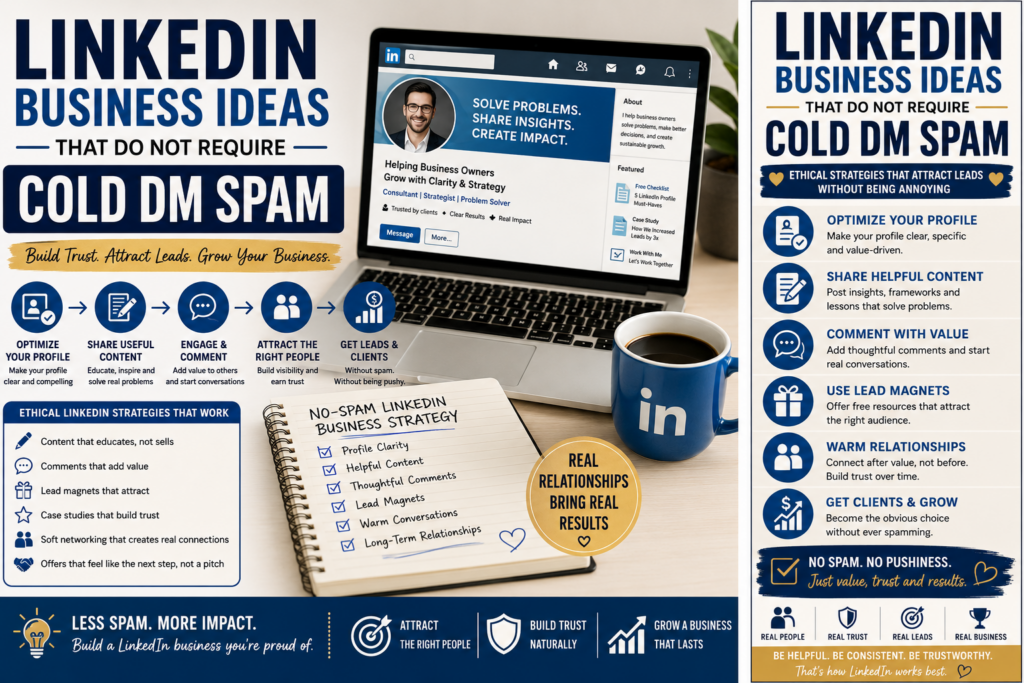
A Simple No-Spam LinkedIn System
Here is a practical system:
Optimize your profile.
Choose one clear audience.
Create three content pillars.
Post useful content two to four times per week.
Comment thoughtfully on relevant posts.
Add a lead magnet or service link to your profile.
Start conversations naturally when people engage.
Offer help only when it fits.
This is slower than spam.
But it builds a much better reputation.
Getting Started This Week
If someone wants to start this business this week, the first step is simple.
Do not send 100 cold DMs.
Instead:
Rewrite your headline.
Improve your About section.
Add a clear featured link.
Choose one business problem to talk about.
Write three posts about that problem.
Leave thoughtful comments on ten relevant posts.
Create one simple lead magnet or service page.
Invite natural conversations from people who engage.
This is enough to start.
The goal is not instant leads.
The goal is to become visible, clear, and useful.
That is how LinkedIn can become a business channel without becoming a spam channel.
Final Thoughts
LinkedIn business does not have to mean cold DM spam.
There are many better ways to use the platform.
You can build a consulting business, profile optimization service, content repurposing offer, case study writing service, carousel design business, newsletter, lead magnet funnel, or high-ticket personal brand without annoying strangers.
The key is to stop treating LinkedIn like a list of people to pitch.
Treat it like a platform for trust.
Show what you know.
Explain problems clearly.
Help people think better.
Make your profile easy to understand.
Create useful content.
Start real conversations.
Offer help when it makes sense.
That is ethical LinkedIn marketing.
And for many solopreneurs, it is a much better business model than chasing strangers with messages they never wanted.
Internal Linking
Related Articles:
The Complete LinkedIn Business Plan for Solopreneurs
How to Turn LinkedIn Posts into Consulting Leads
How to Build a LinkedIn Business Without Becoming an Influencer
LinkedIn Business Ideas for Solopreneurs
LinkedIn Personal Branding for High-Ticket Clients From Your Phone