Most people think franchise content is only about big names.
McDonald’s. Subway. KFC. 7-Eleven. Dunkin’. Burger King.
Those brands are interesting, but they are not always realistic for beginners. The startup costs can be high, the rules can be strict, and many people watching business content are not ready to invest hundreds of thousands of dollars into a major franchise.
That is where the micro-franchise review YouTube channel becomes interesting.
Instead of focusing only on large franchise systems, this channel idea focuses on smaller, lower-cost, more accessible franchise and business opportunity models. These could include mobile services, cleaning franchises, vending concepts, small food kiosks, home service brands, tutoring services, pet care models, delivery routes, and other simple business systems that ordinary people can understand.
The idea is simple:
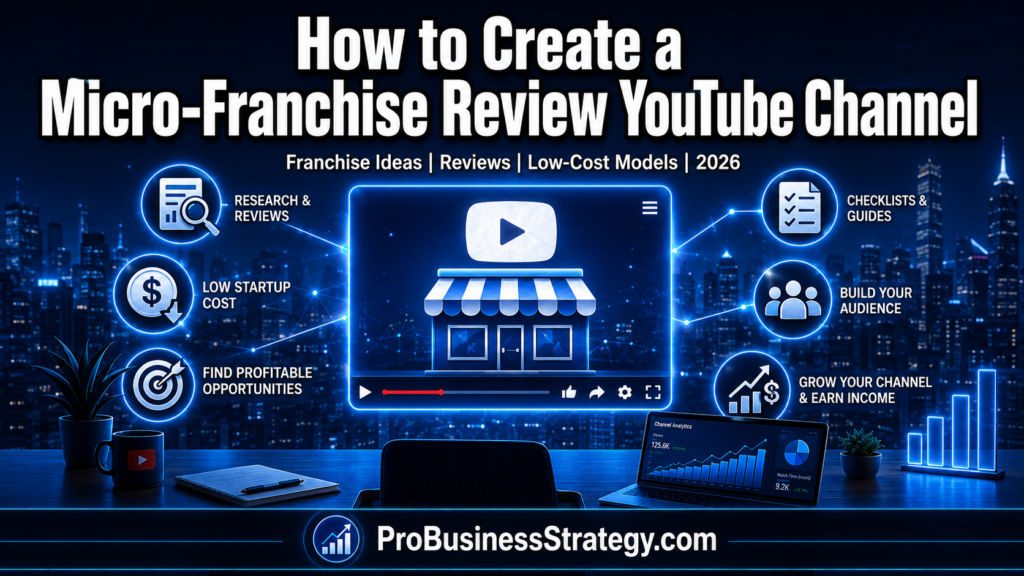
You create a YouTube channel that reviews micro-franchise opportunities, explains how they work, compares startup costs, looks at pros and cons, and helps beginners understand whether these small franchise models are worth studying.
You are not selling the franchise. You are not promising success. You are building a content business around research, explanation, comparison, and education.
That makes this a strong out-of-the-box YouTube business idea.
Affiliate disclosure: This post contains affiliate links. If you make a purchase through one of these links, ProBusinessStrategy may earn a small commission at no extra cost to you. We only recommend tools we genuinely believe in.
Why Micro-Franchise Content Can Work
Franchise content has natural curiosity.
People want to know how much it costs.
They want to know how much money a franchise can make.
They want to know what the owner actually does.
They want to know whether the business is realistic for beginners.
But most franchise content focuses on big brands.
That leaves space for smaller opportunities.
A micro-franchise review channel can stand out because it focuses on the kind of business models people rarely see explained in detail. These are not always glamorous businesses, but they can be practical, local, and easier to understand than large corporate franchise systems.
For example, a viewer may never be able to open a major fast-food franchise. But they may be curious about a mobile cleaning franchise, a small vending concept, a local service franchise, or a home-based business opportunity.
That difference matters.
The audience is not only watching for entertainment. They are watching because they may actually be researching a business idea.
That gives this channel strong commercial intent.
The Core Channel Concept
The core idea is to create videos that review and explain small franchise opportunities.
Each video can focus on one franchise, one category, or one comparison.
For example:
Best low-cost franchise ideas for beginners
Mobile franchise businesses explained
Cleaning franchise review for first-time owners
Micro-franchise opportunities under a certain investment level
Food kiosk franchises versus mobile service franchises
Home-based franchise ideas for solopreneurs
Pet service franchise opportunities
Vending and route-based business models
The channel becomes a research library for people who want to explore franchise ownership without immediately jumping into large, expensive brands.
This gives you a clear position:
You help beginners understand smaller franchise opportunities before they make expensive decisions.
That is useful content.
And useful content can become a business.
Why This Is Different From a Normal Franchise Channel
A normal franchise channel often talks about big names, large investments, brand rankings, or interviews with franchise owners.
That can work, but it may feel distant for beginners.
A micro-franchise review channel can be more practical.
Instead of saying, “Here are the biggest franchises in the world,” your channel says:
“Here are smaller business systems that may be easier for beginners to understand.”
That makes the content feel more accessible.
You can also take a more honest angle. Many franchise opportunities sound attractive, but every model has risks. Some have high fees. Some require local sales skills. Some depend heavily on territory, hiring, equipment, or customer acquisition.
Your channel can explain both sides.
That is where trust is built.
The goal is not to hype every opportunity. The goal is to help viewers think clearly.
Choosing the Right Micro-Franchise Topics
Not every franchise opportunity makes good content.
The best topics have three things:
Clear business model
Beginner curiosity
Enough detail to compare
A good topic should help viewers answer questions like:
What does this business actually do?
How does the owner make money?
What is the startup investment range?
Is it service-based, product-based, mobile, or location-based?
Does it require employees?
Does it need a physical location?
Can it be run from home?
What are the risks?
What kind of person is it best for?
Strong categories to review include:
Cleaning franchises
Mobile car wash franchises
Lawn care franchises
Senior care franchises
Pet care franchises
Tutoring franchises
Vending franchises
Food cart or kiosk franchises
Coffee cart concepts
Home inspection franchises
Property maintenance franchises
Junk removal franchises
Pressure washing franchises
Repair service franchises
Route-based delivery businesses
Business service franchises
These topics are practical because many of them connect to services people already understand.
That makes them easier to explain on YouTube.
Structuring Each Review Video
A successful micro-franchise channel needs a repeatable format.
If every video follows a similar structure, viewers know what to expect. That makes the channel easier to binge-watch.
A strong video structure could look like this:
The Hook
Start with a clear reason to watch.
Example:
“Most people think franchises require huge investments, but some smaller franchise models are built around simple local services. Today we are looking at how this micro-franchise model works and whether it makes sense for beginners.”
This tells viewers exactly what the video is about.
The Business Model
Explain the franchise in simple language.
What does the business do?
Who are the customers?
How does it deliver the service or product?
Is it home-based, mobile, online, or location-based?
Do not assume the viewer understands the business.
Your job is to make it clear.
The Startup Costs
This is one of the most important sections.
People watching franchise videos usually want to know how much money is needed.
You can discuss possible costs such as:
Franchise fee
Equipment
Training
Marketing
Vehicle
Software
Insurance
Inventory
Local licenses
Working capital
Be careful with exact numbers unless you have current official data. Franchise costs can change. A safer approach is to say that viewers should always check the official franchise disclosure documents and speak with the company directly before making decisions.
Your channel is educational, not financial or legal advice.
The Daily Work
This is where many review videos become more useful.
A franchise may sound good on paper, but what does the owner actually do?
Do they sell?
Do they manage employees?
Do they visit customers?
Do they handle marketing?
Do they operate equipment?
Do they manage appointments?
Do they work nights or weekends?
This section helps viewers imagine the reality.
That is more valuable than only talking about income potential.
The Pros
Explain what could make the franchise attractive.
Possible pros include:
Recognizable brand system
Training and support
Lower startup cost than larger franchises
Simple service model
Repeat customers
Local demand
Marketing materials
Operational systems
Beginner-friendly structure
But do not exaggerate.
A good review should feel balanced.
The Cons
This section is important for trust.
Possible cons include:
Franchise fees
Royalty payments
Limited flexibility
Local competition
Sales pressure
Need for employees
Territory limitations
Equipment costs
Marketing costs
No guarantee of success
Many people skip the negatives because they want the content to sound positive. But honest content is stronger.
Viewers appreciate creators who explain risks clearly.
The Final Verdict
End each review with a simple summary.
For example:
“This micro-franchise may be interesting for someone who wants a local service business with a structured system, but it may not be ideal for someone who wants a fully passive income model.”
That kind of conclusion helps viewers think.
It also gives your channel a professional tone.
Video Ideas for the Channel
This channel can produce many different types of videos.
Here are strong formats:
Single Franchise Reviews
Each video focuses on one opportunity.
Example titles:
Is This Cleaning Franchise Worth It for Beginners?
This Mobile Service Franchise Looks Simple, But Is It?
Small Franchise Review: What Beginners Should Know
The Low-Cost Franchise Model Nobody Talks About
Category Breakdowns
These videos compare a full category.
Example titles:
Best Micro-Franchise Ideas for First-Time Business Owners
Mobile Franchise Ideas That Do Not Need a Storefront
Service Franchises That Can Start Small
Home-Based Franchise Ideas for Solopreneurs
Comparison Videos
These can perform well because people like side-by-side analysis.
Example titles:
Cleaning Franchise vs Lawn Care Franchise: Which Is Better?
Mobile Franchise vs Storefront Franchise: Which Is Easier to Start?
Franchise Business vs Independent Business: What Beginners Should Know
Low-Cost Franchise vs Starting From Scratch
Warning Videos
These can attract attention because they help people avoid mistakes.
Example titles:
Before You Buy a Micro-Franchise, Watch This
The Hidden Costs of Small Franchise Businesses
Why Some Low-Cost Franchises Are Not as Cheap as They Look
Franchise Mistakes Beginners Should Avoid
List Videos
These are good for discovery and Pinterest-style content.
Example titles:
10 Micro-Franchise Ideas for Beginners
7 Low-Cost Franchise Models to Research
Small Franchise Ideas That Do Not Need a Big Store
Best Franchise Categories for Local Service Businesses
This gives the channel a lot of room to grow.
You do not have to rely on one type of video.
Faceless Channel Potential
This idea can work very well as a faceless YouTube channel.
You do not need to be on camera.
You can use:
Voice-over
Screen recordings
Franchise website screenshots
Simple charts
Stock footage
Icons
Text overlays
Explainer graphics
Comparison tables
Publicly available research
This makes the idea easier to start.
You can build the channel around research and presentation instead of personality.
If you want help with thumbnails, editing, logo design, intro graphics, or voice-over work, you can use freelancers on Fiverr to handle parts of the production process while you focus on research and publishing.
That keeps the model simple.
You are not trying to build a full studio.
You are creating useful business content with a repeatable system.
Turning the Channel Into a Website
A YouTube channel is powerful, but a website can make the business stronger.
Every franchise review video can become a blog post.
For example:
A video reviewing a cleaning franchise can become an article about cleaning franchise ideas.
A video comparing mobile franchises can become a guide to mobile service franchise models.
A video about franchise costs can become an article about what beginners should know before buying a franchise.
This gives you more chances to rank in Google.
It also gives you a place to organize your content, build internal links, publish resource pages, and add affiliate offers naturally where they fit.
A beginner could register a domain with Namecheap and build a simple WordPress website using Bluehost. That site can become the home base for the YouTube channel.
YouTube brings attention.
The website turns that attention into a long-term asset.
Monetization Strategy
A micro-franchise review channel can make money in several ways.
YouTube Ad Revenue
Once the channel qualifies for monetization, YouTube ads can become one income stream.
Business and finance-related content can be valuable because the audience is interested in entrepreneurship, investment, software, business services, and decision-making.
But ad revenue should not be the only strategy.
It is better to treat YouTube ads as one layer of the business.
Affiliate Marketing
Affiliate marketing can fit naturally into this type of content.
The viewer is interested in business ownership. That means they may need business tools, website tools, freelance services, hosting, domain names, templates, and research resources.
For example, when explaining how a franchise review channel can build a website, it is natural to mention Bluehost or WordPress Website Builder.
When explaining branding, video editing, thumbnails, or channel design, Fiverr fits naturally.
The key is to keep the links useful.
Do not force affiliate links into places where they do not belong. A link should feel like a helpful next step, not a sales pitch.
Digital Products
This channel can also sell simple digital products.
Examples include:
Franchise research checklist
Micro-franchise comparison spreadsheet
Startup cost worksheet
Franchise interview questions
Business opportunity evaluation template
Franchise review scorecard
Beginner franchise research guide
Video script templates for review channels
These products fit the audience because viewers are already researching business opportunities.
If your content helps them think clearly, they may want a simple tool that helps them compare ideas.
Sponsorships
As the channel grows, sponsorships may become possible.
Potential sponsors could include:
Business software companies
Website builders
Business formation services
Accounting tools
CRM platforms
Franchise lead platforms
Local marketing tools
AI video tools
Business education platforms
A micro-franchise review channel has a specific audience. That can make it attractive to companies that want to reach future business owners.
Consulting and Research Services
Another option is offering research help.
Some viewers may want help comparing business models. Others may want help understanding whether a certain franchise category makes sense for them.
You could offer:
One-on-one research calls
Business idea audits
Franchise comparison reports
Market research summaries
Content strategy for franchise channels
This is not required in the beginning, but it can become a high-value income stream later.
Why Pinterest Can Support This Channel
Pinterest can work well for this type of content because the platform is built around ideas, planning, and discovery.
A single article can create several Pinterest Pins.
Example Pin titles:
How to Create a Micro-Franchise Review YouTube Channel
Low-Cost Franchise Ideas for Beginners
Micro-Franchise Business Ideas to Research
Franchise Review Channel Idea for YouTube
Small Franchise Opportunities Explained
You can create a simple workflow:
Research one franchise topic
Create a YouTube video
Turn the video into a blog post
Create one or more Pinterest Pins
Link the Pins to the article
Embed the YouTube video in the post
Add relevant internal and affiliate links
This turns one idea into multiple traffic sources.
That is how a content business becomes stronger over time.
Using AI to Speed Up the Workflow
AI can help with this channel, especially during the research and content planning stage.
You can use AI to help with:
Video outlines
Article structures
Comparison tables
Question lists
Title ideas
Pinterest descriptions
Script drafts
Pros and cons sections
Franchise category research
But AI should not replace careful thinking.
Franchise content can involve important financial decisions, so you need to be careful with claims. Always encourage viewers to verify details directly with the franchise company, read official documents, and get professional advice before investing.
AI can help organize the work.
Your judgment makes the content trustworthy.
If you want to build a website around the channel faster, an AI-based website option like WordPress AI Sitebuilder can help beginners create a starting point without spending too much time on the technical setup.
Common Challenges and Solutions
Challenge: Franchise Information Can Change
Solution: Be careful with exact claims.
Costs, fees, requirements, territories, and support systems can change. When possible, link viewers to official franchise information and remind them to verify details before making decisions.
Your channel should help people research smarter, not replace due diligence.
Challenge: The Topic Sounds Too Serious
Solution: Use clear and curiosity-driven titles.
Instead of:
“Micro-Franchise Business Model Explained”
Try:
“Can a Small Franchise Be a Smart Business Idea for Beginners?”
The topic is serious, but the title should still create interest.
Challenge: Viewers May Think You Are Recommending Every Franchise
Solution: Be clear that you are reviewing and explaining, not endorsing every opportunity.
A review channel becomes stronger when it is balanced.
Sometimes the best conclusion is:
“This may work for the right person, but it is not for everyone.”
That honesty protects your credibility.
Challenge: The Channel Needs Research
Solution: Build a repeatable research checklist.
Before creating a video, collect information about:
Startup costs
Franchise fee
Royalty fee
Training
Support
Territory
Daily operations
Customer type
Marketing requirements
Risks
Owner profile
This makes each video easier to produce.
Challenge: Monetization Takes Time
Solution: Build the system from the start.
Do not wait until the channel is big.
Create the website early.
Add internal links.
Create Pinterest Pins.
Build resource pages.
Use affiliate links where relevant.
Turn each video into an article.
The income may start slowly, but the content library becomes stronger with every post.
Why This Is a Good Business Idea for Solopreneurs
This YouTube channel idea is strong for solopreneurs because it is research-based.
You do not need a warehouse.
You do not need inventory.
You do not need employees.
You do not need to own a franchise yourself.
You need curiosity, consistency, and the ability to explain business ideas clearly.
That makes it realistic for one person.
You can start with a laptop, a phone, basic editing software, and a simple website.
This also connects well with other one-person business models. A micro-franchise review channel can become part of a larger business content brand, especially if you already write about business ideas, YouTube channels, solopreneurship, or starting from a phone.
Getting Started This Week
Do not overcomplicate the first step.
Choose one micro-franchise category and create your first video.
A good first topic could be:
“Best Micro-Franchise Ideas for Beginners”
Or:
“Mobile Franchise Businesses Explained for First-Time Owners”
Research five to seven examples. Compare the business models. Explain the pros and cons. Keep the video practical and honest.
Then turn the video into a blog post.
Create one Pinterest Pin.
Add the article to your website.
Link it to related content.
Repeat the process with the next category.
The goal is not to become the biggest franchise expert overnight.
The goal is to build a useful content library that helps beginners understand small franchise opportunities one video at a time.
A micro-franchise review YouTube channel may not be as flashy as a general business motivation channel.
But it can be more useful.
And in business content, useful can become valuable.
Internal Linking
Related Articles:
How to Create a YouTube Affiliate Channel from Your Smartphone
50 Businesses You Can Run from Your Phone
How to Use ChatGPT from Your Phone for Business