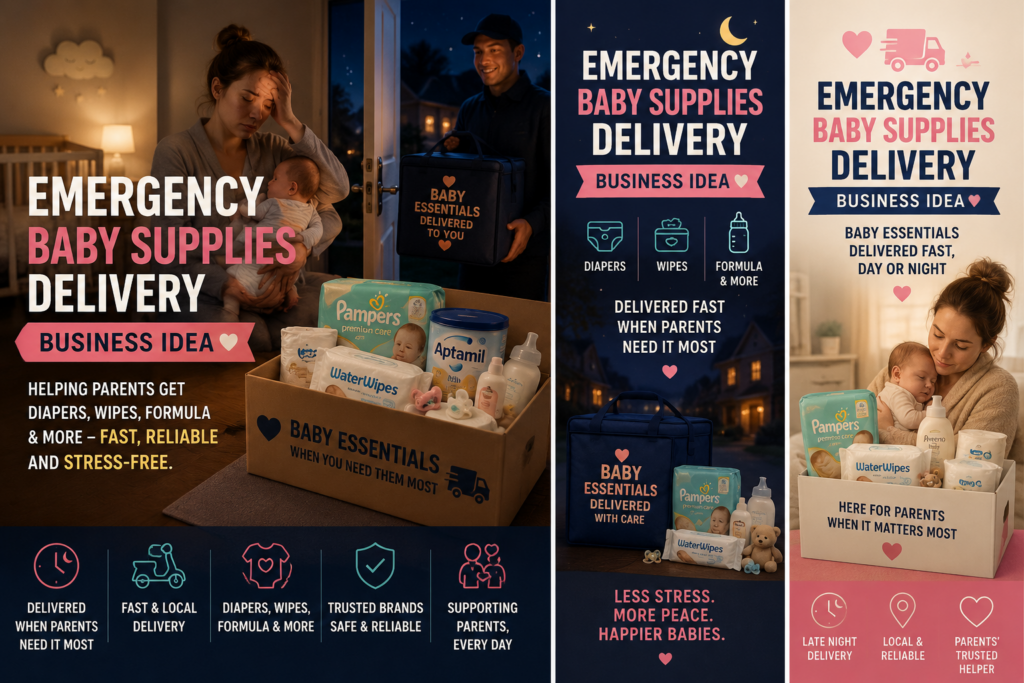
New parents do not always run out of baby supplies at a convenient time.
They may run out of diapers at night.
They may discover there are no wipes left after the baby is already crying.
They may need baby cream, bottles, pacifiers, formula, baby soap, extra onesies, or small care items when they are too tired to leave the house.
That moment creates a business opportunity.
An emergency baby supplies delivery business is a local delivery service that helps parents get essential baby products quickly, especially during stressful moments.
This is not a normal parcel delivery idea.
It is not only about moving products from one place to another.
It is about timing, trust, and relief.
Parents are not just buying diapers.
They are buying peace of mind.
That is what makes this an out-of-the-box delivery business idea.
The business can start small in one neighborhood, city, or local area. It can focus on a limited number of trusted baby essentials and deliver them quickly to families who need help now.
Affiliate disclosure: This post contains affiliate links. If you make a purchase through one of these links, ProBusinessStrategy may earn a small commission at no extra cost to you. We only recommend tools we genuinely believe in.
What Is an Emergency Baby Supplies Delivery Business?
An emergency baby supplies delivery business delivers urgent baby products to parents, caregivers, grandparents, babysitters, and families.
The service could deliver:
- diapers
- baby wipes
- baby formula
- bottles
- pacifiers
- diaper cream
- baby shampoo
- baby lotion
- baby powder where appropriate
- baby laundry detergent
- baby food
- baby snacks
- teething rings
- bibs
- burp cloths
- onesies
- sleep sacks
- baby blankets
- nursery night lights
- small baby medicine only where legally allowed
- parent comfort products
The business could operate during:
- evenings
- weekends
- late nights
- early mornings
- public holidays
- school holidays
- emergency windows
- scheduled weekly delivery times
The service can be positioned as:
“Baby essentials delivered when parents need them most.”
That is a clear and emotional promise.
Why This Business Idea Can Work
This idea works because parents often value reliability more than saving a small amount of money.
When a parent has a sleeping baby, a crying baby, or a tired household, going to the store can feel like a major task.
A quick local delivery service can solve that problem.
The emotional value is strong because the service reduces stress.
A parent who runs out of diapers at 10 PM is not casually shopping.
They need a solution.
That is why this business can be stronger than a general delivery service.
It focuses on one clear audience and one urgent problem.
A general delivery app may offer many categories, but it may not feel personal or specialized.
A baby supplies delivery service can feel more focused, safer, and more helpful.
Who Is the Target Customer?
The target customer is not only “parents.”
There are several customer groups.
New Parents
New parents are the most obvious audience.
They may be overwhelmed, tired, and still learning what products they need.
A service that delivers essentials quickly can become very useful.
For this group, trust is extremely important.
They want reliable products, clear descriptions, simple ordering, and no confusion.
Parents with Babies or Toddlers
Parents with babies and toddlers often have repeated needs.
They regularly buy diapers, wipes, baby food, snacks, creams, and laundry products.
This creates both emergency delivery potential and subscription potential.
Grandparents
Grandparents may care for the baby sometimes but not have all supplies at home.
A baby supplies delivery service could offer a “grandparent visit box” with diapers, wipes, baby snacks, bibs, and basic care products.
Babysitters and Nannies
Babysitters may suddenly need extra supplies while parents are away.
A fast local delivery service can support them when something runs out.
Hotels and Short-Stay Apartments
Families traveling with babies often forget something.
Hotels, Airbnb hosts, and short-stay apartments could partner with a baby supplies delivery service.
A QR code in the room could say:
“Forgot baby essentials? Order diapers, wipes, formula, and baby care items locally.”
This could be a very strong niche.
Maternity Visitors
People visiting new parents may want to send something useful instead of another toy.
They could order a “new parent essentials box” with diapers, wipes, snacks for parents, baby care items, and a small card.
What Could You Deliver?
The best product list should be simple at first.
Do not try to offer every baby product.
Start with the most urgent and repeatable items.
1. Diapers
Diapers are the main product.
You could offer:
- newborn diapers
- size 1
- size 2
- size 3
- size 4
- pull-ups
- overnight diapers
- eco-friendly diaper options
Diaper sizing must be clear because parents need the right size quickly.
2. Baby Wipes
Wipes are another essential product.
Offer a small number of trusted options:
- sensitive wipes
- fragrance-free wipes
- water-based wipes
- travel-size wipes
- bulk wipes
3. Formula and Feeding Products
Formula is an important but sensitive category.
Parents often want the exact brand and type their baby already uses.
A delivery service should be careful with this.
Do not randomly substitute baby formula unless the parent clearly agrees.
Possible products:
- common formula brands
- baby bottles
- bottle nipples
- bottle brushes
- pacifiers
- baby spoons
- baby bowls
- bibs
Clear product information matters here.
4. Baby Care Products
These can include:
- diaper cream
- baby lotion
- baby shampoo
- baby soap
- baby oil
- baby laundry detergent
- baby-safe cleaning wipes
- cotton pads
Keep the selection simple and trusted.
5. Baby Comfort Items
These are useful during stressful moments.
Examples:
- pacifiers
- teething rings
- small blankets
- sleep sacks
- soft burp cloths
- baby mittens
- baby socks
- onesies
- night lights
6. Parent Comfort Items
This is an underrated category.
Parents also need support.
A “new parent comfort add-on” could include:
- tea
- snacks
- bottled water
- coffee
- simple breakfast items
- tissues
- hand cream
- small note card
This can make the service feel warmer and more thoughtful.
Emergency Delivery vs Subscription Delivery
There are two strong business models.
The first is emergency delivery.
The second is subscription delivery.
The best business may combine both.
Emergency Delivery Model
The emergency model is for immediate needs.
Examples:
- “We ran out of diapers.”
- “We need wipes now.”
- “The baby formula is almost finished.”
- “We forgot pacifiers at home.”
- “The babysitter needs baby supplies.”
- “We arrived at the hotel and forgot baby products.”
Emergency delivery can charge a higher convenience fee because speed matters.
Subscription Model
The subscription model is for repeated needs.
Parents can receive a weekly or monthly delivery of essentials.
Examples:
- weekly diaper and wipes delivery
- monthly baby care box
- new parent refill box
- toddler snack box
- formula reminder delivery
- grandparent baby visit box
Subscriptions can create predictable income.
They also reduce emergency stress for parents.
A smart service could offer both:
“Emergency baby supplies now, or scheduled baby essentials every week.”
Baby Supply Box Ideas
Boxes make the business easier to market.
Instead of selling only individual items, you can create themed bundles.
The Emergency Diaper Box
Includes diapers, wipes, diaper cream, and disposal bags.
The New Parent Night Box
Includes diapers, wipes, baby care item, parent snack, water, and a small encouragement card.
The Hotel Baby Essentials Box
Includes diapers, wipes, pacifier, baby soap, bib, and small travel items.
The Grandparent Visit Box
Includes diapers, wipes, baby snacks, bib, burp cloth, and simple toy.
The Feeding Emergency Box
Includes formula where legally and safely available, bottle, bottle brush, bib, and baby spoon.
The Toddler Snack Box
Includes toddler-friendly snacks, wipes, bib, small drink, and travel pack.
The Baby Care Refill Box
Includes baby lotion, shampoo, diaper cream, wipes, and laundry detergent.
Bundles are useful because they solve a complete situation.
They also increase average order value.
How to Start This Business Locally
This business should start carefully.
Parents need trust.
The first version should be simple, local, and reliable.
Step 1: Choose a Small Delivery Area
Start with one clear area.
For example:
- one neighborhood
- one city center
- one suburb
- one student/family district
- one area near hospitals
- one area near hotels and short-stay apartments
A smaller area makes delivery faster and easier to manage.
Step 2: Choose a Limited Product List
Start with the products parents need most.
For example:
- 5 diaper sizes
- 2 types of wipes
- 3 diaper creams
- 2 baby soaps
- 2 pacifier options
- 2 bottle options
- 3 baby food/snack options
- 2 parent comfort add-ons
The first menu should not be overwhelming.
You can expand after learning what people actually order.
Step 3: Build a Simple Ordering System
You do not need a complicated app in the beginning.
You can start with:
- WhatsApp ordering
- a simple website
- a basic order form
- Instagram direct messages
- a local landing page
- a simple online store
A simple website can help build trust because parents can see the delivery area, products, prices, hours, and policies.
If you want to create a simple website for this service, you could use Namecheap for a domain name and Bluehost for a beginner-friendly website setup.
The site should be clean and easy to understand.
Step 4: Create Trust Before You Sell
Trust is more important here than clever marketing.
Your website and social media should explain:
- who you serve
- where you deliver
- what products you carry
- delivery times
- product substitution policy
- refund policy
- contact information
- safety standards
- business registration where relevant
Parents should feel that the service is serious and responsible.
Step 5: Test with One Customer Group
Do not target everyone at once.
Start with one group:
- new parents in one neighborhood
- hotels with family guests
- grandparents
- babysitters
- family apartments
- maternity visitors
A clear starting group makes marketing easier.
Marketing Ideas for an Emergency Baby Supplies Delivery Business
This business can be marketed through local trust, partnerships, and helpful content.
1. Local Parent Groups
Many parents are active in local Facebook groups, WhatsApp groups, community forums, and neighborhood apps.
Your message should be helpful, not spammy.
For example:
“Local baby essentials delivery for parents who run out of diapers, wipes, or baby care products in the evening.”
2. Partnerships with Hotels and Airbnb Hosts
Traveling families often forget baby supplies.
You could partner with:
- hotels
- serviced apartments
- Airbnb hosts
- guesthouses
- family vacation rentals
Give them QR code cards to place in rooms.
The card could say:
“Forgot diapers, wipes, or baby essentials? Local delivery available.”
3. Partnerships with Maternity Services
Depending on local rules, you could connect with:
- maternity photographers
- baby stores
- birth coaches
- doulas
- maternity gift shops
- family service providers
Do not make medical claims.
Keep the offer practical and product-based.
4. Content Marketing
Create helpful blog posts like:
- What to Keep in a Baby Emergency Box
- Baby Essentials New Parents Forget to Refill
- How to Prepare for the First Month With a New Baby
- What to Pack When Traveling With a Baby
- Diaper and Wipes Checklist for New Parents
These articles can bring local traffic and build trust.
5. Flyers and QR Codes
Physical flyers can work well for local family services.
Possible locations:
- baby stores
- laundromats
- family cafés
- community centers
- apartment buildings
- hotels
- daycare centers where allowed
- maternity shops
A simple flyer could say:
“Ran out of diapers or wipes? Baby essentials delivered locally.”
6. Social Media
Short videos can show:
- packing an emergency diaper box
- preparing a hotel baby essentials kit
- “3 things parents always run out of”
- “what to keep in your baby emergency basket”
- “new parent night box”
- “grandparent visit box”
This can work on TikTok, Instagram Reels, YouTube Shorts, Pinterest, and Facebook.
Pricing Ideas
Pricing should reflect both product cost and convenience.
Possible models:
Product Price + Delivery Fee
Example:
Diaper pack + wipes + delivery fee.
Bundle Pricing
Example:
Emergency Diaper Box: fixed price
Hotel Baby Essentials Box: fixed price
New Parent Night Box: fixed price
Late-Night Surcharge
If you deliver outside normal hours, a late-night fee may be reasonable.
Be clear about this before checkout.
Subscription Pricing
Examples:
Weekly diaper refill plan
Monthly baby care box
Grandparent visit box subscription
New parent first-month essentials plan
Partner Pricing
Hotels, Airbnb hosts, and family service providers may get special pricing or referral arrangements.
Important Safety and Legal Considerations
This business serves families with babies, so it must be handled carefully.
You should avoid making medical claims.
You should not present yourself as a medical service.
You should be careful with products that are regulated, age-restricted, prescription-based, or health-related.
Important areas to check locally:
- food safety rules
- baby formula handling
- product labeling requirements
- delivery insurance
- business permits
- consumer protection rules
- refund and return policies
- product liability
- medication delivery laws
- data privacy for customer addresses and baby-related orders
In many cases, the safest beginner model is to focus on packaged baby essentials from reputable suppliers.
Avoid repackaging products unless you fully understand the rules.
Avoid substituting sensitive products like formula without clear customer permission.
The trust of the parent is more valuable than one quick sale.
How This Business Could Grow
An emergency baby supplies delivery business can grow in several directions.
1. Local Parent Delivery Brand
You become the trusted baby essentials delivery service in one city.
2. Subscription Baby Refill Service
Parents subscribe to weekly or monthly delivery of diapers, wipes, and baby care products.
3. Hotel and Travel Baby Essentials Partner
You partner with hotels and short-stay properties to serve traveling families.
4. New Parent Gift Box Business
You create useful baby and parent boxes that friends and family can order as gifts.
5. Family Convenience Delivery Service
You expand beyond baby products into family convenience items.
Examples:
- kids activity kits
- toddler snacks
- school supplies
- sick day comfort boxes
- rainy day boxes
6. Micro-Franchise Model
If the system works in one city, it could become a blueprint other people use in their own area.
This could become a digital product, business course, consulting package, or franchise-style local model.
Why This Fits the Out-of-the-Box Delivery Hub
This idea fits the delivery hub because it is built around a specific moment.
A parent needs something now.
The baby is crying.
The stores are closed.
The parent is tired.
Leaving the house is difficult.
A normal parcel service is too slow.
A general delivery app may not carry the right product.
That moment creates a niche.
The business is not only “delivery.”
It is emergency convenience for parents.
That makes the idea specific, emotional, and practical.
Final Thoughts
An emergency baby supplies delivery business can be a powerful local service because it solves a real problem for a specific audience.
Parents do not always need more options.
Sometimes they need one reliable solution at the right moment.
Diapers.
Wipes.
Formula.
Baby care products.
Pacifiers.
Bottles.
Small comfort items.
Delivered quickly, clearly, and responsibly.
This business can start small with one neighborhood, one simple menu, and one delivery window.
Over time, it can grow into subscriptions, hotel partnerships, new parent gift boxes, local family delivery, or a larger baby essentials brand.
The key is trust.
If parents trust the service, they may use it more than once.
And if the service truly helps them during stressful moments, it can become more than a delivery business.
It can become a small but valuable support system for local families.
Related Articles