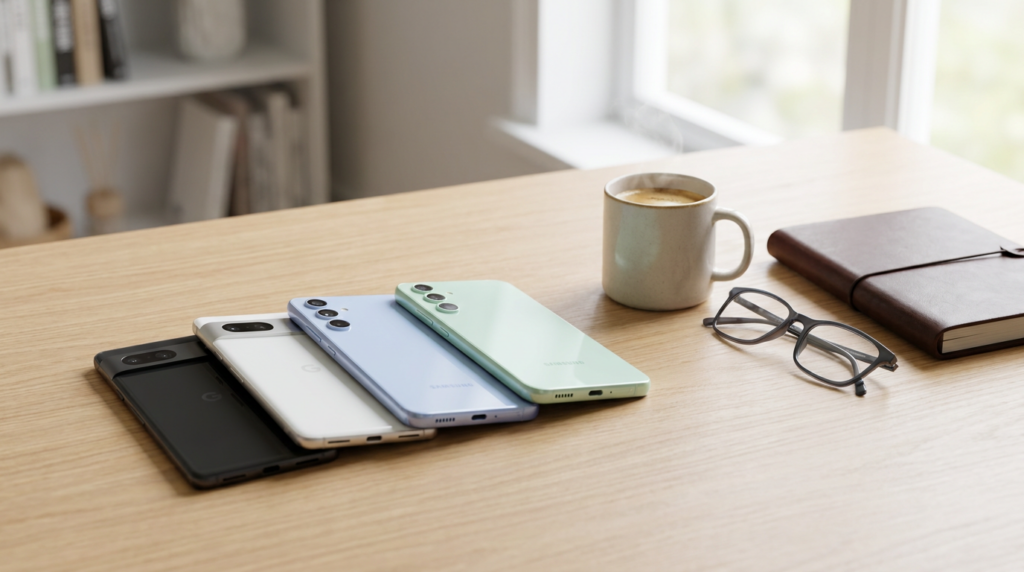
One of the biggest misconceptions in the digital entrepreneur world is that you need a $1,500 “Ultra” or “Pro Max” device to launch a successful company. While those flagship phones are impressive, they are often a luxury, not a necessity.
In 2026, the mid-range smartphone market has evolved to a point where a $300 to $500 device can handle 95% of business tasks—from video editing and multi-tasking to managing complex logistics—without breaking a sweat.
If you are starting your journey on probusinessstrategy.com, your goal is efficiency and ROI (Return on Investment). Spending your initial capital on a gold-plated titanium phone isn’t a smart business move. Spending it on a reliable tool that leaves money in the bank for marketing? That’s the pro move.
In this comprehensive guide, we’ll break down the best budget smartphones for business in 2026, what specs actually matter for an entrepreneur, and how to turn a “cheap” phone into a high-end mobile office.
Affiliate disclosure: This post contains affiliate links. If you make a purchase through one of these links, ProBusinessStrategy may earn a small commission at no extra cost to you. We only recommend tools we genuinely believe in.
Why Your Smartphone Choice is Your Most Important Business Decision
When you run a smartphone-based business, your device isn’t just a phone; it’s your storefront, your office, your accounting department, and your marketing agency.
Since you’ll be spending 8 to 12 hours a day on this screen, you need a device that won’t lag when you have thirty Chrome tabs open while jumping between a Zoom call and a Shopify dashboard.
The Budget Entrepreneur’s Strategy:
We are looking for “The Sweet Spot.” This is where performance meets price. In 2026, processors that were top-of-the-line eighteen months ago are now appearing in budget models. This means “budget” no longer means “slow.”
The Top 7 Budget Business Smartphones of 2026
1. The Productivity King: Google Pixel 9a (or latest “a” series)
Google’s “a” series has consistently been the gold standard for budget-conscious professionals.
- Why it’s for you: It offers the purest Android experience with zero “bloatware.” This means more storage for your business apps and a faster interface.
- The Business Edge: The AI integration. In 2026, the Pixel’s “Clear Calling” and live translation features are essential if you are dealing with international clients or taking calls in noisy environments like coffee shops.
- Internal Link: Pair this with the best apps to start a business on your phone to maximize the clean OS.
2. The Battery Powerhouse: Samsung Galaxy A57
Samsung’s A-series dominates the mid-range for one reason: the screen and the battery.
- Why it’s for you: The Super AMOLED display makes long hours of reading emails or editing social media graphics much easier on the eyes.
- The Business Edge: Samsung Knox security. If you are handling sensitive client data, the enterprise-grade security built into Samsung devices is a major plus. Plus, the battery life typically lasts two full workdays on a single charge.
3. The Performance Maverick: OnePlus Nord 5
OnePlus has returned to its roots in 2026, offering “flagship killer” specs at a fraction of the cost.
- Why it’s for you: Charging speed. The Nord series features 80W or 100W charging. For an entrepreneur on the go, being able to go from 0% to 100% in 30 minutes while you have a quick lunch is a game-changer.
- The Business Edge: High RAM configurations. Look for the 12GB or 16GB RAM versions. This allows you to keep dozens of business apps open in the background without the phone closing them to save memory.
4. The Creator’s Choice: Nothing Phone (3a)
Nothing has carved out a niche for being stylish yet incredibly functional.
- Why it’s for you: The interface is designed to reduce distractions. The monochrome icons help you stay focused on tasks rather than being drawn into the colorful “dopamine loops” of social media.
- The Business Edge: Incredible camera quality for the price. If your business relies on high-quality content for Instagram or TikTok, the Nothing Phone punches way above its weight class.
5. The iOS Entry Point: iPhone SE (4th Gen)
If you are locked into the Apple ecosystem but can’t justify a $1,000 purchase, the SE remains the only choice.
- Why it’s for you: Access to Apple-exclusive business apps and the seamless integration with MacBooks and iPads.
- The Business Edge: Longevity. Apple supports their “budget” phones with software updates for 6-7 years. This is a long-term investment.
6. The Rugged Professional: Motorola Moto G Stylus (2026 Edition)
Don’t sleep on Motorola. Their Stylus series offers a feature usually reserved for the $1,300 “Ultra” models: a built-in pen.
- Why it’s for you: Do you need to sign contracts on the fly? Or sketch out quick ideas for product designs? The built-in stylus is an incredible productivity tool for specific niches.
- Internal Link: This phone is perfect for those following our 50 businesses you can run from your phone guide, specifically for consulting or design-heavy niches.
7. The Global Value Leader: Xiaomi Redmi Note 15 Pro
If you are outside the US or have access to global imports, Xiaomi offers specs that seem impossible for the price.
- Why it’s for you: 144Hz displays and massive 200MP cameras at a 60% discount compared to Western brands.
- The Business Edge: Dual-SIM capabilities are standard. This allows you to have a dedicated business line and a personal line on the same device without carrying two phones.
What Specs Actually Matter for an Entrepreneur? (And What’s Just Hype)
In 2026, marketing departments will try to sell you on “Space Zoom” or “Titanium Frames.” Ignore them. For your business, focus on these four pillars:
- RAM (Memory): In 2026, 8GB is the bare minimum for business. 12GB is the “Goldilocks” zone. If a phone has 4GB or 6GB, walk away. You will experience lag when multitasking.
- Storage: 256GB is the target. Between high-res photos, video content for marketing, and offline documents, 128GB fills up faster than you think. If the phone has an SD card slot (like some Samsungs and Motorolas), that’s a huge budget-saving bonus.
- Battery Health & Charging: Look for “mAh” (aim for 5,000) but more importantly, look at “W” (Watts) for charging. Fast charging is more important than a slightly larger battery.
- Software Update Cycle: A phone is only a good deal if it lasts. Ensure the manufacturer promises at least 3-4 years of security updates.
How to Turn Your Budget Phone into a $2,000 Workstation
You don’t need a laptop to be professional. As we discussed in our Phone vs Laptop for Business article, it’s all about the peripherals.
With the money you save by buying a budget phone, invest $100 in these three things:
- A Foldable Bluetooth Keyboard: Allows you to write long-form content (like this!) in a coffee shop using your phone.
- A Universal USB-C Dock: Connect your budget phone to any monitor or TV and use “Desktop Mode” (if supported) or simply a larger screen to review spreadsheets.
- An External Power Bank: Because your business stops when your battery dies.
Real-World Business Scenarios: Which Phone Should You Choose?
- “I am a Content Creator/Influencer”: Go with the Nothing Phone (3a) or Google Pixel 9a. The camera processing is superior for skin tones and lighting.
- “I am a Virtual Assistant/Project Manager”: Go with the Samsung Galaxy A57. The large screen and multi-window multitasking features are the best on Android.
- “I am an E-commerce Seller (Shopify/eBay)”: Go with the OnePlus Nord 5. You’ll be taking lots of photos and uploading them while managing orders; the fast charging keeps you live.
- “I am a Freelance Writer/Consultant”: Go with the Motorola Moto G Stylus. Note-taking and signing PDFs with the stylus will save you hours of frustration.
Is It Really Realistic to Run a Business on a Cheap Phone?
A common fear is that a budget phone will look “unprofessional” or fail during a crucial moment. Let’s do a Reality Check.
As we covered in Can You Really Make Money with Just a Smartphone?, your clients don’t know (and don’t care) what phone you are using. They care about the quality of your work, the speed of your communication, and the results you deliver.
A $400 phone that is organized with free business tools is more powerful than a $1,500 phone used only for scrolling social media.
Conclusion: Your Empire Starts with the Tool You Can Afford
Stop waiting until you can afford “the best” equipment. Perfectionism is a form of procrastination.
The best budget smartphone for your business in 2026 is the one that gets you started today. Whether it’s a Samsung, a Pixel, or a Motorola, these devices are more than capable of generating six-figure revenues if you put in the work.
Pick a device from this list, set up your mobile office, and start building.
What’s Next?
Now that you have your hardware sorted, it’s time to optimize your operations. Check out our guide on how to manage your entire business from a smartphone step-by-step to keep your new device organized and profitable.
Pro Business Strategy Checklist: Buying Your Budget Phone
- Minimum 8GB RAM
- Minimum 128GB (Ideally 256GB) Storage
- Check for 5G connectivity (Essential for 2026 speeds)
- Verify at least 3 years of promised software updates
- Buy a protective case (Your phone is your income; don’t leave it unprotected)