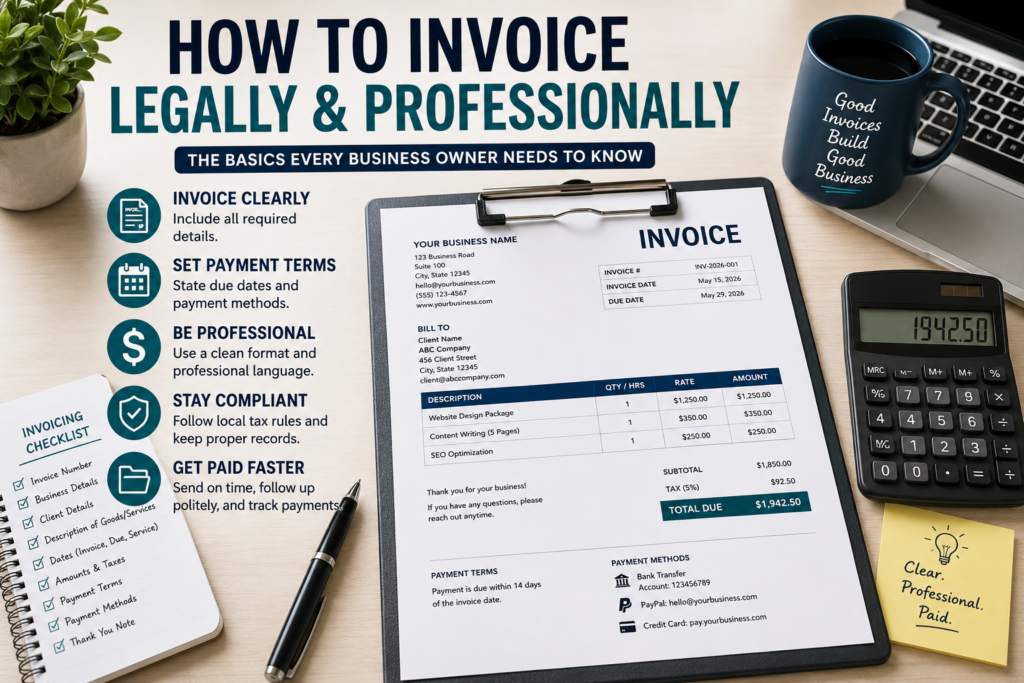
Sending an invoice may seem simple.
You finish the work, write down the amount, send it to the client, and wait for payment.
But in a real business, invoicing is more than asking for money.
An invoice is part of your legal, financial, and professional system.
It helps show what was sold, who sold it, who bought it, when it was delivered, how much is owed, when payment is due, and what taxes may apply.
A good invoice protects your business, reduces confusion, improves cash flow, and makes you look more professional.
A bad invoice can create delays, disputes, tax problems, and awkward client conversations.
This guide explains the basic principles of invoicing legally and professionally for beginners.
It is not legal or tax advice. Rules can differ by country, state, business structure, industry, and tax status. Before relying on an invoicing system, check the rules in your own location or ask a qualified accountant or legal professional.
Affiliate disclosure: This post contains affiliate links. If you make a purchase through one of these links, ProBusinessStrategy may earn a small commission at no extra cost to you. We only recommend tools we genuinely believe in.
What Is an Invoice?
An invoice is a document that requests payment for goods or services.
It usually includes the seller’s details, the customer’s details, a description of the work or product, the amount charged, taxes if applicable, payment terms, and the total amount due.
An invoice is not the same as a receipt.
An invoice asks for payment.
A receipt confirms that payment has been received.
For example, if you complete a logo design project and send the client a document asking them to pay $500, that document is an invoice.
After the client pays, you may send a receipt or payment confirmation.
Why Invoices Matter
Invoices matter because they create a clear business record.
They help you:
Request payment professionally
Track income
Show what was delivered
Avoid misunderstandings
Prepare tax records
Follow up on unpaid bills
Look more professional
Create financial history
Separate business from personal transactions
For small business owners, freelancers, consultants, agencies, coaches, digital product sellers, and service providers, invoices are part of running the business properly.
Even if your business is small, your invoicing process should be organized.
What Should Be on a Basic Invoice?
A basic invoice should clearly show the most important details of the transaction.
In many places, invoice requirements include items such as a unique invoice number, your business name and contact details, customer details, description of goods or services, invoice date, supply or service date, amounts charged, applicable tax, and the total amount due.
As a beginner-friendly checklist, include:
The word “Invoice”
Invoice number
Invoice date
Your business name
Your business address or contact details
Your customer’s name
Your customer’s address or billing details
Description of products or services
Date the product or service was delivered
Quantity or hours if relevant
Price per item or rate
Subtotal
Tax if applicable
Total amount due
Payment due date
Payment methods
Payment terms
Notes or thank-you message
This does not mean every invoice in every country looks exactly the same.
But these items create a strong professional foundation.
1. Use a Unique Invoice Number
Every invoice should have a unique invoice number.
This helps you and your client identify the invoice quickly.
For example:
INV-001
INV-002
2026-001
PBS-2026-001
CLIENTNAME-001
A simple numbering system is enough in the beginning.
Do not reuse the same number for different invoices.
A unique invoice number makes it easier to track payments, answer client questions, and organize your records.
2. Add Your Business Details
Your invoice should clearly show who is sending it.
Include:
Business name
Your name if relevant
Business address or contact address
Email address
Phone number if needed
Website if relevant
Business registration number if required
Tax or VAT number if required
The exact requirements depend on your location and business structure.
For example, some countries may require a registered business number or VAT number if you are registered for tax.
If you are not sure what applies to you, ask a local accountant or check official government guidance.
3. Add Customer Details
Your invoice should also show who is being billed.
Include:
Customer name
Company name if applicable
Billing address
Email address if needed
Contact person if relevant
This is especially important for business-to-business invoicing.
A company may need the correct invoice details for its own bookkeeping, tax records, and payment approval process.
If you send an invoice to a larger company, ask who should be listed on the invoice and which billing email should receive it.
4. Describe the Product or Service Clearly
A vague invoice can create confusion.
Do not write only:
“Work done”
or:
“Services”
Be more specific.
Examples:
Website homepage copywriting
Logo design package
Monthly social media management
Business consultation session
Client call strategy report
10 blog post outlines
E-commerce product photography
Virtual assistant support, 5 hours
A clear description helps the client understand exactly what they are paying for.
It also helps your records later.
If there is ever a question about the invoice, the description gives context.
5. Include Dates
A professional invoice should include dates.
The most common dates are:
Invoice date
Service date or delivery date
Payment due date
The invoice date is when you created or sent the invoice.
The service date is when the product or service was delivered.
The due date tells the customer when payment should be made.
Dates are important because they help both sides understand timing.
They also help with tax records, accounting periods, late payments, and cash flow planning.
6. Show the Amounts Clearly
The financial part of the invoice should be easy to understand.
Show:
Quantity or hours
Rate or price
Subtotal
Discount if applicable
Tax if applicable
Total amount due
For example:
Consulting session: 2 hours × $75 = $150
Subtotal: $150
Tax: $0 or applicable amount
Total due: $150
Do not make the client guess.
A clear invoice is easier to approve and pay.
7. Add Tax Information if Applicable
Tax rules depend heavily on where your business is located, where your customer is located, what you sell, and whether you are registered for VAT, sales tax, GST, or another tax system.
If tax applies, your invoice may need to show:
Tax rate
Tax amount
Tax registration number
Tax type
Total including tax
If tax does not apply, some businesses include a note such as:
“No VAT charged”
“Tax not applicable”
“Reverse charge applies”
But do not copy tax wording without understanding it.
Tax language can have legal meaning.
This is one area where local advice matters.
8. State Your Payment Terms
Payment terms tell the client when and how to pay.
Examples:
Due on receipt
Due within 7 days
Due within 14 days
Due within 30 days
50% deposit before work starts
Remaining balance due on delivery
Clear payment terms reduce awkward conversations.
If you do not include payment terms, the client may assume they can pay whenever they normally pay vendors.
That may not work for your cash flow.
For service businesses, it is often smart to agree on payment terms before starting the work.
9. Include Payment Methods
Make it easy for the customer to pay.
Include the payment methods you accept, such as:
Bank transfer
Credit card
PayPal
Stripe
Wise
Online payment link
Check if still used in your market
Add the information needed to complete payment.
For bank transfers, this may include bank name, account number, IBAN, routing number, or payment reference, depending on your country.
For payment links, make sure the link is correct.
The easier you make payment, the fewer delays you create.
10. Use Professional Language
An invoice should be clear and polite.
You do not need long text.
A simple note can be enough:
“Thank you for your business.”
or:
“Please include the invoice number as the payment reference.”
or:
“Payment is due within 14 days.”
Avoid emotional, unclear, or aggressive language.
The invoice is a business document.
Keep it calm, professional, and precise.
11. Send the Invoice Promptly
Do not wait too long after completing the work.
Late invoicing can create late payment.
If you send the invoice quickly, the client still remembers the work, the project is fresh, and payment can enter their process sooner.
For recurring services, choose a consistent invoicing schedule.
For example:
First day of the month
Last day of the month
After project completion
Before work starts for deposits
After each milestone
Consistency helps both you and the client.
12. Keep Copies of Your Invoices
You should keep copies of all invoices you send.
Good recordkeeping helps you track income, prepare taxes, handle disputes, and understand business performance.
Your system can be simple.
You can store invoices by:
Year
Client
Invoice number
Paid or unpaid status
Project
For example:
2026 / Client Name / INV-001.pdf
Also track:
Invoice sent date
Due date
Amount
Payment received date
Payment method
Status
The IRS notes that business records should support income and deductions on a tax return, and supporting documents are part of recording business transactions properly.
13. Track Paid and Unpaid Invoices
Sending an invoice is not enough.
You also need to know whether it has been paid.
Use a simple tracker.
Columns could include:
Invoice number
Client
Invoice date
Due date
Amount
Status
Payment date
Notes
Status could be:
Draft
Sent
Paid
Overdue
Cancelled
This helps you avoid forgetting unpaid invoices.
It also makes follow-up easier.
14. Follow Up Professionally
If an invoice is overdue, follow up calmly.
Do not assume bad intentions immediately.
Sometimes invoices are missed, payment systems are slow, or the wrong person received the invoice.
A simple follow-up message:
“Hi [Name], I hope you are well. I wanted to follow up on invoice INV-004, which was due on [date]. I have attached it again for convenience. Please let me know if you need anything from me.”
If the invoice remains unpaid, you may need a firmer follow-up based on your contract and local rules.
But always start professionally.
15. Use Written Agreements Before Invoicing
Invoices work best when the client already understands the price and terms.
Before doing work, confirm:
Scope of work
Price
Payment schedule
Due date
Deposit if needed
Revision limits
Delivery date
Late payment terms
Cancellation terms
This can be done in a contract, proposal, order form, email agreement, or terms of service.
The invoice should not surprise the client.
It should match what was already agreed.
16. Avoid Common Invoicing Mistakes
Common mistakes include:
No invoice number
No due date
Wrong client details
Vague service description
Missing tax information
Incorrect totals
No payment method
Sending invoices late
Not tracking payment status
Mixing personal and business payments
Using inconsistent formatting
Forgetting to save copies
Not following up on overdue invoices
Most invoicing problems come from lack of structure.
A simple system can prevent many of them.
17. Create a Simple Invoice Template
A template saves time and keeps your invoices consistent.
Your invoice template should include:
Your logo or business name
Invoice title
Invoice number
Dates
Your details
Customer details
Itemized table
Subtotal
Tax
Total
Payment terms
Payment methods
Notes
You can create a template in accounting software, Google Docs, Microsoft Word, Excel, Google Sheets, Canva, or invoicing tools.
If you want help creating a professional invoice template, branded PDF, proposal design, or payment document, Fiverr can be useful for finding freelancers who offer document design, bookkeeping templates, business forms, and admin support.
18. Invoice Like a Real Business
Even if you are just starting, professional invoicing helps you behave like a real business.
It creates separation between hobby activity and business activity.
This matters because clients take you more seriously when your process is professional.
A professional invoice says:
This is a real transaction.
The work has a clear price.
Payment is expected.
The business is organized.
The client knows what to do next.
That can improve trust.
19. Make Payment Easy but Controlled
You want payment to be easy, but you also want your records to stay clean.
Avoid mixing many random payment methods without tracking them.
If possible, use a consistent payment process.
For example:
Invoice sent by email
Payment link included
Invoice number used as reference
Payment recorded in tracker
Receipt sent if needed
Invoice marked as paid
This helps you stay organized as your business grows.
20. When to Ask for Professional Help
You should consider professional advice if:
You are unsure about tax rules
You sell internationally
You charge VAT, GST, or sales tax
You work with large companies
You have recurring contracts
You offer subscriptions
You have unpaid invoices
You need legal payment terms
You are changing business structure
You are hiring staff or contractors
Invoicing looks simple, but it connects to taxes, contracts, bookkeeping, and legal obligations.
When in doubt, ask a professional.
Final Thoughts
Invoicing legally and professionally is not only about creating a document.
It is about creating a clear business process.
A good invoice tells the client what they bought, what they owe, when payment is due, how to pay, and who sent the invoice.
It also helps you track income, prepare records, reduce confusion, and follow up when needed.
You do not need a complicated system at the beginning.
Start with a clean invoice template, clear payment terms, accurate details, and good recordkeeping.
Then improve your system as your business grows.
Professional invoicing helps you get paid, stay organized, and build trust.
That is why every serious business owner should learn the basics.