Most people start a product business by trying to find the perfect product.
They research trends.
They compare niches.
They look at competitors.
They read reviews.
They overthink the logo, website, packaging and brand name.
But what if the business idea started with a question instead?
Can I sell this?
That question could become the foundation of an entire YouTube channel.
The idea is simple: choose a weird product, unusual digital offer, strange niche item or unexpected ecommerce idea, then document the process of trying to sell it.
Not in theory.
Not as a boring business tutorial.
Not as a fake success story.
As a real challenge.
Can you sell glow-in-the-dark garden signs?
Can you sell tiny printable certificates for pet birthdays?
Can you sell motivational mugs for people who hate mornings?
Can you sell mystery productivity kits?
Can you sell ugly T-shirts on purpose?
Can you sell a digital planner for people who never finish planners?
The product can be funny, strange, useful, niche or ridiculous.
The entertainment comes from the challenge.
The business value comes from the validation process.
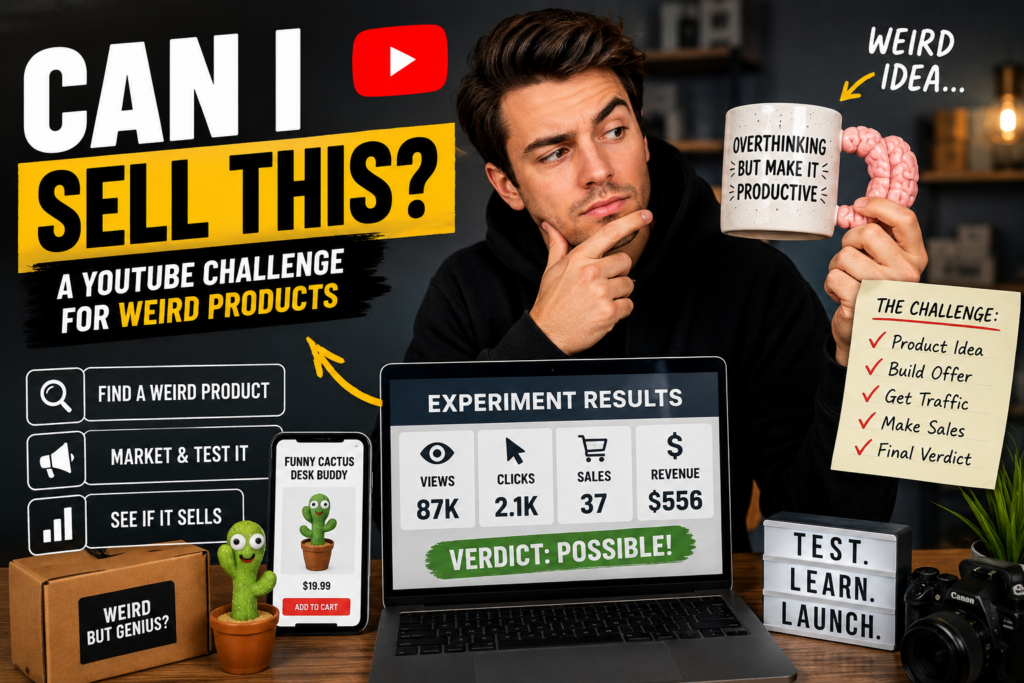
This is the idea behind a “Can I Sell This?” YouTube challenge for weird products.
Affiliate disclosure: This post contains affiliate links. If you make a purchase through one of these links, ProBusinessStrategy may earn a small commission at no extra cost to you. We only recommend tools we genuinely believe in.
What Is the “Can I Sell This?” YouTube Challenge?
The “Can I Sell This?” challenge is a YouTube content format where you test whether an unusual product or offer can attract real interest, clicks, leads or sales.
Each episode follows one product experiment.
The creator chooses a product idea, builds a simple sales page or listing, creates basic marketing, publishes the offer and documents what happens.
The goal is not always to make a fortune.
The goal is to answer one question:
Can this product get real buyers?
That makes the format more interesting than a normal product review or ecommerce tutorial.
You are not just explaining.
You are testing.
The viewer gets to watch the whole process:
The product idea
The reason you chose it
The target audience
The sales angle
The listing or landing page
The marketing attempt
The comments and reactions
The results
The lessons learned
The final verdict
This creates a natural story arc.
At the beginning, there is curiosity.
In the middle, there is action.
At the end, there is a result.
That is exactly what YouTube likes: a clear idea, a clear question and a reason to watch until the end.
Why This Could Work as a YouTube Business
This idea works because it combines several powerful content angles.
First, people like watching experiments.
A video titled “I Tried Selling Weird Products for 7 Days” is more clickable than “How to Start an Ecommerce Business.”
Second, people like unusual products.
Weird items create curiosity. A boring product may be profitable, but a strange product is often more entertaining on video.
Third, the format teaches business without feeling like a lecture.
Viewers can learn about product research, pricing, landing pages, product descriptions, ads, organic marketing, customer psychology and validation by watching you test real ideas.
Fourth, every episode can lead to multiple monetization options.
A “Can I Sell This?” channel can potentially monetize through:
YouTube ads
Affiliate links
Sponsored tools
Digital templates
Ecommerce products
Print-on-demand stores
Business courses
Consulting or audits
Product research tools
Email list growth
Behind-the-scenes memberships
This is not just a fun content idea.
It can become a content-driven business model.
The Basic Episode Structure
A good “Can I Sell This?” episode needs structure.
Without structure, it becomes random.
Here is a simple format:
1. The Product Reveal
Start with the product or idea.
Example:
“Today I’m going to find out if I can sell motivational mugs to people who are tired of toxic productivity advice.”
Or:
“I found one of the strangest product ideas I could think of: printable apology certificates for pets. The question is, can anyone actually buy this?”
The opening should immediately create curiosity.
2. The Hypothesis
Explain why you think the product might work.
Who might buy it?
What problem does it solve?
Is it funny, emotional, practical or giftable?
Is there a niche audience?
Is it connected to a trend?
This makes the video feel like a real business experiment instead of a random joke.
3. The Build
Show how you create the offer.
This could include:
Product mockup
Landing page
Etsy listing
Shopify product page
Print-on-demand item
Simple digital download
Product description
Price
Images
Checkout setup
You do not need to make this overly technical. Show enough so the viewer understands the process.
4. The Marketing Test
Now you try to get attention.
You could test:
TikTok videos
Pinterest Pins
Instagram Reels
YouTube Shorts
Reddit posts where allowed
Facebook groups where allowed
Cold outreach
Small ad budget
Email list
Influencer outreach
Organic SEO
Marketplace search
The key is to document what you tried.
5. The Results
Show the numbers.
Views
Clicks
Comments
Saves
Messages
Add-to-carts
Sales
Revenue
Costs
Profit or loss
Conversion rate
Lessons
Even if the product fails, the episode can still be valuable.
Sometimes failure is more entertaining and educational than success.
6. The Verdict
End with a clear conclusion:
Can I sell this?
Yes, but only with better positioning.
No, the audience was wrong.
Maybe, but the price was too high.
Yes, but it needs a better product image.
No, people liked the joke but did not want to buy.
This gives the video a satisfying ending.
Product Ideas That Fit This Challenge
The product should be unusual enough to make people curious, but not so absurd that nobody understands it.
Here are some possible categories.
Weird Physical Products
Unusual mugs
Funny tote bags
Strange desk accessories
Niche T-shirts
Novelty notebooks
Odd home office products
Pet owner gifts
Micro-niche posters
Unusual kitchen items
Themed stickers
Funny garden signs
Awkward greeting cards
Print-on-Demand Products
Print-on-demand is useful for this type of channel because you can test ideas without holding inventory.
You could test:
Funny quote shirts
Niche mugs
Motivational posters
Pet owner hoodies
Business owner notebooks
Lifestyle tote bags
Sticker packs
Phone cases
Gift products
Seasonal products
A tool like Printful can be useful for turning designs into testable products without buying inventory upfront.
Digital Products
Digital products are excellent for experiments because they are fast to create and cheap to deliver.
Examples:
Printable planners
Funny certificates
Niche checklists
Micro-guides
Business templates
Budget sheets
Content calendars
Habit trackers
Pet care printables
Wedding planning templates
Digital workbooks
Mini ebooks
Notion-style templates
Weird Service Offers
You could also test unusual services.
Examples:
“I’ll name your houseplants.”
“I’ll create fake business slogans for your dog.”
“I’ll write a motivational speech for your Monday morning.”
“I’ll roast your website homepage.”
“I’ll create a one-page business idea for your weird hobby.”
A platform like Fiverr could also be used for research, outsourcing small creative tasks or testing how similar micro-services are positioned.
Strange Niche Offers
Sometimes the best product ideas are not completely weird. They are specific.
Examples:
Meal planners for night-shift workers
Budget planners for new dog owners
Digital checklists for first-time Etsy sellers
Wedding speech templates for shy people
Content calendars for cleaning businesses
Motivational wall art for freelancers
Birthday printables for cat owners
Mini business plans for teenagers
Specific often sells better than broad.
The trick is making the niche interesting enough for YouTube.
How to Choose Products for the Challenge
Not every weird product is worth testing.
You need selection rules.
A good challenge product should have at least some of these qualities:
It is visually interesting
It has a clear target audience
It solves a small problem
It is funny or surprising
It can be explained quickly
It can be created cheaply
It can be marketed online
It has gift potential
It connects to a trend or niche
It creates a strong video title
Before choosing a product, ask:
Who would buy this?
Why would they buy it?
Where can I reach them?
Can I make or mock it up quickly?
Can I test it without spending too much?
Would people click a video about this?
Would the result teach something useful?
The product does not need to be perfect.
But it does need to create curiosity.
A weak idea is:
“Can I sell a normal white T-shirt?”
A stronger idea is:
“Can I sell a T-shirt for people who hate networking events?”
That has a clearer angle.
How to Build the Offer Fast
For this YouTube format, speed matters.
You do not want to spend two months building one product before making one video.
The challenge should feel fast, simple and repeatable.
A basic setup could include:
A product mockup
A simple sales page
A product description
A price
A checkout method
A few promotional posts
A simple tracking sheet
If you want a small ecommerce store, Shopify can be useful for building a test product page. For a simple website or landing page, you can also use Namecheap for a domain and Bluehost for hosting if you want a WordPress-based setup.
But do not overbuild.
The purpose of the challenge is validation.
A simple test is enough.
You can always improve the product later if it gets traction.
The Validation Scorecard
To make the series more professional, create a repeatable scorecard.
At the end of each episode, rate the product.
For example:
Product Validation Score
Clickability: Did people care enough to click?
Clarity: Did people understand the offer quickly?
Audience Fit: Was the target audience specific enough?
Sales Potential: Did people show buying intent?
Profit Potential: Could the margins work?
Content Potential: Did the product make a good video?
Repeat Potential: Could this become a real product line?
Give each category a score from 1 to 10.
Then give the product a final verdict:
Dead idea
Needs repositioning
Good content, weak business
Small niche opportunity
Strong test result
Worth building further
This makes the series feel more structured and bingeable.
Viewers can compare products across episodes.
Video Title Ideas
This concept can produce very clickable titles.
Examples:
I Tried Selling the Weirdest Product I Could Find
Can I Sell This Ugly T-Shirt in 7 Days?
I Built a Store for a Product Nobody Asked For
Can I Turn a Joke Product Into Real Sales?
I Tried Selling a Digital Product in 48 Hours
Can I Sell a Mug With One Instagram Reel?
I Tested a Weird Etsy Product Idea from My Phone
Can I Make Money Selling Printables for Pet Owners?
I Launched a Product Nobody Believed In
Can I Sell This Product Without Paid Ads?
I Tried to Sell the Most Specific Gift Idea Ever
Can a Stupid Product Idea Make Money?
I Tested 3 Weird Product Ideas and One Actually Sold
I Made a Fake Brand for a Real Product Test
Can I Sell This? The Weird Product Challenge
The title should create a question that viewers want answered.
That is the core of the format.
Monetization Ideas for the Channel
This channel could make money in several ways.
YouTube Ad Revenue
If the channel grows, ad revenue can become one income stream.
Business, ecommerce and marketing content can attract valuable audiences, but the content still needs to be entertaining enough to earn views.
Affiliate Marketing
You can naturally recommend tools used in the experiments.
Examples:
Ecommerce platforms
Print-on-demand tools
Domain providers
Hosting providers
Design tools
Mockup tools
Product research tools
AI writing tools
Freelance services
The key is to only promote tools that fit the experiment.
Selling the Tested Products
If a product works, keep selling it.
A successful challenge can turn into a real micro-brand.
The video itself becomes marketing.
Selling Templates
You can sell:
Product validation spreadsheet
Challenge planning template
Landing page copy template
Product description prompt pack
Weird product idea database
Ecommerce test checklist
YouTube challenge script template
This fits the audience because viewers may want to run similar experiments.
Sponsorships
As the channel grows, sponsors in ecommerce, AI, design, print-on-demand or creator tools may be relevant.
Consulting or Audits
If the creator becomes known for product testing, they could offer product validation audits for small businesses or creators.
Why Viewers Would Watch This
This format has multiple viewer hooks.
Some people watch for entertainment.
They want to see whether the weird product succeeds or fails.
Some people watch for business education.
They want to learn how validation works.
Some people watch for ideas.
They want to find inspiration for their own products.
Some people watch for the process.
They enjoy seeing a creator build something from scratch.
Some people watch for the ending.
They want the final number: did it sell or not?
A good channel can serve all of these viewers at once.
That is what makes the idea strong.
Mistakes to Avoid
Making the Product Too Random
Weird is good. Completely pointless is not.
The product still needs a possible buyer.
Faking the Results
Do not fake sales or pretend a product worked when it did not.
The honesty is part of the appeal.
Spending Too Much Per Test
Keep experiments lean.
The goal is to test, not to gamble.
Making the Video Too Technical
Viewers do not need every tiny setup detail.
Focus on the story and the lesson.
Testing Products Without a Clear Audience
A product with no audience is hard to validate.
Always define who might buy it.
Ignoring the Lessons
The result matters, but the lesson matters more.
A failed product can still make a great video if the conclusion is useful.
A Simple First Episode Plan
Here is a possible first episode:
Title:
Can I Sell a Weird Productivity Mug in 7 Days?
Product:
A mug with a funny quote for business owners who plan too much and launch too little.
Audience:
New entrepreneurs, freelancers and side hustlers.
Setup:
Create a simple mug design, mockup, product description and product page.
Marketing Test:
Post 3 Shorts, 3 Pinterest Pins and 3 Instagram Reels. Share the product in relevant places where allowed.
Tracking:
Measure views, clicks, add-to-carts and sales.
Ending:
Show the final result and decide whether the product is worth continuing.
This is simple enough to execute, but interesting enough to watch.
Final Thoughts
The “Can I Sell This?” YouTube challenge is a strong out-of-the-box business idea because it turns product validation into entertainment.
Instead of only teaching ecommerce, the creator actually tests it.
Instead of pretending every product will succeed, the series shows what happens when strange ideas meet real customers.
That makes the content more honest, more useful and more watchable.
The business potential is also strong.
A channel like this can generate income from YouTube ads, affiliate links, tested products, templates, sponsorships and consulting. It can also become a product research engine where the best experiments turn into real brands.
The first version does not need to be perfect.
Start with one weird product.
Create a simple offer.
Try to sell it.
Document the process.
Share the result.
Repeat with the next idea.
That is the whole concept.
One question.
One product.
One experiment.
Can I sell this?
That question could become an entire YouTube business.
Related Articles
How to Build a One-Person Business Lab on YouTube
Zero Dollar Startup Challenge: YouTube Business Idea