A lot of people want to start a TikTok business, but they get stuck on one issue immediately:
They do not want to show their face.
For some, it is a privacy issue. For others, it is discomfort, lack of confidence, or simply a preference for keeping business content separate from personal identity. And for many aspiring creators, that one hesitation becomes the reason they never start.
That is a mistake.
Because in 2026, you do not need to show your face to build a real TikTok business.
In fact, some of the smartest TikTok business models are faceless by design. They rely on strong ideas, clear positioning, useful content, compelling hooks, repeatable formats, and strategic monetization. They do not depend on personality-led influencer branding. They depend on structure.
That is good news, because structure scales better than vibes.
A faceless TikTok business can be built around affiliate marketing, digital products, lead generation, service funnels, niche education, curation, product demonstrations, tutorials, storytelling, visual compilations, screen recordings, AI voiceovers, text-based videos, and more. If you approach it correctly, being faceless is not a limitation. It is a business model.
This guide will show you how to start a TikTok business without showing your face, what type of faceless content actually works, how to choose a monetization path, what tools help you move faster, how to connect TikTok to your website, and how to build something that feels like an asset instead of just another social account.
Affiliate disclosure: This post contains affiliate links. If you make a purchase through one of these links, ProBusinessStrategy may earn a small commission at no extra cost to you. We only recommend tools we genuinely believe in.
Why faceless TikTok businesses are growing so fast
TikTok has matured.
It is no longer just a platform for dances, trends, lip-sync clips, or personality-first entertainment. It is now a discovery engine, a search platform, a recommendation machine, and, for many businesses, a traffic source. People use TikTok to find ideas, products, tutorials, reviews, shortcuts, inspiration, and business opportunities.
That shift is important because it changes what kind of content works.
A few years ago, people often assumed TikTok success required charisma on camera. Today, many users care more about clarity than identity. If a video solves a problem, explains something quickly, or presents a useful opportunity in a compelling way, viewers will watch it whether your face appears or not.
That is why faceless business accounts are thriving in niches such as:
product recommendations
side hustle ideas
business tips
AI tools
productivity systems
tutorials
ecommerce content
affiliate roundups
niche storytelling
curated educational clips
The real advantage of faceless content is not just privacy. It is repeatability.
When your business is built around formats instead of moods, it becomes easier to create consistently. You do not need perfect lighting, perfect makeup, perfect confidence, or perfect energy. You need a system.
And systems are what turn content into businesses.
What a faceless TikTok business actually is
A faceless TikTok business is not simply a TikTok account without a visible person on camera.
It is a content-driven business model where the brand, niche, message, and monetization strategy matter more than personal exposure.
That business can be built around different goals.
Some faceless TikTok accounts exist to drive traffic to a website. Some exist to promote affiliate products. Others sell digital downloads, promote ecommerce offers, attract leads for services, or build an audience that can later be monetized in several ways.
The most important thing to understand is that TikTok itself is rarely the full business.
TikTok is the attention layer.
The actual business usually lives in one or more of these places:
your website
your email list
your digital product funnel
your affiliate offers
your store
your service offer
That is why the smartest faceless TikTok strategy is not “how do I get views?” but “how do I turn views into business outcomes?”
If you keep that in mind from day one, you avoid building a content account with no real commercial structure behind it.
Why many people fail with faceless TikTok content
Faceless content is easier to start than face-led content, but many people still fail with it because they make one of three mistakes.
The first mistake is creating generic content with no real angle. They post random quote videos, vague motivation, or trend copies with no clear niche, audience, or business purpose. That may generate a few views, but it rarely creates momentum.
The second mistake is focusing only on virality. Viral reach feels exciting, but if your content does not connect to an offer, a niche, or a useful next step, the views do not become a business.
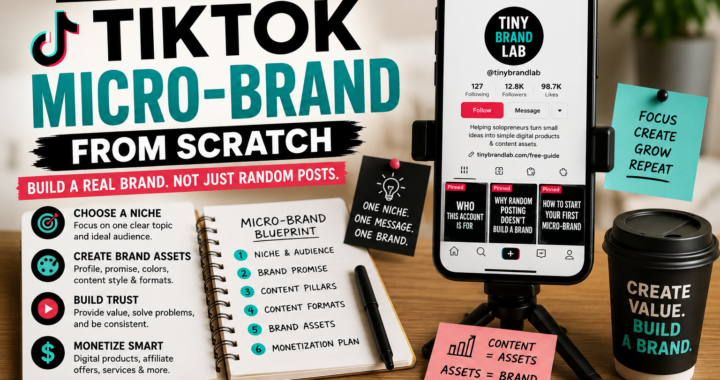
The third mistake is forgetting that faceless content still needs identity. You may not be showing your face, but your account still needs a recognizable style, perspective, and promise. People should quickly understand what your content is about and why they should follow.
If you want this to work long term, you need more than “faceless.” You need positioning.
The best faceless TikTok business models in 2026
There is not one correct faceless TikTok business model. There are several strong ones, and the right choice depends on what you want to build.
1. Affiliate content business
This is one of the easiest faceless models to start.
You create helpful videos around tools, products, business ideas, or niche solutions. Then you direct people toward an article, resource page, or offer where your affiliate links live.
For example, if your niche is online business or content systems, you can create videos that naturally lead into recommendations such as Bluehost for hosting, WordPress for building a content-based site, Shopify for ecommerce, or Fiverr when your audience needs freelancers for setup, editing, or design.
This model works best when TikTok content leads into a deeper article or resource page, because that gives you more space to educate and monetize naturally.
2. Digital product funnel
A faceless TikTok account can also be used to sell templates, guides, checklists, prompts, mini-courses, planners, swipe files, or niche packs.
The content attracts attention. The product captures value.
This works especially well when your niche is practical and searchable, such as productivity, creator tools, side hustle workflows, content planning, or business systems.
3. Lead generation business
Not every faceless TikTok business needs to sell low-ticket offers. You can also use TikTok to generate leads for services.
For example, if you offer content strategy, Pinterest management, ecommerce consulting, or AI workflow help, your TikTok content can attract the right type of audience and move them into a contact form, booking page, or email sequence.
4. Product-driven business
Some faceless TikTok accounts function as discovery channels for a product business. This can work for physical products, digital products, or print-on-demand setups. If you want to test product selling from mobile, Shopify is one of the cleanest ways to manage that side of the business.
5. Traffic-to-blog business
This is especially relevant for your site strategy.
You can use TikTok as a front-end attention channel and then direct people to long-form blog posts where the real SEO, internal linking, and monetization happen. This is a strong model because social media gives you fast exposure while blog content builds long-term compounding traffic.
The biggest myth: “faceless” means “low quality”
A lot of beginners assume that not showing their face means their content has to feel low effort. That is completely wrong.
A faceless TikTok business can feel premium if the content is clear, useful, and visually consistent.
High-quality faceless content usually has:
a sharp hook
a clear structure
readable text
a strong niche angle
consistent design choices
good pacing
a relevant next step
Your audience does not need your face. They need confidence that the content will deliver value quickly.
That means your job is to make the video easy to understand and easy to trust.
The most effective faceless TikTok content formats
This is where most people either win or waste time. If you want a faceless TikTok business to grow, you need repeatable formats.
Here are some of the strongest ones.
Screen recording tutorials
These work especially well in business, AI, productivity, and app-related niches.
You show:
a tool
a workflow
a setup process
a feature comparison
a result
You can pair this with captions, text overlays, or voiceover. If you are teaching people how to do something from their phone, this is one of the strongest formats available.
Text-on-screen business tips
This format is simple but effective when the insights are sharp.
Examples:
3 faceless TikTok business ideas that do not require followers
5 mistakes new affiliate marketers make on TikTok
4 ways to monetize a faceless content account
The key is not making it too vague. Generic advice dies quickly.
Product demo videos
These can be physical products, digital products, software tools, templates, dashboards, or before-and-after demonstrations. If the product is useful and visually easy to show, you do not need to appear on camera.
AI voiceover explainers
This is a great option if you want a more documentary or instructional feel. The visuals can be screen recordings, stock-style clips, slides, motion graphics, app walkthroughs, or animated text.
Story-based slideshows
You can structure faceless TikTok content like mini case studies.
For example:
I tried building a TikTok affiliate funnel in 7 days
This faceless account got 10,000 views with simple product videos
I tested whether TikTok traffic could grow a small blog
That story structure creates retention.
Curated resource videos
These are useful for niche recommendation content.
Examples:
best AI tools for content creators
best apps for running a business from your phone
best side hustle tools for beginners
This type of content works especially well when it leads to a blog article with deeper breakdowns and affiliate recommendations.
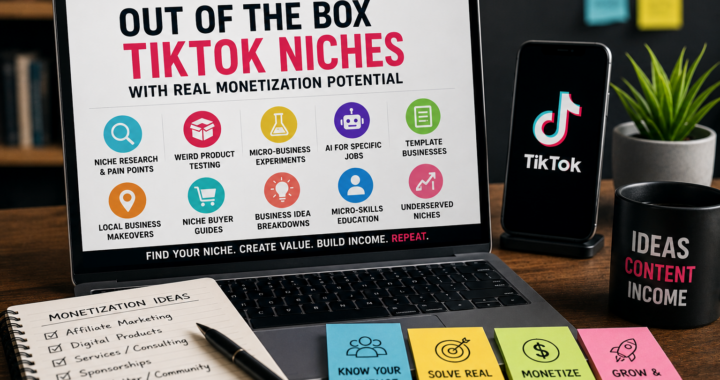
How to choose the right niche for a faceless TikTok business
A good niche is one that sits at the intersection of three things:
something people actively want
something you can create repeatable content around
something that can be monetized
That is the sweet spot.
For example, “faceless TikTok business” itself is interesting, but as a channel niche it is too narrow unless you expand it into a larger business category like:
online business from your phone
AI tools for entrepreneurs
content systems for solopreneurs
faceless creator business models
side hustle workflows
digital product business ideas
You do not need to pick the most exciting niche. You need to pick a niche with enough depth for content and enough commercial potential for real business growth.
If your long-term goal is to strengthen your website, pick a niche that can also support blog content. That gives you more leverage.
Why your website matters even if TikTok is the growth channel
This is one of the biggest strategic mistakes people make on social media.
They build their whole system on rented platforms.
TikTok is excellent for attention, but attention alone is not ownership. If your account changes, traffic drops, or the platform evolves, you want something stable that you control.
That is where your website comes in.
A site built on WordPress and hosted with Bluehost gives you a foundation for articles, resource pages, affiliate content, lead capture, internal linking, and long-term SEO. TikTok can bring people in, but your website is where they go deeper.
This is also where your faceless TikTok account becomes more than a content experiment.
Your account can drive people into:
cornerstone articles
affiliate roundups
tutorials
email signups
guides
related phone business content
That makes the business more stable and far more scalable.
A simple faceless TikTok business funnel
You do not need a complex funnel to make this work. A simple structure is enough.
Step 1: Create attention-grabbing niche videos
Focus on useful, clear, specific content. Your videos should solve small problems or spark curiosity around a business topic.
Step 2: Give viewers a reason to go deeper
That can be:
a blog post
a guide
a resource page
a free checklist
a product page
a curated tools recommendation
Step 3: Monetize on the owned platform
This is where affiliate links, product offers, email capture, or service leads live.
For example, if someone watches your TikTok about building a website-based business from a phone, they might click into a deeper article where you naturally recommend Bluehost and WordPress. If your content is about selling products, a supporting page can guide them toward Shopify. If they need help implementing anything, Fiverr becomes a useful next step.
That is how faceless TikTok content becomes a business engine instead of just a content feed.
How to produce faceless content faster without burning out
A faceless TikTok business only works if you can post consistently enough to learn what resonates.
That does not mean posting endlessly. It means creating a workflow that is sustainable.
A practical way to do that is to batch by format.
For example, one day you might script five text-overlay videos. Another day you might record several screen demos. Another day you might turn one article into four short TikTok ideas.
You can also use AI to speed up ideation, hooks, outlines, captions, and repurposing. If you want help structuring that part of your process, this ties naturally into How to Create Content with AI on Your Smartphone and How to Use ChatGPT from Your Phone for Business Tasks.
And if you want to move faster without doing every task yourself, Fiverr can help with video editing, visuals, thumbnails, motion design, subtitle cleanup, or content formatting.
That is an underrated advantage of faceless business models. Because the content does not rely on your physical presence, it is often easier to delegate parts of the workflow.
How to monetize without looking spammy
This is where a lot of TikTok creators get nervous. They assume monetization will make the account feel less authentic.
The opposite is usually true if you do it properly.
Monetization feels spammy when it is disconnected from the content. It feels useful when it supports the viewer’s next logical step.
If your content is about building an online business, recommending Bluehost or WordPress makes sense when the viewer wants to build a site. If the content is about selling products, Shopify fits naturally. If the viewer wants help setting something up or polishing content, Fiverr is relevant.
The key is context.
Do not throw links around randomly. Build content that creates a natural bridge to the offer.
That is one reason long-form written content matters so much. TikTok opens the door. Your article or resource page does the deeper conversion work.
A realistic first 30-day plan
If you want to launch a faceless TikTok business without overcomplicating it, keep the first month simple.
Week 1: choose your angle
Pick one niche and one business goal. Do not try to talk to everyone.
Week 2: define your formats
Choose two or three repeatable content styles:
text-based tips
screen recordings
voiceover explainers
resource videos
short case studies
Week 3: build your backend
Make sure you have a website or landing destination ready. If you are still setting that up, start with Bluehost and build it on WordPress.
Week 4: publish and measure
Post consistently enough to see what gets traction. Watch for:
completion rate
saves
profile visits
clicks
comments
which angles attract the right audience
At this stage, you do not need perfection. You need data.
Common mistakes to avoid
If you want this article to function like a real cornerstone, it is important to be honest about what goes wrong for most people.
Mistake 1: copying faceless trends without a business model
A faceless account with no monetization path is just content.
Mistake 2: being too broad
If your content jumps from random finance tips to beauty hacks to AI apps to affiliate marketing, people will not know why they should follow.
Mistake 3: relying only on TikTok
If you are serious about building an asset, connect TikTok to your site, articles, and deeper offers.
Mistake 4: hiding behind “faceless” as an excuse for low effort
Faceless content still needs clarity, structure, and usefulness.
Mistake 5: never improving the system
The goal is not just to post. The goal is to refine a repeatable model that attracts the right audience and supports a business.
Why this is such a strong long-term model
A faceless TikTok business is attractive because it combines privacy, scalability, and flexibility.
You can create from your phone. You can batch content. You can test multiple angles. You can tie content to affiliate offers, products, or blog assets. You can outsource parts of the process. You can build a brand without turning yourself into the product.
That matters.
Not everyone wants to become an influencer. Many people simply want to build something profitable and sustainable. A faceless TikTok business gives them a path to do that.
And if the content feeds a website, an email list, or a broader social media ecosystem, it becomes even stronger. That is how a channel stops being “just social content” and starts acting like part of a real business machine.
Final thoughts
You do not need to show your face to build a serious TikTok business in 2026.
What you need is a clear niche, a repeatable content system, a useful backend, and a business model that makes sense. If you can create videos that are helpful, clear, and strategically connected to something deeper, faceless content becomes a major advantage rather than a compromise.
TikTok gives you reach. Your website gives you depth. Your offers give you monetization. Your systems give you consistency.
That combination is what turns a faceless account into a real business.
If you approach it with structure instead of randomness, you are not just building a TikTok page. You are building a scalable content asset that can support traffic, trust, and income over time.
Related articles to link internally
To strengthen this article inside your broader site structure, link naturally to: