Competitor research sounds serious, but it does not have to be complicated.
You do not need expensive software.
You do not need a large marketing team.
You do not need to spy on anyone.
You do not need to copy what other businesses are doing.
Good competitor research is simply the process of studying what already exists in your market so you can understand what your audience is seeing, asking, clicking, saving and responding to.
Then you use that insight to create better, clearer and more useful content.
This is important because many business owners create content from scratch every time.
They ask:
What should I write about?
What should I post today?
What are people interested in?
Which topics are worth covering?
What are competitors doing better than me?
Where can I stand out?
Competitor research helps answer those questions.
Not by copying.
By finding patterns, gaps, weak spots, missed angles and opportunities.
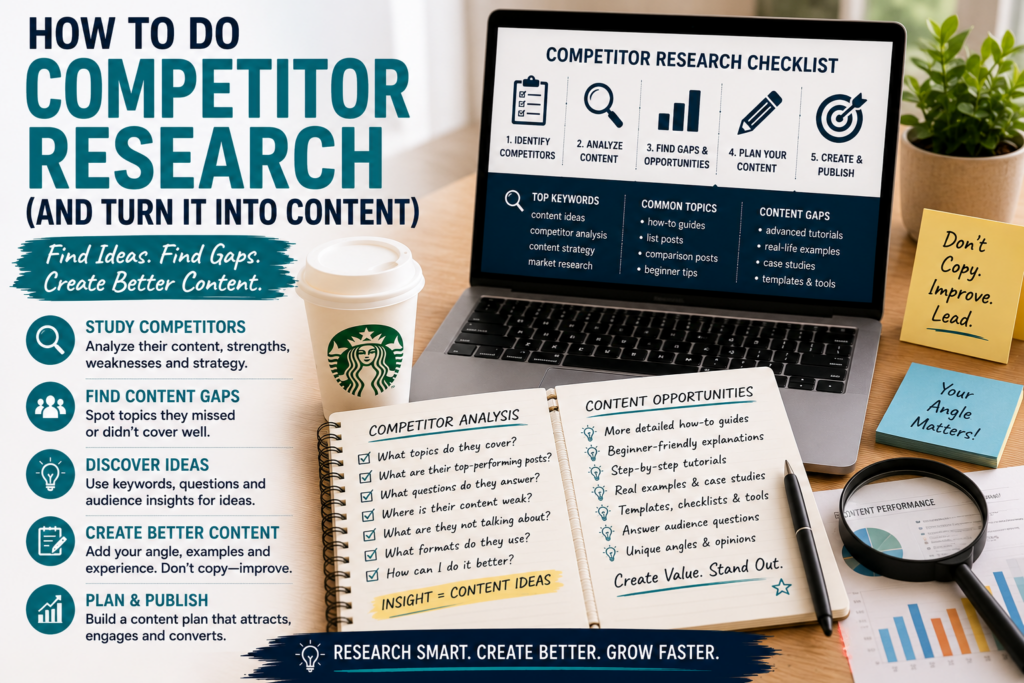
This guide will show you how to do competitor research and turn it into original content for your own business.
Affiliate disclosure: This post contains affiliate links. If you make a purchase through one of these links, ProBusinessStrategy may earn a small commission at no extra cost to you. We only recommend tools we genuinely believe in.
What Competitor Research Really Means
Competitor research means studying businesses, websites, creators or brands that serve a similar audience or solve a similar problem.
You are trying to understand:
What they talk about
Which topics they cover
How they explain their offer
What their audience reacts to
Which questions they answer
Which content formats they use
Which keywords they target
Which platforms they focus on
Where they are strong
Where they are weak
What they ignore
What you can do differently
Competitor research is not theft.
It is market learning.
A restaurant owner looks at other restaurants.
A clothing brand studies fashion trends.
A YouTube creator watches similar channels.
A blogger reads competing articles.
A consultant studies other consultants’ positioning.
That is normal.
The problem begins when people copy titles, structure, wording, images, products or ideas too closely.
Your goal is different.
You want to learn what the market cares about and then create your own useful version with your own angle, examples, experience and positioning.
Why Competitor Research Is Useful for Content
Content creation is easier when you know what already works in your niche.
Competitor research can help you:
Find blog post ideas
Find social media post ideas
Find YouTube video ideas
Find Pinterest Pin angles
Find common customer questions
Find weak competitor content
Find outdated articles
Find missing beginner guides
Find comparison opportunities
Find better headlines
Find product education topics
Find content gaps
Find your unique angle
For example, imagine you run a small business website about home-based business ideas.
You search competitors and notice that many articles talk about “best home business ideas,” but very few explain how to find the first clients without ads.
That is a content gap.
Or imagine you sell digital planners.
You notice competitors show pretty product photos, but they do not explain how to choose the right planner for a specific lifestyle.
That is a content opportunity.
Competitor research helps you stop guessing.
It gives you clues.
Step 1: Choose the Right Competitors
Do not only study the biggest companies in your niche.
Big brands may have large budgets, professional teams and brand awareness you cannot copy.
Instead, study different types of competitors.
Direct Competitors
These are businesses offering something similar to your business.
If you sell website design services for small businesses, another website designer is a direct competitor.
If you sell printable planners, another printable planner shop is a direct competitor.
Content Competitors
These are websites or creators ranking for topics your audience searches, even if they do not sell the same thing.
For example, a blog, YouTube channel or Pinterest account may compete with you for attention.
Platform Competitors
These are accounts doing well on the platform you want to grow.
For example:
Pinterest accounts in your niche
TikTok accounts with similar content
YouTube channels with similar video topics
LinkedIn creators talking to your audience
Blogs ranking for similar keywords
Aspirational Competitors
These are businesses you may not compete with directly yet, but they show where your niche is going.
Study them for structure, positioning and content strategy.
A good competitor research list includes 5 to 10 examples.
Do not overwhelm yourself with 100 competitors.
Start small.
Step 2: Create a Simple Competitor Research Sheet
Use a spreadsheet or simple document.
Track:
Competitor name
Website or profile
Main topic
Target audience
Products or services
Content formats
Strongest content
Weakest content
Common keywords
Best headlines
Repeated questions
Interesting angles
Content gaps
Ideas for your own content
This does not need to be beautiful.
It only needs to help you think clearly.
Your goal is to collect patterns.
After reviewing several competitors, you may notice:
Everyone talks about beginner tips.
Nobody explains mistakes clearly.
Most articles are outdated.
Many videos have strong titles but weak depth.
Pinterest Pins use similar headlines.
Customer comments reveal unanswered questions.
Competitors talk about tools but not workflows.
They explain what to do but not how to start.
Those patterns become content ideas.
Step 3: Study Their Website Content
Start with competitor websites.
Look at:
Homepage
Blog posts
Service pages
Product pages
About page
FAQ page
Resource pages
Guides
Lead magnets
Case studies
Testimonials
Ask:
What do they emphasize first?
Who do they say they help?
What problems do they mention?
What topics do they cover repeatedly?
What do they explain well?
What feels unclear?
What questions are not answered?
What outdated content could be improved?
What beginner topics are missing?
What advanced topics are missing?
Do not just look at the design.
Look at the message.
For example, a competitor may have a beautiful website but weak explanations.
That gives you an opportunity to create clearer educational content.
Or a competitor may rank for many topics but write very generic articles.
That gives you an opportunity to create more practical, example-driven articles.
Step 4: Analyze Their Blog Posts
If competitors have blogs, review their article topics.
Look for:
Most common categories
Recurring keywords
Beginner guides
How-to articles
List posts
Comparison posts
Mistake posts
Case studies
Product education posts
Trend articles
Frequently updated topics
Write down article titles that seem important.
Then ask:
What is the main angle?
Who is this article for?
Is the article beginner-friendly?
Is it practical or vague?
Does it include examples?
Does it answer the real question?
Is there a missing step?
Could the content be more specific?
Could it be more current?
Could it be turned into a better guide?
This is where you find content opportunities.
For example, a competitor article titled:
“10 Marketing Tips for Small Businesses”
could inspire more specific content like:
“How to Create a Weekly Marketing Routine for a One-Person Business”
or:
“Marketing Basics for New Business Owners Who Have No Budget”
or:
“How to Turn One Customer Question Into 10 Marketing Posts”
You are not copying the article.
You are finding a more useful angle.
Step 5: Look at Search Results
Search engines are one of the best places for competitor research.
Type your topic into search and study the results.
For example:
how to get first clients
home based business ideas
how to start a printable business
TikTok micro brand
competitor research content
small business marketing plan
Look at the top results.
Ask:
What types of pages appear?
Are they blog posts, videos, tools, product pages or forums?
What titles are used?
What questions appear in search suggestions?
What related searches appear?
What subtopics show up repeatedly?
Which articles feel strong?
Which articles feel thin or outdated?
Search results show what the market already considers relevant.
They also show what your audience may be trying to learn.
Your job is not to write the same article.
Your job is to create a better or more specific version.
Better can mean:
More practical
More beginner-friendly
More niche-specific
More current
More visual
More step-by-step
More honest
More complete
More useful for a specific audience
Step 6: Study Social Media Content
Competitor research is not only for blogs.
Social media can show what people react to.
Look at competitor posts on:
Pinterest
YouTube
TikTok
Instagram
Facebook
LinkedIn
Pay attention to:
Post topics
Hooks
Headlines
Thumbnails
Captions
Comments
Shares
Saves
Questions
Repeated formats
Strong reactions
Content series
Audience language
For example, on TikTok or YouTube, comments can reveal content ideas.
People may ask:
“How do I start?”
“What tool do you use?”
“Can this work for beginners?”
“How much does it cost?”
“What if I have no audience?”
“Can you show an example?”
“Does this work from a phone?”
“What would you do first?”
Those are content ideas.
Comments are often more valuable than the original post because they show what the audience still wants to know.
Step 7: Find Content Gaps
A content gap is a topic, question or angle competitors have not covered well.
There are different types of gaps.
Beginner Gap
Competitors assume people already know the basics.
You can create beginner-friendly content.
Example:
Instead of “advanced content strategy,” create “content strategy for business starters.”
Practical Gap
Competitors explain the idea but not the process.
You can create step-by-step content.
Example:
Instead of “why competitor research matters,” create “how to do competitor research and turn it into content.”
Niche Gap
Competitors talk broadly.
You can make it specific.
Example:
Instead of “how to get clients,” create “how to find your first home-based clients without ads.”
Example Gap
Competitors provide theory but no examples.
You can include templates, examples, checklists or scenarios.
Trust Gap
Competitors sound polished but not realistic.
You can write honestly about mistakes, limitations and practical first steps.
Update Gap
Competitor content is old.
You can create a newer, clearer version.
Finding gaps is the real power of competitor research.
This is where your content becomes original.
Step 8: Turn Competitor Topics Into Your Own Angles
The topic may be common.
The angle makes it yours.
For example, many people write about “content ideas.”
You can create different angles:
Content ideas for business starters
Content ideas for home-based businesses
Content ideas for LinkedIn beginners
Content ideas for Pinterest affiliate websites
Content ideas for TikTok micro-brands
Content ideas for service providers with no audience
Content ideas based on customer questions
Content ideas from competitor research
Same broad topic.
Different angle.
When turning competitor research into content, use this formula:
Competitor topic + specific audience + specific problem + useful format
Example:
Competitor topic: marketing plan
Specific audience: new solopreneurs
Specific problem: no time
Useful format: weekly routine
New content idea:
“How to Create a Simple Weekly Marketing Routine as a Solopreneur”
Another example:
Competitor topic: product descriptions
Specific audience: mobile ecommerce sellers
Specific problem: writing from a phone
Useful format: AI workflow
New content idea:
“How to Use AI to Write Product Descriptions from Your Phone”
This is how you create original content from market research.
Step 9: Build a Content Idea Bank
Do not try to create every idea immediately.
Create a content idea bank.
For each idea, include:
Topic
Target audience
Problem
Competitor inspiration
Your unique angle
Content format
Possible title
Keywords
Platform
Priority
Notes
Example:
Topic: first clients
Audience: home-based business owners
Problem: no ad budget
Angle: warm outreach and referrals
Format: step-by-step guide
Possible title: How to Find Your First Home-Based Clients Without Ads
Priority: high
This helps you avoid losing ideas.
Over time, your competitor research becomes a content strategy asset.
You are not starting from zero every week.
You are building a library of content opportunities.
Step 10: Create Better Content, Not Just More Content
Competitor research should not lead to endless copycat content.
The goal is better content.
To make your content better, ask:
Can I make this clearer?
Can I add better examples?
Can I make it more specific?
Can I make it more useful for beginners?
Can I add a checklist?
Can I explain what to avoid?
Can I include a simple process?
Can I show a real scenario?
Can I connect this to a product or service?
Can I answer questions competitors ignore?
For example, if every competitor writes “10 ways to grow your business,” you can create:
“A 14-Day No-Ads Plan to Find Your First Clients”
That is more specific, more practical and easier to act on.
More content is not always better.
Better content is better.
Step 11: Use Competitor Research for Different Content Formats
One competitor research session can create many types of content.
From one topic, you can create:
Blog post
Pinterest Pin
YouTube video
TikTok script
LinkedIn post
Instagram carousel
Email newsletter
Checklist
Lead magnet
FAQ section
Product idea
Short-form video
Comparison guide
For example, competitor research around “how to get clients” could become:
Blog post: How to Find Your First Home-Based Clients Without Ads
Pinterest Pin: 6 Ways to Find Clients Without Ads
LinkedIn post: Why your first clients usually come from conversations, not funnels
TikTok video: 3 ways to get clients before running ads
Lead magnet: First Client Outreach Checklist
Email: What to say when asking for referrals
This is how competitor research turns into a content machine.
You do the thinking once.
Then you repurpose it across platforms.
Step 12: Avoid Copying Competitors
This step matters.
Competitor research is useful, but copying is dangerous.
Do not copy:
Their article text
Their unique structure
Their images
Their product names
Their brand style
Their course outline
Their original frameworks
Their email copy
Their sales page wording
Their exact headlines repeatedly
Instead, extract patterns.
For example, you can notice that:
Beginner guides perform well
People ask about pricing
Short checklists get saved
Mistake posts get comments
Comparison posts attract buyers
Case studies build trust
Then create your own content from those patterns.
Good competitor research asks:
What can I learn?
Bad competitor research asks:
What can I steal?
Stay on the right side.
Your brand becomes stronger when your content has its own voice, structure and value.
Step 13: Add Your Own Experience and Opinion
Your content becomes more original when you add your own thinking.
This can include:
Your opinion
Your method
Your examples
Your mistakes
Your process
Your checklist
Your preferred tools
Your audience focus
Your personal observations
Your client experience
Your test results
Even if the topic is common, your perspective can make it different.
For example, many people write about competitor research.
But your article might focus on helping beginners turn research into practical content ideas without copying.
That is a specific angle.
Your opinion could be:
“Competitor research should not make your brand more generic. It should help you see where your market is underserved.”
That kind of thinking makes the content stronger.
Step 14: Prioritize Content Opportunities
After research, you may have too many ideas.
Prioritize them.
Use simple scoring.
Rate each idea from 1 to 5 for:
Audience interest
Business relevance
Search potential
Content gap
Ease of creation
Monetization potential
Evergreen value
A high-priority idea is one that:
Your audience cares about
Connects to your business
Has search or platform potential
Fills a clear gap
Can be created well
May support future offers
Will stay useful over time
Do not only chase trending topics.
Evergreen content often becomes more valuable for a business.
A good evergreen article can keep attracting readers, leads and customers long after it is published.
Step 15: Create a Competitor Research Routine
Competitor research should not be a one-time activity.
Create a simple routine.
Weekly:
Review 3 competitor posts or articles
Save good topic ideas
Check comments for questions
Add ideas to your content bank
Monthly:
Review top competitors
Look for new content patterns
Update old content ideas
Find new gaps
Choose priority topics
Quarterly:
Review your own content compared to competitors
Update outdated posts
Improve weak articles
Create new guides from gaps
Check if your positioning is still clear
This does not need to take hours.
A simple 30-minute research session can produce several strong content ideas.
The key is consistency.
A Simple Competitor Research Template
Use this simple template:
Competitor name:
Website or profile:
Audience:
Main topics:
Best content examples:
Weak content examples:
Repeated questions from audience:
Keywords or phrases:
Content formats used:
What they do well:
What they miss:
My content opportunity:
Possible title:
My unique angle:
Priority:
Example:
Competitor name: Small business marketing blog
Audience: new entrepreneurs
Main topics: marketing, social media, content strategy
What they do well: broad beginner guides
What they miss: practical no-budget examples
My content opportunity: no-ads client acquisition guide
Possible title: How to Find Your First Home-Based Clients Without Ads
My unique angle: warm outreach, referrals and local contacts
Priority: high
This simple template can turn competitor research into real content planning.
Common Mistakes to Avoid
Studying Too Many Competitors
Too much research can become procrastination.
Start with 5 to 10 competitors.
Copying Instead of Learning
Use competitor research for insight, not imitation.
Ignoring Small Competitors
Small brands often reveal useful niche ideas that big brands ignore.
Only Looking at Popular Posts
Also study weak content. Weak content shows where you can improve.
Forgetting the Audience
The competitor is not the real focus.
The audience is.
Study what the audience wants, asks and responds to.
Creating Content With No Business Purpose
Every content idea should support your audience and your business direction.
Never Publishing
Research is useful, but publishing teaches you more.
Do the research, create the content and measure what happens.
Final Thoughts
Competitor research is one of the simplest ways to create smarter content.
It helps you understand what your audience already sees, what competitors explain, what questions remain unanswered and where your business can stand out.
But the goal is not to copy.
The goal is to create better content.
Study competitors.
Find patterns.
Read comments.
Look for gaps.
Choose specific angles.
Build a content idea bank.
Add your own experience.
Prioritize the best opportunities.
Publish consistently.
When done well, competitor research turns into a practical content engine.
You stop asking, “What should I post?”
Instead, you start asking:
“What is missing in my market, and how can I explain it better?”
That question can lead to blog posts, videos, Pins, newsletters, lead magnets, product ideas and stronger positioning.
Your competitors are not just businesses to watch.
They are clues.
Use those clues wisely, and you can turn competitor research into content that is original, useful and valuable for your audience.
Related Articles
The First 10 Customers Plan: A Step-by-Step Guide for New Business Owners