B2B Office Supply Niche: How to Build a Recurring Business Supply Company in 2026
Office supplies may not sound like the most exciting business in the world.
But they are practical, repeatable, and necessary.
Every business needs supplies. Offices need paper, pens, printer cartridges, cleaning items, shipping materials, labels, desk accessories, breakroom products, and ergonomic equipment. Remote teams need home office kits. Coworking spaces need meeting room supplies. Clinics need hygiene products. Startups need onboarding kits for new employees.
That makes the B2B office supply market a strong opportunity for entrepreneurs who prefer stable, practical, recurring revenue over trend-chasing.
A B2B Office Supply Niche Business sells office-related products to other businesses, but with a focused angle. Instead of trying to become a general office supply giant, you serve a specific customer group or product category better than broad competitors.
Examples include:
- eco-friendly office supplies for small businesses
- ergonomic desk setup kits for remote teams
- branded welcome kits for new employees
- office supply subscriptions for coworking spaces
- hygiene and paper supplies for clinics
- premium stationery for creative agencies
- printer supply plans for local businesses
- breakroom coffee and snack supply services
- shipping and labeling supplies for e-commerce sellers
The opportunity is not in selling everything.
The opportunity is in becoming the most convenient supplier for a specific business need.
Affiliate disclosure: This guide may contain affiliate links. If you purchase through them, ProBusinessStrategy may earn a commission at no extra cost to you. We only recommend tools we believe are genuinely useful for beginners and serious builders.
What Is a B2B Office Supply Niche Business?
B2B means business-to-business.
Instead of selling to individual consumers, you sell to companies, teams, offices, clinics, agencies, coworking spaces, schools, contractors, or remote organizations.
A niche office supply business focuses on a specific segment.
For example:
- sustainable office products for eco-conscious companies
- ergonomic home office bundles for remote-first teams
- monthly supply boxes for small law firms
- branded onboarding kits for tech startups
- office coffee and breakroom supplies for local businesses
The customer is not buying a single product casually.
They are often solving an operational problem.
They want:
- supplies delivered on time
- consistent quality
- easy reordering
- invoice-friendly purchasing
- predictable pricing
- one supplier they can trust
That is where the business opportunity sits.
Why B2B Office Supplies Are Attractive in 2026
Businesses buy repeatedly
Office supplies are not one-time purchases.
Companies regularly reorder:
- printer paper
- ink and toner
- notebooks
- pens
- sticky notes
- cleaning supplies
- coffee cups
- shipping labels
- packaging tape
- envelopes
- hygiene products
- breakroom items
Recurring demand makes revenue more predictable.
B2B customers value convenience
Business customers often care less about finding the absolute cheapest option and more about reducing hassle.
If you can save a business owner or office manager time, they may stay loyal.
Convenience can beat price.
Orders can be larger
A consumer might buy one notebook.
A company might order:
- 50 notebooks
- 200 pens
- 30 desk mats
- 100 shipping boxes
- 20 ergonomic footrests
- monthly restocks of breakroom supplies
This increases average order value.
Niche positioning creates differentiation
Large suppliers compete on selection and price.
You can compete on specialization.
For example:
- “sustainable office supplies for modern startups”
- “remote employee onboarding kits delivered worldwide”
- “monthly restock boxes for small clinics”
- “premium stationery for creative studios”
Specific positioning makes marketing easier.
Choosing Your Office Supply Niche
The niche determines who you serve, what you sell, and how you market.
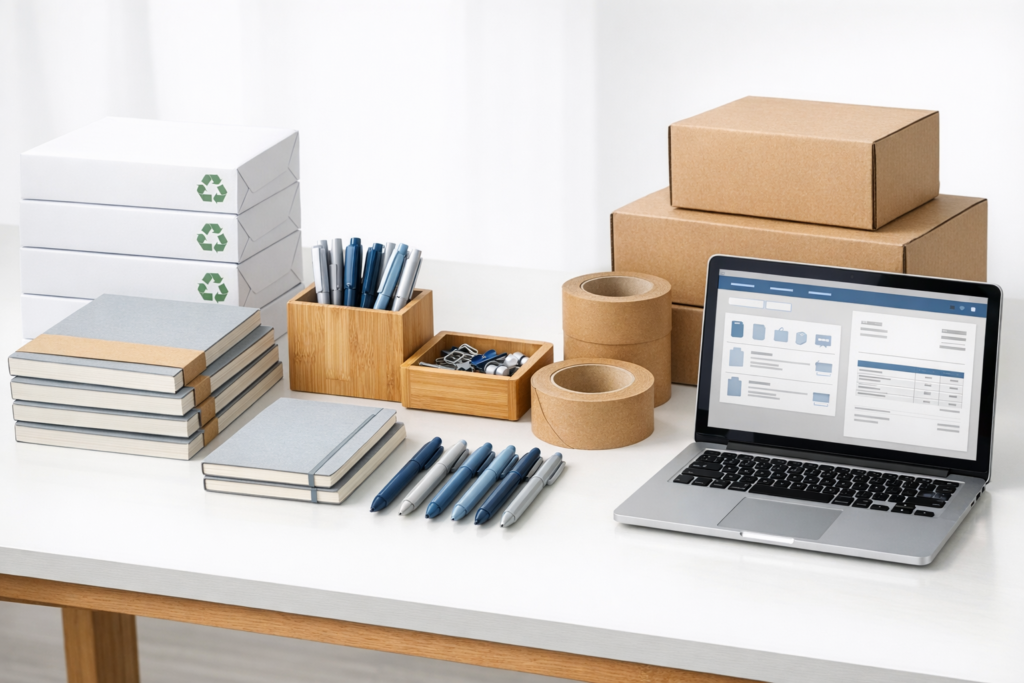
Eco-friendly office supplies
Products:
- recycled paper
- refillable pens
- bamboo desk accessories
- compostable mailers
- plastic-free packaging tape
- recycled notebooks
- natural cleaning products
Why it works:
Many companies want to improve sustainability without researching every item themselves.
This connects naturally with eco-friendly household kits.
Ergonomic home office kits
Products:
- laptop stands
- ergonomic mouse
- wrist rests
- monitor risers
- footrests
- desk lamps
- posture cushions
- cable organizers
Why it works:
Remote work and hybrid teams remain common. Companies may offer home office budgets for employees.
New employee welcome kits
Products:
- branded notebooks
- pens
- mugs
- desk accessories
- company swag
- onboarding cards
- laptop sleeves
- welcome letters
- productivity planners
Why it works:
Startups and remote companies want professional onboarding experiences.
Coworking space supply plans
Products:
- whiteboard markers
- sticky notes
- printer paper
- coffee supplies
- cleaning wipes
- meeting room notebooks
- name tags
- charging cables
Why it works:
Coworking spaces need constant replenishment.
Clinic and wellness office supplies
Products:
- paper towels
- sanitizing wipes
- disposable cups
- appointment cards
- clipboards
- pens
- waiting room supplies
- natural cleaning products
Why it works:
Healthcare and wellness spaces need reliability and recurring restocks.
E-commerce shipping supply niche
Products:
- mailers
- boxes
- labels
- packing tape
- thank-you cards
- thermal label rolls
- protective packaging
- branded inserts
Why it works:
Online sellers constantly need packaging and shipping materials.
This niche connects well with broader e-commerce businesses like vintage clothing resale and refurbished tech.
Product Categories That Work Well
A strong B2B office supply niche usually includes a mix of consumables, equipment, and bundles.
Consumables
These create repeat purchases.
Examples:
- paper
- ink
- toner
- pens
- labels
- envelopes
- cleaning wipes
- coffee filters
- trash bags
- packaging materials
Productivity tools
Examples:
- planners
- notebooks
- whiteboards
- desk organizers
- filing systems
- sticky notes
- calendars
Ergonomic products
Examples:
- laptop stands
- wrist rests
- chair cushions
- footrests
- monitor risers
- ergonomic keyboards
- ergonomic mice
Branded supplies
Examples:
- custom notebooks
- company pens
- welcome kits
- branded mugs
- printed folders
- business cards
Breakroom supplies
Examples:
- coffee
- tea
- cups
- stirrers
- napkins
- snacks
- water filters
Business Models You Can Use
Traditional online B2B store
Businesses order supplies through your website.
Best for:
- product variety
- SEO traffic
- catalog-style shopping
Subscription restock service
Customers receive supplies monthly or quarterly.
Best for:
- clinics
- coworking spaces
- agencies
- remote teams
- small offices
Custom bundle service
You build kits for specific use cases.
Examples:
- new employee welcome kit
- remote work starter kit
- meeting room kit
- eco-office starter kit
- shipping station kit
Local delivery supply service
Serve businesses in your city or region.
Benefits:
- faster delivery
- personal relationships
- easier repeat orders
- local SEO opportunities
Procurement-as-a-service
You become the person who simplifies office purchasing for small businesses.
Instead of browsing 20 suppliers, they send you a list and you handle sourcing.
Sourcing Products
Wholesale distributors
Look for office product wholesalers, packaging suppliers, janitorial suppliers, and breakroom supply distributors.
Evaluate:
- minimum order quantities
- shipping costs
- product variety
- wholesale pricing
- reliability
- return policy
- inventory availability
Direct manufacturers
For higher volume, source directly from manufacturers.
Best for:
- notebooks
- pens
- packaging supplies
- ergonomic accessories
- branded items
Local suppliers
Local sourcing can reduce lead times.
Useful for:
- printing
- branded products
- coffee supplies
- cleaning products
- paper goods
Private label
Once you grow, private label can improve margins.
Examples:
- your own recycled notebooks
- branded desk pads
- private label packaging tape
- custom office kits
- branded ergonomic bundles
Pricing Strategy for B2B
B2B pricing is different from consumer pricing.
Businesses often expect:
- volume discounts
- invoice payment
- repeat order pricing
- subscription discounts
- custom quotes
- tax invoices
- purchase orders
Pricing formula
Selling Price=Product Cost+Shipping+Packaging+Labor+Overhead+Profit MarginSelling\ Price = Product\ Cost + Shipping + Packaging + Labor + Overhead + Profit\ MarginSelling Price=Product Cost+Shipping+Packaging+Labor+Overhead+Profit Margin
Volume discount example
- 1–10 units: standard price
- 11–50 units: 5% discount
- 51–100 units: 10% discount
- 100+ units: custom quote
Subscription pricing
Offer monthly restock plans.
Example:
- Small Office Plan: $99/month
- Growing Team Plan: $249/month
- Coworking Plan: $499/month
- Custom Business Plan: quote-based
Selling to Business Customers
Identify the buyer
Your buyer may be:
- office manager
- founder
- operations manager
- HR manager
- clinic owner
- coworking manager
- facilities manager
- procurement assistant
Your content and sales message should speak to their needs.
What B2B buyers care about
They want:
- reliability
- easy ordering
- clear invoices
- fast delivery
- consistent stock
- responsive support
- predictable pricing
- fewer headaches
Outreach methods
You can reach customers through:
- local business directories
- cold email
- partnerships
- networking groups
- coworking spaces
- industry associations
- Google Business Profile
- local SEO
Example outreach message
Subject: Office supply restock service for small teams
Hi [Name],
I noticed your team operates a busy office in [City]. We help small businesses simplify office supply restocking with monthly supply bundles, eco-friendly options, and easy invoicing.
Instead of ordering from multiple suppliers every month, your team can receive one organized restock box based on your actual usage.
Would it be helpful if I sent over a sample supply plan for a team of [X] people?
Best,
[Your Name]
Marketing Strategy
SEO content
Write articles like:
- Best Eco-Friendly Office Supplies for Small Businesses
- Remote Employee Welcome Kit Ideas
- Office Supply Checklist for Small Teams
- Best Ergonomic Desk Accessories for Remote Workers
- How to Reduce Office Supply Costs
- Monthly Office Supply Subscription for Coworking Spaces
Local SEO
If serving a city, create pages like:
- Office Supply Delivery in [City]
- Eco-Friendly Office Supplies for [City] Businesses
- Coworking Space Supplies in [City]
LinkedIn content
Post about:
- reducing office supply waste
- remote work setup tips
- onboarding kit ideas
- ergonomic desk mistakes
- sustainability in small offices
Partnerships
Partner with:
- HR consultants
- coworking spaces
- office designers
- business coaches
- local printers
- IT setup companies
- cleaning services
Operations and Fulfillment
Inventory approach
You can start with:
- low inventory
- supplier dropship arrangements
- pre-built bundles
- made-to-order kits
- local supplier pickup
- just-in-time ordering
Reorder systems
Recurring customers need simple reordering.
Offer:
- one-click reorder
- monthly restock reminders
- subscription plans
- custom supply lists
- account manager support
- usage tracking
Delivery and shipping
For local B2B, consider:
- weekly delivery route
- same-day delivery for urgent items
- pickup partnerships
- courier services
For national B2B:
- shipping software
- negotiated carrier rates
- warehouse fulfillment
- flat-rate shipping thresholds
Tools Needed
Useful tools include:
- e-commerce platform
- inventory management
- invoicing software
- CRM
- email marketing
- shipping software
- accounting software
- quote management tools
This connects well with business automation apps and business tool comparison sites.
Customer Retention
B2B success depends on repeat relationships.
Make reordering effortless
Send monthly reminders:
- “Do you need your usual supplies?”
- “Your paper and toner restock is ready.”
- “Time to refresh your meeting room kit?”
Create business accounts
Offer:
- saved payment methods
- saved delivery addresses
- invoice history
- recurring order templates
- approval workflows
Offer quarterly reviews
For bigger clients, review usage:
- what they ordered
- what they wasted
- what they can save
- what should be automated
Common Mistakes to Avoid
Mistake 1: Competing with giants on price
You will struggle against huge suppliers if price is your only strategy.
Compete on niche, service, speed, convenience, and specialization.
Mistake 2: Serving everyone
A clear niche is easier to market.
Mistake 3: Ignoring shipping costs
Office products can be bulky or heavy.
Calculate carefully.
Mistake 4: Weak invoicing process
Business buyers need clean invoices, receipts, tax details, and payment terms.
Mistake 5: No reorder system
If reordering is difficult, customers drift away.
Mistake 6: Carrying too much inventory too soon
Start lean. Let demand guide inventory.
30-Day Launch Plan
Days 1–5: Choose your niche
Pick one:
- eco-friendly supplies
- remote work kits
- coworking supply plans
- clinic restock service
- shipping supplies for e-commerce sellers
- new employee welcome kits
Days 6–10: Build your starter catalog
Choose 20–50 products.
Focus on:
- repeat demand
- clear use case
- manageable shipping
- reliable suppliers
- healthy margins
Days 11–15: Create bundle offers
Build 3–5 bundles.
Examples:
- Eco Office Starter Kit
- Remote Employee Desk Kit
- Monthly Small Office Restock Box
- Coworking Meeting Room Kit
- E-commerce Shipping Station Kit
Days 16–20: Set up ordering and invoicing
Create:
- simple website
- quote request form
- payment options
- invoice template
- product catalog
- business contact page
Days 21–25: Contact potential customers
Reach out to:
- local offices
- agencies
- clinics
- coworking spaces
- e-commerce sellers
- startups
- HR managers
Days 26–30: Test first orders
Offer sample bundles or first-month discounts.
Collect feedback.
Improve catalog and pricing.
Example Starter Business Concept
Brand:
EcoOffice Supply Co.
Target customer:
Small businesses and remote teams that want sustainable office supplies.
Offer:
Monthly eco-office restock boxes and remote employee welcome kits.
Products:
- recycled notebooks
- refillable pens
- bamboo desk organizers
- compostable mailers
- recycled printer paper
- natural cleaning wipes
- plastic-free tape
- reusable coffee cups
Revenue streams:
- one-time bundles
- monthly restock subscriptions
- custom corporate kits
- branded product add-ons
- local delivery
- bulk orders
Final Thoughts
A B2B Office Supply Niche Business may not be flashy, but it can be practical, stable, and profitable.
Businesses need supplies to operate.
They value reliability.
They reorder.
They often buy in larger quantities.
The key is not to become a generic office supply store. The key is to serve a specific business audience with a clear promise.
Make ordering easy.
Choose products carefully.
Build supplier relationships.
Offer recurring restock plans.
Focus on convenience, trust, and consistency.
If you do that, office supplies become more than pens and paper.
They become a recurring business system.
Suggested next reads