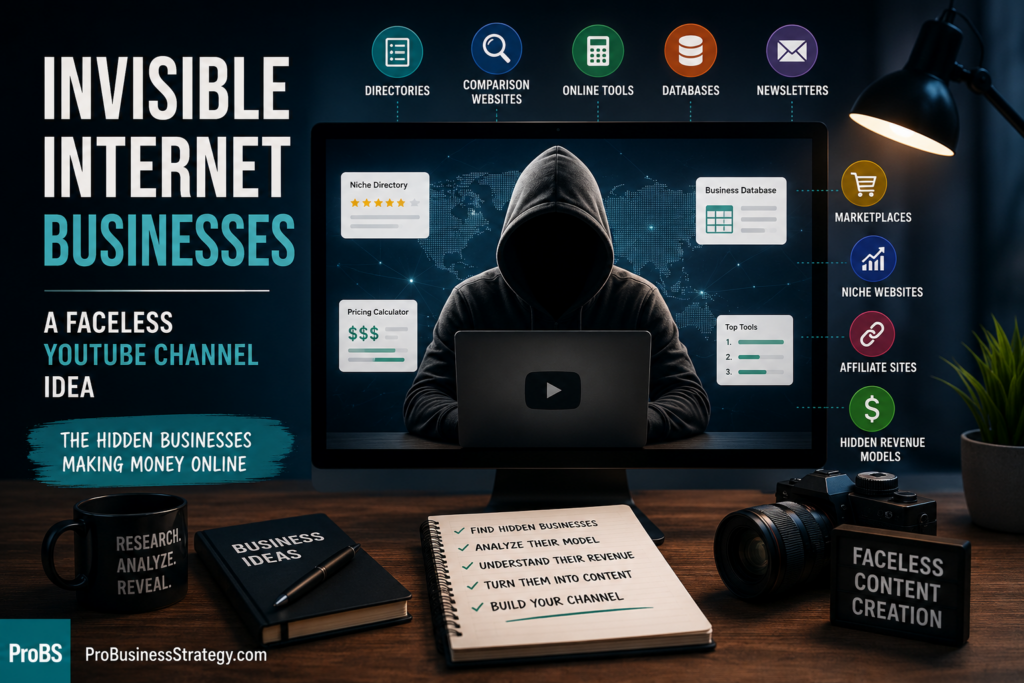
Some of the most interesting online businesses are almost invisible.
They do not have famous founders, viral social media accounts, or physical stores. Many operate quietly in the background while earning money from directories, niche websites, small software tools, newsletters, databases, affiliate content, digital marketplaces, or specialised services.
Most internet users interact with these businesses without ever thinking about who built them.
That creates an unusual opportunity for a faceless YouTube channel.
Instead of making another channel about famous entrepreneurs or billion-dollar startups, you could investigate the small, hidden businesses that make the internet work. Each video would reveal how one of these businesses attracts visitors, provides value, and generates revenue.
The channel could combine business education, digital archaeology, practical analysis, and unusual online business ideas—all without requiring you to appear on camera.
Affiliate disclosure: This post contains affiliate links. If you make a purchase through one of these links, ProBusinessStrategy may earn a small commission at no extra cost to you. We only recommend tools we genuinely believe in.
What Is an Invisible Internet Business?
An invisible internet business is an online company, website, or digital asset that earns money without depending heavily on a visible personal brand.
The owner may rarely appear publicly. Customers may use the service without knowing who operates it.
Examples include:
- niche directories;
- comparison websites;
- online calculators;
- job boards;
- template libraries;
- small software tools;
- paid databases;
- specialised newsletters;
- lead-generation websites;
- affiliate content sites;
- industry marketplaces;
- browser extensions;
- domain portfolios;
- digital resource libraries;
- local information websites;
- licensing businesses;
- membership communities;
- data aggregation services.
These companies are not necessarily secret. They are simply less visible than influencer businesses, personal brands, and heavily promoted startups.
A visitor may search for a specific solution, use the website, click a recommendation, download a resource, or pay for access—without ever seeing the founder.
The YouTube Channel Concept
The channel would investigate one hidden online business model at a time.
Each video could answer questions such as:
- What does this business provide?
- Who is the target customer?
- How does it attract traffic?
- How does it make money?
- Why does the business not need a visible founder?
- What makes the model difficult to copy?
- Could a beginner build a smaller version?
- Which tools would be needed?
- What are the risks?
- How could the idea be improved?
The channel should not merely list business ideas.
Its strength would come from showing viewers how an apparently simple website or tool functions as a complete business system.
For example, a video about a niche directory could explain:
- why people search for the listed providers;
- how the directory obtains its data;
- how it ranks in search engines;
- how businesses pay for featured listings;
- how affiliate links or lead fees create additional revenue;
- how a new creator could start with one narrow geographic or professional niche.
That makes the content both entertaining and practical.
Why This Works as a Faceless Channel
This concept does not require a traditional presenter.
The subject itself provides the visuals.
Videos can use:
- website screen recordings;
- diagrams;
- animated business models;
- screenshots;
- charts;
- maps;
- search-result examples;
- icons;
- stock footage;
- text overlays;
- narrated explanations.
The channel is therefore built around research and storytelling rather than personality.
A faceless format can also suit creators who:
- do not want to appear on camera;
- speak English but do not feel confident presenting live;
- prefer writing and research;
- want to outsource parts of production;
- are building the channel alongside a job;
- want the channel itself to become an asset.
Faceless does not mean effortless or anonymous in every sense. The videos still need a recognisable editorial style, original analysis, clear narration, and consistent quality.
The channel’s identity may come from its visual design, recurring format, tone of voice, and approach to investigating businesses.
A Clear Channel Promise
The channel needs a simple promise that viewers can understand immediately.
For example:
We reveal the quiet online businesses earning money behind websites, tools, directories, and digital services most people overlook.
Other possible channel positioning statements include:
Discover the hidden business models powering the internet.
We investigate small online companies you use but never notice.
Real internet businesses without influencers, offices, or public founders.
The promise should remain narrow enough that viewers know why they should subscribe.
A general channel about “making money online” would be much harder to distinguish from thousands of existing channels.
A channel specifically about invisible internet businesses has a more original identity.
Five Core Content Pillars
A strong channel needs recurring content categories.
1. Hidden Website Businesses
These videos examine websites that appear simple but have a clear monetisation system.
Potential subjects include:
- specialist directories;
- local comparison sites;
- industry databases;
- quote-request websites;
- classified websites;
- review platforms;
- calculators;
- resource libraries;
- niche job boards.
A video could be titled:
How a Simple Directory Becomes a Profitable Online Business
2. Quiet Software Businesses
Not every software company is trying to become the next global technology giant.
Many small tools solve one narrow problem for a specific group.
Examples include:
- invoice generators;
- booking widgets;
- file converters;
- pricing calculators;
- browser extensions;
- reporting dashboards;
- plugins;
- industry-specific automation tools.
Possible video:
The Tiny Software Tools Making Money From One Annoying Problem
3. Hidden Monetisation Models
These videos focus on revenue rather than one particular website.
Subjects could include:
- paid listings;
- affiliate commissions;
- lead generation;
- sponsorship;
- subscriptions;
- data licensing;
- premium reports;
- marketplace fees;
- advertising;
- software licences;
- downloadable products.
Possible video:
Seven Ways a Free Website Can Quietly Make Money
4. Build-a-Smaller-Version Videos
These episodes translate an established model into a realistic beginner business.
For example:
- turn a national directory into a local directory;
- turn a complex software platform into a spreadsheet-based service;
- turn a large marketplace into a curated niche marketplace;
- turn a broad newsletter into a specialised industry briefing;
- turn a major review site into a single-product comparison resource.
Possible video:
How to Build a Tiny Version of a Million-Visitor Website
5. Invisible Business Case Studies
These would analyse real categories of companies without needing to reveal confidential financial information.
A case study can investigate:
- the problem solved;
- likely customer journey;
- pricing;
- traffic sources;
- operational requirements;
- competitive advantages;
- weaknesses;
- possible expansion opportunities.
The analysis must clearly distinguish verified information from estimates or assumptions.
Video Ideas for the First Channel Month
A strong launch requires several related videos so that new viewers can immediately understand the channel.
Your first ten videos could be:
- What Is an Invisible Internet Business?
- How Niche Directories Make Money
- Seven Boring Websites That Can Become Real Businesses
- How Free Online Calculators Generate Revenue
- Why Small Job Boards Still Work
- The Hidden Business Behind Comparison Websites
- How a One-Person Database Business Works
- Tiny Software Tools That Solve Expensive Problems
- How to Build a Local Directory From Scratch
- Five Invisible Businesses You Could Start Without Showing Your Face
The early videos should be closely connected. That gives YouTube and viewers a clearer understanding of the channel’s subject.
A Repeatable Video Structure
Using a repeatable structure will make production faster and give the channel a professional identity.
Opening Hook
Begin with a surprising observation:
This website looks like a simple list of suppliers. But every featured company may be paying for visibility, leads, or customer enquiries.
Explain the Business
Describe what the company or website provides and who uses it.
Reveal the Revenue Model
Show how money may enter the system:
- listing fees;
- subscriptions;
- commissions;
- advertising;
- lead fees;
- premium tools;
- downloadable products.
Explain the Traffic Model
Cover how users discover it:
- Google search;
- direct referrals;
- industry partnerships;
- email;
- social platforms;
- repeat usage;
- embedded tools.
Identify the Competitive Advantage
Explain why competitors cannot immediately replace it.
Advantages may include:
- years of accumulated data;
- strong search rankings;
- industry relationships;
- user reviews;
- a useful tool;
- switching costs;
- specialised knowledge;
- brand recognition within a small niche.
Build the Beginner Version
Show how a viewer could begin with a smaller, narrower model.
End With One Practical Question
For example:
Which industry contains valuable information that is still scattered across dozens of websites?
That encourages comments without relying on generic engagement requests.
How to Produce the Videos
The production system can remain relatively simple.
Research
Start with one business category rather than trying to reveal private information about individual owners.
Collect:
- customer problems;
- pricing examples;
- common revenue models;
- search terms;
- competitor features;
- user reviews;
- market gaps.
Never invent revenue figures merely to make a title more exciting.
When financial information is unavailable, describe the business model rather than pretending to know exactly how much the company earns.
Script
Write a clear narrative rather than a collection of facts.
A useful script sequence is:
problem → hidden solution → revenue model → competitive advantage → beginner opportunity
Narration
You can use:
- your own voice;
- a hired narrator;
- a properly licensed synthetic voice.
A faceless channel can use AI-assisted production, but the final videos still need original value. YouTube requires monetisable content to be original and non-repetitious, and its channel review considers whether the creator has meaningfully produced or transformed the material.
When realistic footage, voices, or events are meaningfully altered or synthetically generated, YouTube may require the creator to use its altered or synthetic content disclosure.
Visuals
Create visuals from:
- your own screen recordings;
- diagrams;
- original animations;
- licensed stock assets;
- custom infographics;
- graphs based on cited data;
- screenshots used for commentary or explanation.
Do not build the entire channel from copied clips, generic slideshows, or minimally edited material.
Editing
Use recurring visual elements:
- the same title sequence;
- consistent fonts;
- one colour system;
- recurring chapter labels;
- the same diagram style;
- a recognisable thumbnail format.
When production becomes too time-consuming, tasks such as thumbnail production becomes too time design, research assistance, narration, or editing can be outsourced through Fiverr. Keep editorial judgment and final quality control under your own direction.
Monetisation Opportunities
The channel can eventually combine several income streams.
YouTube Revenue
Full advertising-revenue eligibility generally requires 1,000 subscribers plus either 4,000 valid public watch hours during the previous 12 months or 10 million valid public Shorts views during the previous 90 days.
In eligible countries, the expanded YouTube Partner Program provides earlier access to certain fan-funding and Shopping features at 500 subscribers, three valid public uploads within 90 days, and either 3,000 watch hours or 3 million Shorts views. Meeting a threshold does not guarantee approval; YouTube evaluates the channel based on various criteria.
This channel should not depend solely on advertising, however.
Affiliate Marketing
Many videos will naturally mention tools used to build online businesses.
For example:
- A domain-focused episode can recommend Namecheap.
- A website or directory guide can introduce Bluehost.
- A beginner who wants help creating a companion website can explore the WordPress AI Sitebuilder.
- Production tasks can be outsourced through Fiverr.
Affiliate recommendations should match the video. Adding unrelated tools to every description will weaken trust.
Sponsorships
Potential sponsors could include:
- hosting companies;
- domain providers;
- website builders;
- business software;
- research tools;
- newsletter platforms;
- automation products;
- payment services.
A focused audience of entrepreneurs may be commercially valuable even before the channel becomes very large.
Digital Products
The channel could sell:
- business-model worksheets;
- directory launch checklists;
- niche research templates;
- website opportunity scorecards;
- monetisation maps;
- research databases;
- video case-study collections.
Paid Newsletter
A weekly newsletter could feature:
- one invisible business;
- one monetisation model;
- one tool;
- one opportunity;
- one warning.
This gives the channel a direct relationship with its audience instead of depending entirely on YouTube.
Companion Website
A website can become the permanent library behind the channel.
It might include:
- written case studies;
- business-model categories;
- searchable directories;
- downloadable resources;
- affiliate recommendations;
- newsletter registration;
- updated versions of older videos.
A domain can be registered through Namecheap, while Bluehost or the WordPress AI Sitebuilder can support the website itself.
The companion site could eventually become an invisible internet business of its own.
The Biggest Mistake to Avoid
The main danger is turning the channel into a low-effort collection of copied websites and AI-generated summaries.
A strong episode needs an original reason to exist.
It should provide:
- a new framework;
- a clear explanation;
- practical analysis;
- original comparisons;
- useful diagrams;
- a credible beginner version;
- honest discussion of risk.
YouTube states that monetisable videos must be original and non-repetitious, and creators must have the necessary commercial rights for the visual and audio elements they use.
Being faceless is not the problem.
Being replaceable is.
A Simple 30-Day Launch Plan
Week 1: Define the System
Choose:
- channel name;
- visual identity;
- thumbnail template;
- narration style;
- five content pillars;
- standard video structure.
Research the first four videos before publishing anything.
Week 2: Produce the First Videos
Create two long-form videos and several Shorts based on the same research.
A long video about directories could produce Shorts such as:
- three ways directories make money;
- why local directories still work;
- the biggest directory mistake;
- how paid listings function.
Week 3: Publish Consistently
Publish the first long video, followed by supporting Shorts.
Do not immediately jump to unrelated subjects. Give the channel a recognisable theme.
Week 4: Study Viewer Behaviour
Review:
- click-through rate;
- average view duration;
- audience retention;
- comments;
- returning viewers;
- traffic sources;
- topics viewers request.
Use the findings to improve the next group of videos.
Who This Channel Is Best For
This idea suits someone who enjoys:
- researching online businesses;
- analysing websites;
- explaining systems;
- finding unusual niches;
- creating visual stories;
- writing scripts;
- teaching entrepreneurship;
- experimenting with digital products.
It is less suitable for someone looking for completely automated income.
Research-heavy faceless channels still require judgment, originality, and editorial discipline.
Final Thoughts
An Invisible Internet Businesses channel could occupy a distinctive space between business education, online entrepreneurship, and documentary-style YouTube content.
The internet is filled with quiet companies that solve narrow problems and earn money without celebrity founders or massive audiences.
That gives the channel an almost unlimited supply of subjects:
- websites people overlook;
- tools hidden inside workflows;
- directories serving narrow markets;
- small software products;
- unusual monetisation systems;
- online assets built by one person.
The strongest version of this idea would not promise easy money.
It would teach viewers how to notice business systems hiding in plain sight.
And, over time, the channel itself could become the kind of invisible internet business it investigates.
Related Articles
How to Build a One-Person Business Lab on YouTube