Many new business owners try to keep things simple.
They start with a conversation.
They agree on a price.
They deliver the work.
They send an invoice.
They hope everything goes smoothly.
Sometimes that works.
But sometimes it does not.
A client changes the scope.
A customer says they expected something different.
A freelancer disappears halfway through the project.
A payment is late.
A business partner remembers the agreement differently.
Someone wants a refund after the work is already delivered.
This is where contracts become important.
A contract is not only for big companies, lawyers, or complicated business deals. A contract is simply a written agreement that explains what both sides are agreeing to. Contracts are legally binding agreements, and they are part of everyday business life.
For a small business owner, a contract can protect your time, your money, your work, your expectations, and your relationship with the other person.
You do not need to make contracts scary.
You just need to make them clear.
This guide explains the simple version of business contracts: what they are, why you need them, what should be included, and when a beginner should use one.
Affiliate disclosure: This post contains affiliate links. If you make a purchase through one of these links, ProBusinessStrategy may earn a small commission at no extra cost to you. We only recommend tools we genuinely believe in.
Why Contracts Matter in Business
A contract creates clarity.
That is the main point.
Many business problems do not start because someone is trying to cheat. They start because people assumed different things.
You thought the project included three revisions.
The client thought unlimited revisions were included.
You thought payment was due before delivery.
The customer thought payment was due after results.
You thought the service was for one month.
The client thought support was included for six months.
You thought you owned the final design.
The freelancer thought they could reuse parts of it.
Without a written agreement, these situations become difficult. Everyone remembers the conversation differently.
A contract gives both sides something to look at.
It says:
This is the work.
This is the price.
This is the timeline.
This is what is included.
This is what is not included.
This is what happens if something changes.
That alone can prevent many problems.
A Contract Is Not a Sign of Distrust
Some beginners feel uncomfortable asking for a contract.
They think it makes them look difficult, cold, or too formal.
But a contract is not a sign of distrust.
It is a sign of professionalism.
A good contract does not say, “I do not trust you.”
It says, “Let’s make sure we both understand the agreement.”
That is better for everyone.
The client knows what they are getting.
The business owner knows what they must deliver.
The payment terms are clear.
The timeline is clear.
The responsibilities are clear.
This can actually make the relationship stronger.
People often respect a business more when it has clear processes.
The Simple Version of a Contract
A contract does not always have to be a long, complicated legal document.
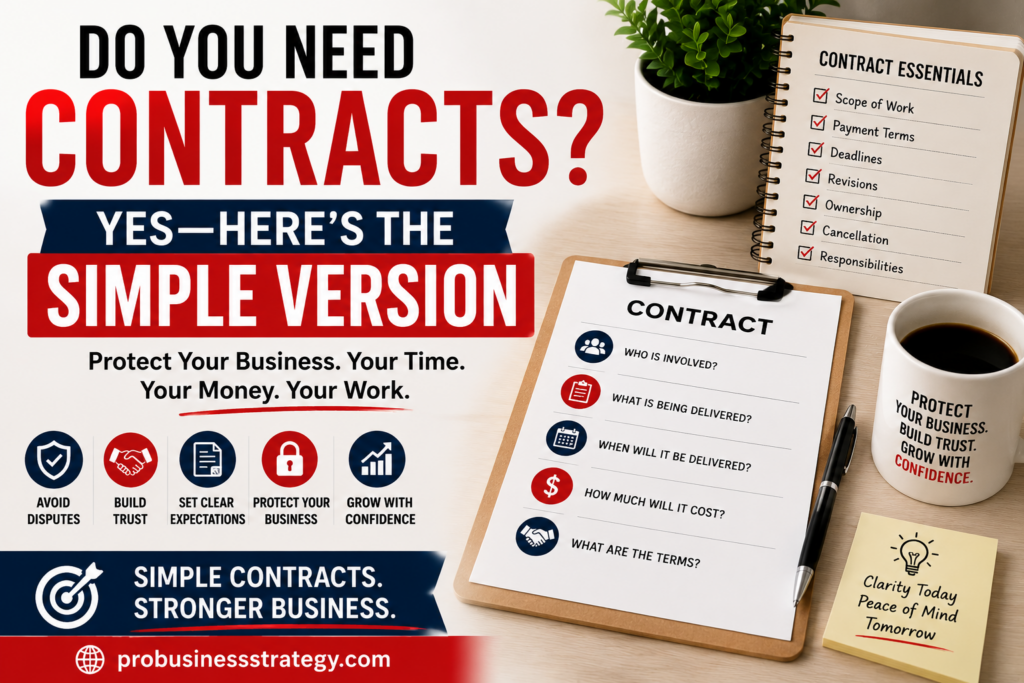
For many small business situations, the simple version needs to answer a few basic questions.
Who is involved?
What is being delivered?
When will it be delivered?
How much will it cost?
When is payment due?
What is included?
What is not included?
What happens if something changes?
Who owns the final work?
How can the agreement end?
That is the foundation.
The goal is not to write something impressive.
The goal is to write something clear.
A simple, plain-English agreement is often more useful than a document full of complicated language that nobody understands. Nolo also recommends using clear, plain-English business agreements and putting important terms in writing.
When You Should Use a Contract
You do not need a formal contract for every tiny business action.
But there are situations where you should almost always use one.
When You Work With Clients
If you provide a service, use a contract.
This applies to:
Web design
Graphic design
Marketing
Consulting
Coaching
Writing
Video editing
Social media management
Virtual assistance
SEO services
Business planning
Photography
Freelance work
A service contract should explain the work, price, timeline, revision limits, payment terms, and what happens if the client wants extra work.
This is especially important if the project is custom.
Custom work can easily create confusion because the client may have expectations that were never clearly discussed.
When You Hire Freelancers
If you hire someone to help your business, use an agreement.
This could be a designer, writer, developer, editor, assistant, consultant, or contractor.
The agreement should explain:
What they will do
How much you will pay
When payment will happen
Who owns the work
Whether deadlines matter
How communication will work
What happens if the work is not delivered
This is not about making the relationship complicated. It is about protecting the project.
FindLaw notes that independent contractor agreements can clarify project scope, payment terms, and ownership of work created.
That is exactly what a small business owner needs.
When You Sell Digital Products or Services
If you sell digital products, templates, downloads, courses, memberships, or online services, you need clear terms.
These may include:
Refund policy
License terms
Usage rights
Delivery method
Access period
Payment terms
Restrictions on copying or reselling
Support limits
For example, if you sell a digital template, can the buyer use it for client work? Can they resell it? Can they share it with others? Can they request a refund after downloading it?
If you do not explain these things, problems can happen later.
When You Work With Business Partners
Business partnerships should never rely only on friendship or verbal agreement.
A partnership can start with excitement, but later questions appear.
Who owns what percentage?
Who makes decisions?
Who invests money?
Who does the work?
How are profits split?
What happens if one person wants to leave?
What happens if the business fails?
What happens if the business succeeds?
These questions can become painful if they are not answered early.
A written agreement is especially important when money, ownership, and decision-making are involved.
When You Rent, Lease, or Borrow
If your business rents equipment, leases space, borrows money, or shares resources, use written agreements.
These situations often involve risk.
What happens if equipment breaks?
Who pays for repairs?
When is rent due?
What happens if payment is late?
Can the agreement be cancelled?
Are deposits refundable?
Do not rely on memory for these things.
Put them in writing.
The Most Important Parts of a Simple Contract
A beginner does not need to understand every legal term in the world.
But you should understand the main parts of a basic business contract.
1. Names of the Parties
The contract should clearly state who is involved.
This may be:
Your personal name
Your business name
The client’s name
The customer’s company name
The freelancer’s name
The legal business entity
Be careful here. If you operate through a business entity, the contract may need to use the official business name.
2. Scope of Work
This is one of the most important sections.
The scope of work explains what will be delivered.
For example:
“I will design a five-page WordPress website.”
That is clearer than:
“I will make a website.”
A strong scope might include:
Number of pages
Number of designs
Number of revisions
Deliverables
File formats
Meetings included
Timeline
What is not included
Scope protects both sides.
The client knows what they are getting.
You know where the project ends.
Without a clear scope, small projects can become endless projects.
3. Payment Terms
Payment terms should be clear.
Include:
Total price
Deposit amount
Payment schedule
Due dates
Accepted payment methods
Late payment rules
Refund policy
What happens if payment is not made
For example, a service provider may require 50% upfront and 50% before final delivery.
A consultant may charge monthly.
A digital product seller may state that digital downloads are non-refundable once accessed, depending on applicable law and platform rules.
The point is simple: do not leave payment vague.
4. Timeline and Deadlines
A contract should explain when things will happen.
This can include:
Project start date
Delivery date
Client feedback deadline
Revision deadline
Payment deadline
Launch date
End date
Also consider what happens if the client delays the project.
For example, if a client takes three weeks to send content, your delivery date may need to move.
A timeline should protect both sides from unrealistic expectations.
5. Revisions and Changes
This is very important for creative and service businesses.
If you do not define revisions, some clients may expect unlimited changes.
A contract can say:
“This project includes two rounds of revisions.”
Then explain what happens after that.
Extra revisions may cost extra. Large changes may require a new quote. New features may be treated as additional work.
This prevents scope creep.
Scope creep happens when a project slowly grows beyond the original agreement without extra payment.
6. Ownership and Usage Rights
Who owns the final work?
This matters for:
Logos
Websites
Copywriting
Videos
Photos
Templates
Software
Designs
Digital products
Marketing materials
If you hire a freelancer, you may want to make sure your business owns the final deliverables after payment.
If you create work for a client, you may want to clarify when ownership transfers and whether you can show the work in your portfolio.
This section is easy to ignore, but it can become very important later.
7. Confidentiality
Some business relationships involve private information.
This could include:
Customer lists
Passwords
Business plans
Marketing strategy
Pricing
Financial information
Product ideas
Internal systems
A confidentiality clause explains what information must stay private.
This is especially useful when working with freelancers, consultants, partners, or agencies.
8. Cancellation and Termination
Every contract should explain how the agreement can end.
What happens if the client cancels?
What happens if you cannot continue?
What happens if someone does not pay?
What happens if deadlines are missed?
What happens to deposits?
What work must still be paid for?
This section may feel negative, but it is practical.
Ending a business relationship is easier when the rules are already clear.
9. Liability Limits
A contract may also limit what you are responsible for.
For example, a marketing consultant should be careful not to guarantee exact revenue results.
A web designer may not want to be responsible for lost business if a client changes something later.
A business coach may not want to promise that the client will make money.
This does not mean avoiding responsibility. It means being realistic about what you can control.
10. Signatures
A contract should be accepted by both sides.
This can happen through physical signatures, electronic signatures, or another clear written acceptance method, depending on the situation and applicable law.
The important thing is that both sides clearly agree.
Contracts Beginners Often Need
Here are common contracts small business owners should know about.
Client Service Agreement
This is used when you provide a service to a client.
It explains the service, price, timeline, revisions, payment terms, and responsibilities.
If you are a freelancer, consultant, coach, designer, writer, or marketer, this is one of the first contracts to consider.
Independent Contractor Agreement
This is used when you hire a freelancer or contractor.
It explains the project, payment, deadlines, ownership, confidentiality, and contractor status.
This helps prevent confusion between hiring an employee and hiring an independent contractor.
Website Terms and Conditions
If you run a website, terms and conditions explain the rules for using your site.
This may include disclaimers, intellectual property, acceptable use, limitations of liability, and other website rules.
This is especially important if you sell products, publish advice, collect user accounts, or offer downloads.
Privacy Policy
If your website collects personal information, such as names, emails, contact forms, analytics data, or payment information, you may need a privacy policy.
Privacy rules can vary by country, state, and type of business, so this is an area where professional legal guidance can be important.
Refund Policy
If you sell products or services, make your refund policy clear.
Do you offer refunds?
How many days does the customer have?
Are digital products refundable?
Are services refundable after work begins?
Are deposits refundable?
A clear refund policy can prevent frustration and disputes.
Non-Disclosure Agreement
A non-disclosure agreement, often called an NDA, is used when confidential information is shared.
This can be useful before discussing business ideas, partnerships, product plans, or private client information.
Partnership Agreement
If you start a business with someone else, use a partnership agreement or operating agreement depending on the business structure.
Do not rely only on trust.
Trust is good.
Clear agreements are better.
Common Contract Mistakes
Mistake 1: Starting Work Without Payment Terms
This is one of the biggest beginner mistakes.
If payment is not clear, problems can happen quickly.
Always define the price, due date, deposit, and payment method.
Mistake 2: Offering Unlimited Revisions
Unlimited revisions can destroy your time.
It sounds friendly, but it can turn a small project into a never-ending project.
Set clear revision limits.
Mistake 3: Not Defining What Is Included
If you do not explain what is included, the client may assume more than you intended.
Be specific.
A clear scope is your friend.
Mistake 4: Copying Random Contracts Online
Templates can be helpful, but random internet contracts may not fit your business, location, or legal situation.
Use templates carefully and consider professional advice when the agreement involves meaningful money, risk, ownership, or long-term obligations.
Mistake 5: Making Promises You Cannot Control
Do not guarantee results unless you can truly control them.
For example:
“I will build your website” is different from “Your website will make $10,000 per month.”
The second promise is risky because results depend on many factors.
The Simple Rule for Beginners
Here is the simple rule:
If money, time, ownership, delivery, or responsibility matters, put it in writing.
That does not mean every agreement must be complicated.
But it should be clear.
A short written agreement is often better than a long conversation that nobody remembers the same way.
When to Ask a Lawyer
You may not need a lawyer for every small agreement, but there are situations where professional legal help is smart.
Consider asking a lawyer when:
Large amounts of money are involved
You are forming a partnership
You are signing a long-term lease
You are hiring employees
You are selling regulated products or services
You are dealing with intellectual property
You are raising money
You are buying or selling a business
You are unsure about legal risk
You are signing something you do not understand
The FTC also provides business guidance to help businesses understand responsibilities and compliance issues, but specific contracts can still require professional advice depending on your situation.
This article is educational and not legal advice. Laws vary by location, business type, and situation. If a contract is important, have a qualified legal professional review it.
Getting Started This Week
You do not need to fix every legal document today.
Start simple.
Choose one area of your business where a written agreement would make things clearer.
If you work with clients, start with a basic service agreement.
If you hire freelancers, create an independent contractor agreement.
If you sell digital products, review your refund policy and usage rights.
If you have a business partner, start writing down roles, ownership, and decision-making rules.
If you run a website, review your terms, privacy policy, and disclaimers.
The goal is not to become a lawyer.
The goal is to become a more professional business owner.
Contracts help you do that.
They protect expectations.
They reduce confusion.
They make payment clearer.
They define responsibility.
They help people work together with less risk.
A contract does not need to be scary.
It needs to be clear.
And for most business owners, that clarity is worth it.
Internal Linking
Related Articles: