Choosing a brand name feels exciting.
You finally find a name that sounds right.
It fits your business idea.
It looks good in a logo.
The domain might be available.
You can imagine it on a website, product label, invoice, social media profile or business card.
But before you build everything around that name, there is one important question:
Can you actually use it safely?
Many new business owners skip this step. They choose a name, create a logo, buy a domain, design a website, open social media accounts and start promoting the brand. Only later do they discover that another business already uses a similar name in the same industry.
That can create serious problems.
You may need to change your name.
You may lose your domain investment.
You may confuse customers.
You may receive a legal warning.
You may need to redesign your entire brand.
You may lose trust, traffic and momentum.
This is why brand name protection matters.
You do not need to become a legal expert, but you should understand the basics of trademarks, brand searches and smart name protection before your business grows.
This guide explains the basics of how to protect your brand name as a new business owner.
This is general educational information, not legal advice. Trademark rules differ by country, industry and situation. If your brand name is important to your business, speak with a qualified trademark attorney or legal professional in your jurisdiction.
Affiliate disclosure: This post contains affiliate links. If you make a purchase through one of these links, ProBusinessStrategy may earn a small commission at no extra cost to you. We only recommend tools we genuinely believe in.
What Is a Trademark?
A trademark is a sign that helps customers identify the source of a product or service.
In simple terms, it helps people know who something comes from.
A trademark can include:
A brand name
A logo
A slogan
A product name
A service name
A symbol
A distinctive phrase
In some cases, other brand identifiers
For example, if customers see a specific brand name on a product, they should understand which business is behind it.
That is the purpose of a trademark.
A trademark is not just decoration. It is a business identifier.
It helps protect the reputation, trust and recognition connected to your brand.
For a small business, your brand name may become one of your most valuable assets. It can appear on your website, packaging, social media, products, invoices, marketing materials, customer reviews and search results.
That is why choosing and protecting the name matters.
Trademark, Business Name and Domain Name Are Not the Same
Many beginners confuse three different things:
Business name
Domain name
Trademark
They are related, but they are not the same.
A Business Name
A business name is the name under which your business is registered with a government or local business authority.
Registering a business name may allow you to operate under that name, but it does not always give you strong trademark protection.
In many places, business registration and trademark registration are separate systems.
A Domain Name
A domain name is your website address.
For example, if you buy a domain name for your brand, that means you control that web address as long as you keep renewing it.
You can use services like Namecheap or WordPress.com Domains to search for and register domain names.
But owning a domain name does not automatically mean you own the trademark rights to that brand name.
A domain is a web address.
A trademark is a brand protection tool.
A Trademark
A trademark protects a brand identifier in connection with specific goods or services.
For example, the same or similar word might exist in different industries if customers are unlikely to be confused. But if two businesses use similar names for similar products or services, there may be a problem.
This is why you should not assume that a domain search is enough.
A domain search tells you whether a web address is available.
A trademark search helps you understand whether the brand name may already be protected or used by someone else in a relevant category.
Why Protecting Your Brand Name Matters
Your brand name is not just a label.
It can become the center of your business identity.
A protected brand name can help you:
Build customer trust
Avoid confusion with competitors
Protect your marketing investment
Make your business look more professional
Reduce the risk of forced rebranding
Protect future product lines
Create a stronger asset if you sell the business later
Make it easier to challenge copycats
Build long-term recognition
Imagine spending two years building a brand.
You create blog content.
You grow on Pinterest.
You publish videos.
You build an email list.
You sell products.
You get customers.
You rank in search engines.
You appear on social media.
People start recognizing your name.
Then you discover that another company has stronger rights to a very similar name in your industry.
That is painful.
It is much better to think about brand protection early.
You do not need to trademark every tiny idea. But if a name will become central to your business, product, course, service, ecommerce store or digital brand, it deserves proper checking.
Step 1: Choose a Strong Brand Name
The first step in protecting your brand name is choosing a name that can actually become protectable.
Not every name is strong from a trademark perspective.
In general, brand names can range from weak to strong.
Generic Names
A generic name is the common name for a product or service.
For example, trying to call a bakery “The Bakery” would be extremely weak because it simply describes the type of business.
Generic names are difficult or impossible to protect as trademarks for that category.
Descriptive Names
A descriptive name directly describes what the business does.
Examples:
Fast Web Design
Cheap Cleaning Services
Online Business Templates
Healthy Meal Plans
Descriptive names can be useful for clarity, but they are often weaker as trademarks because many businesses may need similar words to describe their services.
Suggestive Names
A suggestive name hints at the benefit or idea without directly describing it.
These can be stronger because they require a little imagination.
For example, a name might suggest speed, clarity, growth, simplicity or creativity without directly saying what the product is.
Arbitrary or Invented Names
Arbitrary or invented names are often stronger because they are more distinctive.
An invented name may have no existing meaning.
An arbitrary name may use a real word in an unrelated category.
These names can be easier to distinguish from competitors, but they may require more marketing effort because customers do not instantly know what the business does.
The best beginner approach is to choose a name that is:
Distinctive
Easy to remember
Easy to spell
Relevant to your brand direction
Not too close to competitors
Available across key platforms
Flexible enough for future growth
Do not only choose a name because it sounds nice.
Choose a name that you can build and protect.
Step 2: Search the Name Online
Before you fall in love with a brand name, search it online.
Start simple.
Search:
The exact brand name
Similar spellings
Plural versions
Common misspellings
The name plus your industry
The name plus “business”
The name plus “shop”
The name plus “service”
The name plus your country
The name plus your niche
Look for businesses that already use the same or similar name.
Pay attention to:
Same industry
Similar products
Similar services
Similar audience
Similar logo or branding
Similar domain
Similar social media handles
Similar geographic market
If a similar name exists in a completely different industry, it may or may not be a problem.
If a similar name exists in your industry, be careful.
For example, if you want to start a digital planner brand and another business already sells planners under a similar name, that is a warning sign.
Online searching is not a complete legal clearance search, but it is a useful first step.
If you find obvious conflicts quickly, you can avoid wasting time.
Step 3: Search Domain Names
After the basic online search, check domain availability.
A good domain name is important because it becomes your online home.
Ideally, your brand name and domain name should match closely.
Check:
.com domain
Relevant country domain
Common spelling variations
Hyphen versions
Plural versions
Shorter versions
Potential confusing alternatives
If the exact .com is taken, that does not automatically mean you cannot use the brand name. But it is a signal to investigate further.
Ask:
Who owns the domain?
Is it actively used?
Is it in your industry?
Could customers confuse your brand with that site?
Would a different domain make your brand weaker?
Is the social handle also taken?
For new businesses, domain choice and trademark choice should work together.
A strong brand name is more valuable if you can also secure a clean domain and consistent handles.
You can search domains through tools like Namecheap or WordPress.com Domains, but remember:
Domain availability is not trademark clearance.
It is only one part of the brand protection process.
Step 4: Check Social Media Handles
Next, check whether the name is available on the platforms that matter to your business.
This may include:
Instagram
TikTok
YouTube
Pinterest
LinkedIn
Facebook
X
Threads
Etsy or marketplace usernames
Podcast platforms
Newsletter platforms
You do not need to use every platform immediately.
But if your brand will depend on social media, try to secure consistent handles early.
For example:
@YourBrandName
@YourBrandOfficial
@YourBrandHQ
@YourBrandCo
@YourBrandStudio
Consistent handles make your brand easier to find and remember.
If your exact handle is already used by a similar business, that may be another warning sign.
Again, handle availability does not create trademark rights by itself.
But it is part of your practical brand protection checklist.
Step 5: Search Trademark Databases
After searching online, domains and social media, search official trademark databases.
The database depends on where you want protection.
Examples:
National trademark office database
EU trademark database for European Union protection
International trademark systems
Trademark databases in countries where you plan to sell
Search:
Exact name
Similar names
Similar spelling
Similar sound
Similar meaning
Related product or service categories
Trademark searching can be more complicated than normal searching because conflicts are not always exact matches.
A name can be risky if it is confusingly similar to an existing trademark in a related category.
For example, two names do not have to be identical to create a problem. They may be similar in sound, appearance or commercial impression.
This is where professional advice can be valuable.
A beginner search can help you spot obvious problems.
A proper trademark clearance search can help you understand deeper risks.
Step 6: Understand Trademark Classes
When you apply for a trademark, you usually need to identify the goods or services connected to the mark.
These are organized into classes.
For example, different classes may cover things like:
Clothing
Education services
Software
Printed materials
Consulting services
Digital products
Advertising services
Cosmetics
Food products
Online retail services
This matters because trademark protection is connected to what you actually sell or provide.
A name may be available in one category but not another.
For example, a name used for a restaurant may not automatically block a business coaching service, depending on the situation. But if the industries are close enough that customers may be confused, there may still be risk.
Do not randomly select classes.
Choose classes based on your real business activity and future plans.
If you choose too narrowly, your protection may not cover what you need.
If you choose too broadly without a real business basis, you may create problems or extra costs.
This is another reason to get professional help if the brand name is important.
Step 7: Decide Whether to Register the Trademark
Not every business needs to register a trademark immediately.
But you should consider registration when:
The brand name will be used long term
You will invest in marketing
You plan to sell products or services under that name
You want to build a recognizable brand
You want stronger protection
You are entering a competitive market
You plan to sell online across regions
You want to reduce the risk of copycats
You may eventually license, franchise or sell the brand
You already have customers and traction
Trademark registration can give you stronger legal rights than simply using a name, depending on the country.
It can also make your business look more serious and help you protect your brand if someone else uses a confusingly similar name.
However, registration takes time, costs money and may involve examination, objections or opposition from other trademark owners.
For a small business, the decision should be strategic.
If the name is temporary, registration may not be worth it.
If the name is central to your business, product line or long-term brand, it may be worth protecting properly.
Step 8: Know Where to Register
Trademark rights are territorial.
That means protection usually applies in the country or region where the mark is registered or recognized.
If you only register in one country, that does not automatically protect your brand everywhere in the world.
Common options include:
National trademark registration
European Union trademark registration
International application systems
Separate filings in important markets
A local business may only need national protection at first.
An online brand selling across Europe may consider EU-level protection.
A business selling internationally may need a broader strategy.
Do not assume that one registration automatically covers every market.
Ask:
Where are my customers?
Where will I sell?
Where do I manufacture or distribute?
Where are competitors active?
Where is the brand most valuable?
Where is the highest risk of copying?
Trademark strategy should match your business strategy.
Step 9: Use the Name Consistently
Once you choose and protect a brand name, use it consistently.
Inconsistent use can weaken recognition.
Use the same spelling, capitalization and format across:
Website
Logo
Product pages
Invoices
Email signature
Packaging
Social media profiles
Business listings
Marketing materials
Digital products
Contracts
Terms and policies
For example, do not use three different versions of the same brand name unless there is a clear reason.
Consistency helps customers remember you.
It also helps establish the brand as a recognizable identifier.
If your brand name appears one way on your website, another way in your logo and another way on social media, it can create confusion.
Brand protection is not only legal.
It is also practical.
Step 10: Document Your Use
Keep records of when and how you use your brand name.
This can include:
Website launch date
First product sale
First invoice
First social media posts
Product packaging
Marketing materials
Email campaigns
Screenshots
Customer receipts
Advertising campaigns
Press mentions
Marketplace listings
Business registration documents
These records may be useful if you ever need to prove use, history or brand development.
Create a simple folder for brand documentation.
Save important files and screenshots.
This is especially useful for small businesses that start informally and grow over time.
Good records can help you stay organized and support future legal or business decisions.
Step 11: Monitor Your Brand Name
Protecting a brand name is not a one-time action.
You should monitor it.
Watch for:
Businesses using the same name
Similar names in your industry
Similar domains
Copycat products
Marketplace listings
Social media accounts
Fake accounts
Confusing ads
Unauthorized logo use
Customer confusion
Simple monitoring methods:
Google your brand name regularly
Set up alerts
Search social platforms
Search marketplaces
Check domain variations
Search trademark databases occasionally
Watch competitor activity
If you find a possible conflict, do not react emotionally.
Document it.
Take screenshots.
Save URLs.
Write dates.
Check whether the use is actually related to your business.
Speak with a legal professional before sending threats or public complaints.
Some situations are minor.
Others may need action.
Professional advice matters here.
Step 12: Avoid Common Brand Name Mistakes
Choosing a Name That Is Too Generic
A generic name may be easy to understand, but hard to protect.
Try to choose something distinctive.
Only Checking Domain Availability
A domain search is not enough.
You also need to think about trademarks, business names and existing market use.
Copying a Competitor’s Style
Do not choose a name, logo or brand style that feels too close to a competitor.
Even if you change a few letters, it may still create confusion.
Waiting Too Long
If you wait until the business is already growing, a naming problem becomes more expensive to fix.
Check early.
Ignoring International Plans
If you plan to sell in more than one country, think about where the brand needs protection.
Assuming a Logo Protects the Name
A logo and a word name may be treated differently.
Protecting the logo may not always protect the plain word name in the way you expect.
Letting Others Use Your Brand Freely
If others use your name in confusing ways and you ignore it for too long, protection may become harder.
Monitor the brand.
Using the Wrong Symbol
Do not use trademark symbols incorrectly.
Rules can vary, and registered trademark symbols are generally tied to actual registration.
When in doubt, ask a professional.
When Should You Talk to a Trademark Attorney?
You should strongly consider professional help when:
The name is central to your business
You plan to invest heavily in branding
You are selling products internationally
You find similar existing trademarks
You receive a legal warning
You want to file a trademark application
You are unsure which classes to choose
You want to protect a logo and word mark
You are building a product line
You plan to license or franchise the brand
You want to enforce rights against another business
A trademark attorney can help with:
Search strategy
Risk analysis
Application filing
Class selection
Responding to objections
Opposition issues
International strategy
Enforcement decisions
Brand portfolio planning
Yes, professional help costs money.
But changing a brand name later can cost much more.
For important brands, legal guidance is an investment in stability.
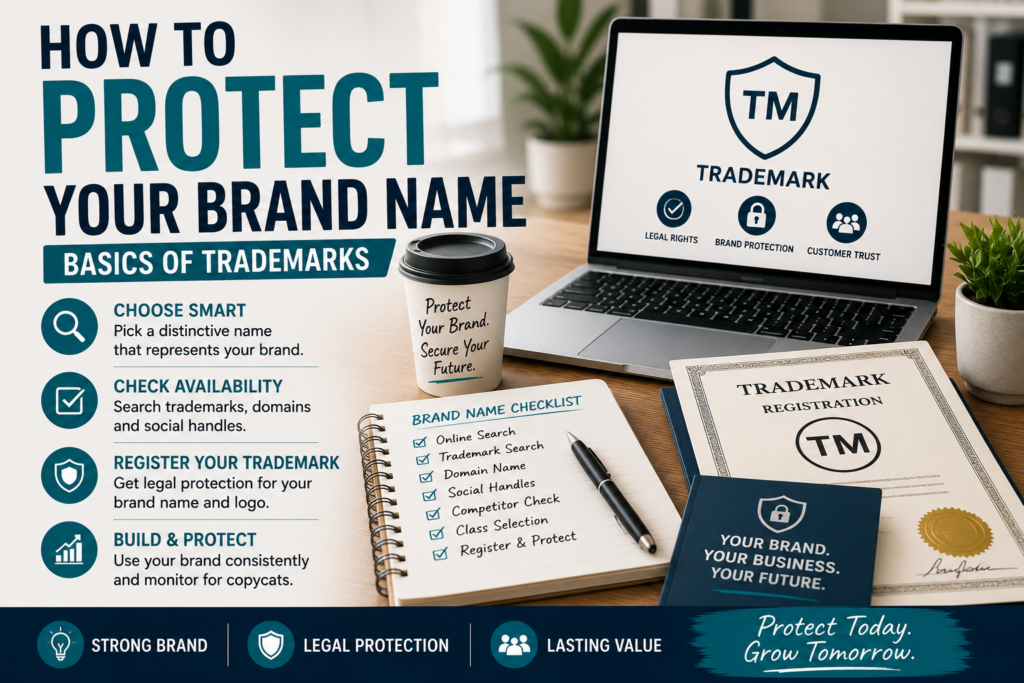
A Simple Brand Name Protection Checklist
Before you commit to a name, go through this checklist:
Choose a distinctive name
Search the exact name online
Search similar names online
Check competitors in your niche
Check domain availability
Check social media handles
Search official trademark databases
Think about product and service classes
Consider where you need protection
Decide whether trademark registration is worth it
Secure the domain
Secure key social handles
Use the name consistently
Document first use
Monitor the brand over time
Speak with a legal professional if the name matters
This checklist will not replace legal advice, but it will help you avoid careless mistakes.
Example: A New Business Checking a Brand Name
Imagine someone wants to start a digital product business called “Bright Path Planners.”
The business will sell printable planners, digital worksheets and small business templates.
Before launching, they should check:
Is “Bright Path Planners” used by another planner business?
Is there a similar business selling digital products?
Is the domain available?
Are the social handles available?
Are there registered trademarks for similar names in planner, printable, education or digital product categories?
Could customers confuse this with another brand?
Will the name still work if the business expands into courses or templates?
Is the name distinctive enough?
Should the founder register it before launching paid products?
If the checks look good, the founder can move forward with more confidence.
If there are conflicts, it is better to change the name before building the website, product library and marketing system.
Early checking saves future pain.
Final Thoughts
Your brand name is one of the first assets your business creates.
It appears everywhere:
Your website.
Your products.
Your emails.
Your social media.
Your customer experience.
Your reputation.
That is why it deserves protection.
You do not need to become a trademark expert, but you should understand the basics.
A smart brand name protection process starts with:
Choosing a distinctive name
Searching online
Checking domains
Checking social handles
Searching trademark databases
Understanding classes
Thinking about where you need protection
Registering the trademark when it makes sense
Using the name consistently
Monitoring the market
The biggest mistake is waiting until the brand is already valuable before checking whether you can safely use it.
Protect the name before you build too much around it.
A good brand name is not just creative.
It is clear, usable, memorable and protectable.
That gives your business a stronger foundation from the start.