Turn Your Eye for Detail into a Phone-Based Income
Do you notice typos in articles before anyone else does? Do grammar mistakes jump out at you like a flashing neon sign? If so, you already have the most important skill for freelance proofreading — a sharp eye for detail.
In 2026, the demand for proofreaders has never been higher. Businesses, bloggers, authors, and content creators are producing more written content than ever before. AI tools have made it easier to generate content, but they have also created a new problem: AI-generated text is full of subtle errors, awkward phrasing, and factual inconsistencies that only a human eye can catch.
That human eye can belong to you — working entirely from your smartphone.
Affiliate disclosure: This post contains affiliate links. If you make a purchase through one of these links, ProBusinessStrategy may earn a small commission at no extra cost to you. We only recommend tools we genuinely believe in.
What Does a Freelance Proofreader Actually Do?
Proofreading is the final quality check before a piece of writing is published or submitted. As a proofreader, your job is to catch:
Spelling mistakes — Including correctly spelled words used in the wrong context.
Grammar errors — Subject-verb agreement, tense consistency, and sentence structure.
Punctuation issues — Missing commas, incorrect apostrophes, and misused semicolons.
Formatting inconsistencies — Inconsistent heading styles, spacing, or font usage.
Awkward phrasing — Sentences that are technically correct but read poorly.
Note: Proofreading is different from editing. Editors restructure and rewrite content. Proofreaders polish the final version. As a beginner, focus on proofreading — it is faster, easier, and still pays well.
The Apps You Need on Your Phone
For Proofreading and Markup:
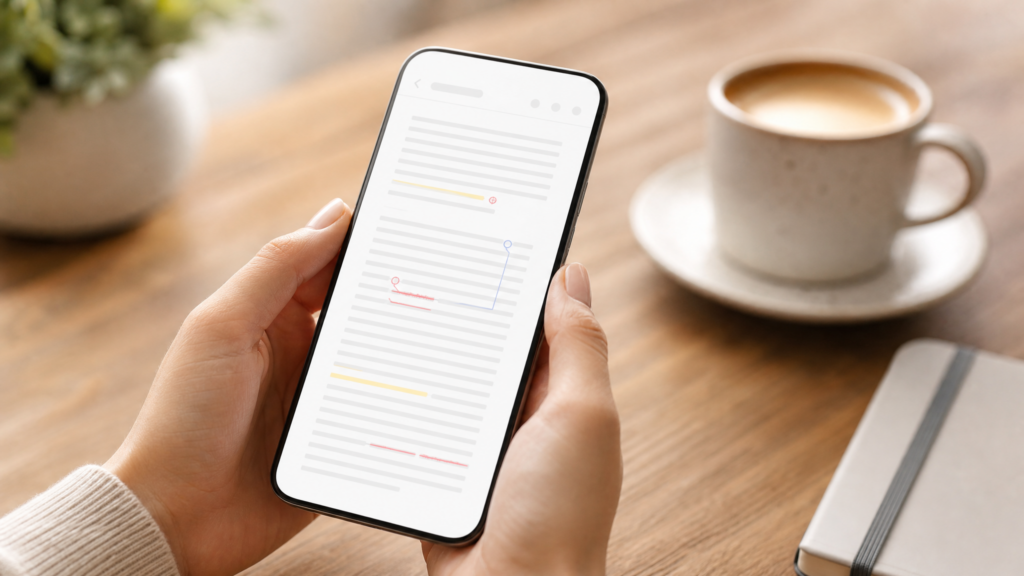
Grammarly — Your best friend. The mobile app catches grammar and spelling errors instantly and explains why something is wrong.
ProWritingAid — A deeper analysis tool that checks style, readability, and consistency.
Google Docs — Most clients will share documents via Google Docs. The mobile app allows you to add comments and suggestions directly.
Microsoft Word Mobile — For clients who work in the traditional Office ecosystem.
For Communication:
Gmail / Outlook — For receiving documents and delivering finished work.
Slack — Many content agencies use Slack for day-to-day communication.
Where to Find Your First Proofreading Clients
Freelance Platforms:
Fiverr — Create a “Proofreading & Editing” gig. Niche down immediately (e.g., “I will proofread your blog posts” or “I will proofread your business emails”).
Upwork — Search for “proofreader” or “copy editor” contracts. Many are ongoing, which means stable monthly income.
Reedsy — Specifically for book authors looking for proofreaders. Higher pay but requires more experience.
Scribbr — A platform that specializes in academic proofreading. Great for consistent work volume.
Direct Outreach:
Bloggers and Content Creators: Many solo bloggers cannot afford a full-time editor but will happily pay $20–$50 per article for a final proofread.
Small Businesses: Local businesses that publish newsletters, brochures, or website content are a goldmine for steady proofreading work.
Self-Publishing Authors: The self-publishing market is booming. Authors on platforms like Amazon KDP need affordable proofreaders before they publish.
How Much Can You Earn?
Proofreading rates vary based on your experience and niche:
Beginner: $0.01–$0.02 per word (a 1,000-word article = $10–$20).
Intermediate: $0.02–$0.04 per word (a 1,000-word article = $20–$40).
Specialist (Legal/Medical/Academic): $0.05–$0.10 per word (a 1,000-word article = $50–$100).
The fastest way to increase your rates is to specialize. A proofreader who focuses on legal contracts or medical research papers can charge 3–5x more than a general proofreader.
Pro Tips for Success
Build a niche portfolio fast. Offer to proofread 2–3 pieces for free in your chosen niche to build samples you can show potential clients.
Use style guides. Learn the basics of AP Style, Chicago Manual of Style, or APA. Clients in journalism, publishing, and academia will expect you to know these.
Set clear turnaround times. Most clients need work back within 24–48 hours. Being reliable and fast is more valuable than being perfect and slow.
Upsell to editing. Once a client trusts your proofreading, offer a light editing service for an additional fee. This doubles your income per client.
Final Thoughts
Freelance proofreading is one of the most accessible phone-based businesses in 2026. The startup cost is zero, the learning curve is gentle, and the demand is growing every single day as more content floods the internet. If you have a love of language and an eye for detail, this could be the perfect phone-based income stream for you.
👉 Ready to find your first proofreading client?
Browse businesses and creators actively looking for proofreaders right now: Find Your First Client on Fiverr