Many people use TikTok by posting whatever comes to mind.
One day they post a funny video.
The next day they post a personal story.
Then a random trend.
Then a product idea.
Then nothing for two weeks.
That can be fun, but it is not really a brand.
A TikTok micro-brand is different.
A micro-brand is a small, focused brand built around a specific audience, topic, style or problem. It does not need a huge team, a large budget or a complicated content strategy. It can start with one person, one phone and one clear idea.
But it does need direction.
If you want to build a TikTok micro-brand from scratch, the goal is not to become famous by accident. The goal is to create a recognizable small brand that people understand, remember and trust.
That means your TikTok account should not feel like random posting.
It should feel like a small media asset.
Every video should help build something:
Audience trust
Brand recognition
Content library
Product interest
Email list growth
Affiliate traffic
Community
Authority
Future sales
This guide will show you how to build a TikTok micro-brand from scratch using a simple brand asset approach.
Affiliate disclosure: This post contains affiliate links. If you make a purchase through one of these links, ProBusinessStrategy may earn a small commission at no extra cost to you. We only recommend tools we genuinely believe in.
What Is a TikTok Micro-Brand?
A TikTok micro-brand is a small brand built around a focused content theme and a specific audience.
It can be personal or faceless.
It can be educational or entertaining.
It can promote products, services, digital downloads, affiliate offers or a larger business.
It can be built by one person with a smartphone.
The word “micro” does not mean weak.
It means focused.
A micro-brand does not try to speak to everyone. It speaks to a specific type of person about a specific type of problem, interest or desire.
Examples:
A TikTok account about simple meal prep for busy students
A faceless brand about minimalist home office setups
A small business brand around dog owner gift ideas
A TikTok page teaching new freelancers how to get clients
A micro-brand around budget-friendly wedding planning
A TikTok account reviewing weird productivity tools
A small beauty brand focused only on curly hair routines
A digital product brand around printable planners for teachers
A business idea page for people who want to start from home
A TikTok account about phone-based business ideas
Each of these could become a micro-brand.
The key is that the viewer quickly understands:
Who this is for
What the account is about
Why they should follow
What kind of content they can expect
What the brand may eventually sell or recommend
A micro-brand is not just a TikTok account.
It is a small business asset.
Why Random Posting Is Not Enough
Random posting can sometimes get views, but it rarely builds a strong business foundation.
The problem with random posting is that every video starts from zero.
There is no clear theme.
There is no audience expectation.
There is no repeatable style.
There is no brand memory.
There is no obvious next step.
There is no clear path to monetization.
A random viral video may bring attention, but attention without direction disappears quickly.
A micro-brand works differently.
Instead of asking:
“What should I post today?”
You ask:
“What content asset does my micro-brand need next?”
That shift matters.
A random TikTok post is just a post.
A brand asset can become:
A trust-building video
A product explainer
A pinned introduction
A recurring content format
A lead magnet teaser
A problem awareness video
A customer education clip
A comparison video
A frequently asked question answer
A short that can be repurposed to other platforms
When you build with assets, every video has a job.
That is how a small TikTok account can become more valuable over time.
Step 1: Choose One Clear Micro-Niche
The first step is choosing a micro-niche.
Do not start with something too broad like:
Fitness
Business
Beauty
Money
Food
Travel
Marketing
Ecommerce
Productivity
These topics are too large.
A micro-brand needs a sharper angle.
Examples:
Fitness for busy dads over 40
Business ideas for people with only a phone
Beauty routines for women with sensitive skin
Budget meals for students with tiny kitchens
Marketing tips for local service businesses
Productivity systems for people who hate planners
Home office ideas for small apartments
Digital products for teachers
Simple branding tips for new Etsy sellers
TikTok business ideas for solopreneurs
A good micro-niche should be specific enough that people recognize themselves.
A broad account says:
“I post business tips.”
A micro-brand says:
“I help people build small businesses from their phone.”
A broad account says:
“I post productivity content.”
A micro-brand says:
“I help overwhelmed creators organize content ideas without complicated systems.”
Specificity makes the brand easier to follow, easier to remember and easier to monetize.
Step 2: Define the Audience Clearly
After choosing the niche, define the audience.
This is where many beginners stop too early.
They say:
“My audience is people interested in business.”
That is too vague.
A stronger audience definition would be:
“My audience is beginner solopreneurs who want to start a simple online business without a large budget.”
Or:
“My audience is small ecommerce sellers who need simple TikTok content ideas to promote their products.”
Or:
“My audience is women planning a wedding on a budget who want creative ideas without hiring an expensive planner.”
The clearer the audience, the easier it becomes to create content.
Ask:
Who are they?
What do they want?
What are they afraid of?
What do they struggle with?
What do they already believe?
What mistakes do they make?
What do they search for?
What would make them follow?
What would make them trust you?
What might they buy later?
Your audience definition should guide your content, tone, examples and offers.
A micro-brand is not built around what you want to post.
It is built around what your audience wants to return for.
Step 3: Create a Simple Brand Promise
Your brand promise explains what people get from following your account.
It should be simple.
Examples:
“Simple TikTok business ideas for solopreneurs.”
“Helping new creators turn content into small digital products.”
“Easy home office ideas for small spaces.”
“Business ideas you can start from your phone.”
“Simple marketing systems for one-person businesses.”
“Budget-friendly wedding planning tips for creative brides.”
“Tiny ecommerce ideas for people who want to test before they invest.”
A brand promise is useful because it keeps the account focused.
It can guide your bio, pinned videos, content planning and product ideas.
A weak brand promise says:
“Helping you live your best life.”
A stronger brand promise says:
“Helping new solopreneurs build simple online businesses with content, tools and digital products.”
A weak brand promise says:
“Tips and inspiration.”
A stronger brand promise says:
“Daily TikTok ideas for small business owners who never know what to post.”
Your brand promise does not have to be clever.
It has to be clear.
Step 4: Build the Basic Brand Identity
A TikTok micro-brand does not need a complicated brand identity, but it does need consistency.
Start with simple brand elements:
Account name
Profile picture or logo
Bio
Color direction
Content style
Tone of voice
Visual format
Recurring phrases
Content categories
Link destination
The goal is recognition.
When someone sees your videos, they should start to feel:
“I know this account.”
That does not require expensive design.
It requires repetition.
For example, you could use:
The same intro style
The same caption structure
The same background color
The same editing rhythm
The same type of hook
The same topic categories
The same visual overlays
The same ending phrase
The same brand color
The same content promise
A micro-brand becomes stronger when it feels familiar.
That does not mean every video should be identical.
It means every video should feel like it belongs to the same small brand.
Step 5: Choose Three to Five Content Pillars
Content pillars are the main categories your account will post about.
For a TikTok micro-brand, three to five pillars are usually enough.
If you have too many, the account becomes messy.
Example micro-brand:
Niche: TikTok business ideas for solopreneurs
Content pillars:
Business ideas
Content examples
Monetization tips
Mistakes to avoid
Simple tools
Another example:
Niche: Budget wedding planning
Content pillars:
Budget tips
DIY ideas
Vendor questions
Timeline planning
Mistakes to avoid
Another example:
Niche: Phone-based business
Content pillars:
Business ideas
AI tools
Content creation
Affiliate marketing
Mobile workflows
Content pillars help you avoid random posting because every video fits into a category.
When planning content, you can simply ask:
Which pillar does this video support?
If the answer is none, it may not belong on the account.
That is how you protect brand focus.
Step 6: Turn Content Into Brand Assets
This is the most important shift.
Do not think of TikTok videos only as daily posts.
Think of them as brand assets.
A brand asset is a piece of content that continues to support the business after it is published.
Examples:
A pinned “start here” video
A video explaining your brand promise
A FAQ video
A beginner guide video
A product teaser
A lead magnet explainer
A customer problem video
A common mistake video
A tutorial video
A comparison video
A content series episode
A case study
A myth-busting video
A “what I would do first” video
Each asset has a purpose.
For example, a new visitor lands on your profile.
They should be able to understand your brand through your existing videos.
Your content should answer:
What is this account about?
Who is it for?
Why should I follow?
What problem does it help me solve?
What can I learn here?
What can I buy, download or read later?
Why should I trust this brand?
That is the difference between a TikTok hobby and a TikTok micro-brand.
A hobby account posts content.
A micro-brand builds assets.
Step 7: Create Repeatable Content Formats
Repeatable formats make content creation easier and make the brand more recognizable.
Instead of inventing a new format every time, create formats you can use again and again.
Examples:
“3 mistakes beginners make with…”
“Can this become a business?”
“Tiny niche idea of the day”
“What I would do if I started from zero”
“One product, three content ideas”
“Stop doing this if you want…”
“Before you post, check this”
“Simple system for…”
“Brand asset of the day”
“Turn this idea into a micro-brand”
Repeatable formats save time.
They also train your audience.
If people like one format, they may want to see the next version.
For example, if your account is about TikTok business, you could create recurring series like:
“Micro-brand breakdown”
“TikTok niche of the day”
“Content asset checklist”
“Faceless TikTok business idea”
“From random post to brand asset”
“Small brand, smart content”
“Monetization path in 60 seconds”
These formats make the account feel structured.
That is valuable when building a micro-brand.
Step 8: Make the First Three Pinned Videos Strategic
Pinned videos are important because they introduce the brand to new visitors.
Do not waste all pinned spots on random viral clips.
Use them strategically.
A simple pinned video setup:
Pinned Video 1: Who This Account Is For
Explain the audience and promise.
Example:
“This account is for people who want to build a small online business using TikTok, simple content systems and micro-brand assets.”
Pinned Video 2: The Main Problem You Solve
Show the pain point.
Example:
“Most people post randomly on TikTok and wonder why it does not become a business. The problem is not only consistency. The problem is lack of brand direction.”
Pinned Video 3: The Best Starting Point
Send people to a guide, free resource, product, article or content series.
Example:
“Start here if you want to build a TikTok micro-brand from scratch.”
These pinned videos turn your profile into a small landing page.
That is exactly how a micro-brand should work.
Step 9: Build Trust Before Selling
A micro-brand can make money, but trust comes first.
If every post is promotional, people may ignore the account.
Start by helping your audience.
Teach something.
Explain something.
Show examples.
Break down mistakes.
Share useful ideas.
Give frameworks.
Answer questions.
Show your process.
Make the topic easier to understand.
Trust-building content can include:
Beginner tips
Mistakes to avoid
Checklists
Mini tutorials
Behind-the-scenes clips
Examples
Before-and-after explanations
Case studies
Opinion videos
Myth-busting videos
Simple frameworks
Selling becomes easier when people already understand the value of your content.
The best micro-brands do not feel like constant advertisements.
They feel useful.
Then, when they recommend a product, service, guide or tool, the audience is more likely to listen.
Step 10: Create a Simple Monetization Path
A TikTok micro-brand should eventually have a monetization path.
This does not mean you need to sell immediately.
But you should know where the account could lead.
Possible monetization paths:
Digital products
Templates
Affiliate marketing
Services
Coaching
Consulting
Paid communities
Sponsorships
Print-on-demand products
Email newsletter
Courses
Ecommerce store
Lead generation for a business
Traffic to a blog or website
The best monetization path depends on the niche.
For example:
A TikTok micro-brand about content planning could sell content calendars, caption templates or digital planners.
A micro-brand about home office setups could use affiliate links for desks, chairs, lighting and accessories.
A micro-brand about starting a business could sell checklists, workbooks, templates or business planning guides.
A micro-brand about wedding planning could promote digital planning tools, printable guides or affiliate products.
A TikTok account should not be the only asset.
Use TikTok to build attention.
Then connect that attention to something you own or control, such as a website, email list, digital product, store or service page.
Step 11: Create a Basic Content Funnel
A simple TikTok micro-brand funnel can look like this:
TikTok video
Profile visit
Pinned videos
Bio link
Website, article, free guide or product page
Email list or purchase
Repeat content exposure
Trust and conversion
You do not need a complicated funnel at the beginning.
Start with one clear next step.
Examples:
Read the full guide
Download the checklist
Join the email list
View the template
Visit the shop
Watch the content series
See the starter plan
Check the product page
The important thing is that viewers should not reach a dead end.
If someone likes your content, where should they go next?
That question matters.
A micro-brand grows stronger when attention has somewhere to flow.
Step 12: Use a Simple Weekly Content System
Consistency is easier when you have a system.
A beginner-friendly weekly TikTok micro-brand system could look like this:
Monday: Problem Video
Talk about a common problem your audience has.
Tuesday: Tip Video
Give one simple solution or step.
Wednesday: Example Video
Show a real or hypothetical example.
Thursday: Mistake Video
Explain what beginners often do wrong.
Friday: Asset Video
Create a useful evergreen video that supports your brand.
Saturday: Soft Promotion
Mention a guide, article, product, service or resource.
Sunday: Recap or Story
Share a simple recap, opinion or behind-the-scenes thought.
This gives you structure without making content feel robotic.
You can also create a lighter system:
3 videos per week
1 educational video
1 example video
1 soft promotional video
The goal is not to post endlessly.
The goal is to build consistently.
Step 13: Measure Brand Signals, Not Just Views
Views matter, but they are not the only metric.
A micro-brand should measure deeper signals.
Look at:
Profile visits
Follows
Comments
Saves
Shares
Link clicks
Email signups
Product views
DMs
Questions from viewers
Repeat engagement
Content series performance
Audience quality
A video with fewer views but many saves may be more valuable than a viral video that brings the wrong audience.
A video that sends people to your website may be more useful than a trend video with no business connection.
Ask:
Did this video attract the right people?
Did it strengthen the brand?
Did it explain the problem better?
Did it help someone take the next step?
Did it support a product or offer?
Did it create trust?
Those are brand-building questions.
Random posting chases views.
A micro-brand builds value.
Step 14: Avoid the Biggest TikTok Micro-Brand Mistakes
Mistake 1: Changing Topics Too Often
If your account changes direction every week, people do not know why to follow.
Stay focused long enough to build recognition.
Mistake 2: Copying Trends Without Strategy
Trends can help, but they should support your brand message.
Do not use a trend just because it is popular.
Mistake 3: Making the Brand Too Complicated
You do not need a full brand book at the beginning.
Start with a clear niche, audience, promise and content style.
Mistake 4: Selling Too Early
If nobody trusts the account yet, heavy selling may not work.
Build value first.
Mistake 5: Ignoring the Profile
Your videos may get attention, but your profile turns that attention into brand recognition.
Make the bio, pinned videos and link clear.
Mistake 6: Posting Without a Next Step
If a viewer likes your content, they should know what to do next.
Follow, read, download, comment, save, click or watch the next video.
Mistake 7: Measuring Only Viral Success
A micro-brand does not need every video to go viral.
It needs the right audience to understand and trust the brand.
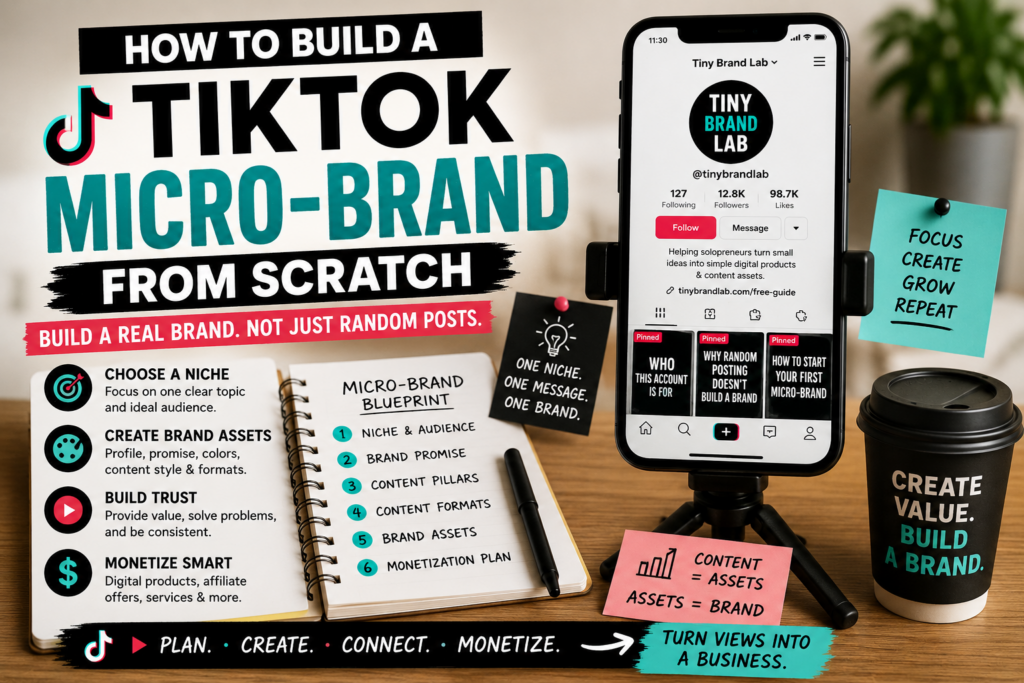
Example: A TikTok Micro-Brand from Scratch
Let’s imagine a micro-brand called:
Tiny Brand Lab
The brand promise:
“Helping solopreneurs turn small ideas into simple digital products and content assets.”
Audience:
Beginner solopreneurs, creators and side hustlers who want to build small online products without overcomplicating the process.
Content pillars:
Micro-brand ideas
Digital product examples
Content assets
TikTok strategy
Monetization paths
Repeatable formats:
“Tiny brand idea of the day”
“Turn this topic into a product”
“Random post or brand asset?”
“3 content ideas for this niche”
“What I would build first”
“Micro-brand mistake to avoid”
Pinned videos:
- What Tiny Brand Lab is about
- Why random posting does not build a business
- How to start your first micro-brand
Monetization path:
Free checklist
Email list
Digital product templates
Affiliate tools
Mini course later
This is not complicated.
But it is focused.
That focus is what makes it a micro-brand instead of just another TikTok account.
Final Thoughts
Building a TikTok micro-brand from scratch is not about posting random videos and hoping one goes viral.
It is about building a small, focused brand asset.
Start with one niche.
Define one audience.
Create one clear brand promise.
Choose a simple visual and content style.
Build three to five content pillars.
Turn videos into brand assets.
Use repeatable formats.
Create strategic pinned videos.
Build trust.
Connect attention to a monetization path.
A TikTok micro-brand can start small.
One person.
One phone.
One focused idea.
One useful content system.
But over time, that small account can become more than a content channel.
It can become a business engine.
The difference is intention.
Random posting asks:
“What should I post today?”
A micro-brand asks:
“What brand asset am I building today?”
That one question can change the entire direction of your TikTok strategy.
Related Articles
Complete TikTok Business Plan for Solopreneurs